
When the subaltern took the floor…
On June 14, an event at the Oxford Union titled “The Student-Led Uprising and the Future of Post-Revolutionary Bangladesh” triggered an interesting dispute at home.
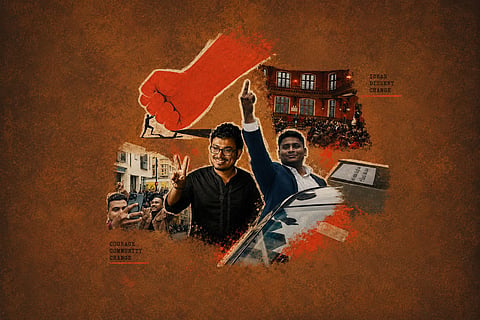
The panel featured key figures from Bangladesh’s July revolution like Hasnat Abdullah, a leader of the National Citizen Party and a newly minted Member of Parliament; Shadik Kayem, a prominent student leader who now heads DUCSU as the VP; and Nabila Idris, an academic who served as a Commissioner on the country's Commission of Inquiry on Enforced Disappearances.
Alongside them sat academic Aliar Hossain. The Oxford Union stated that invitations had also been extended to traditional political groups—the Bangladesh Nationalist Party (BNP), Jamaat-e-Islami, and even to the members of the erstwhile interim government—and that the evening was entirely independent of external curation.
Yet the subsequent fallout back in Dhaka revealed far more than the panel itself. What was billed as an analysis of governance quickly devolved into an existential row over who has the right to speak for the nation in the prestigious global stage.
Critics within Dhaka’s liberal and secular establishments attacked the panel's composition. An op-ed in The Daily Star summarized this anxiety, arguing that the true flaw lay in who was missing. The implication was clear… any proper debate on the country's future required a more ideologically varied, credentialed, and house-trained lineup.
The disagreement turned into an intellectual proxy war when Nabila Idris posted a response on Facebook. Invoking postcolonial theorist Gayatri Chakravorty Spivak, Nabila argued that the elite’s discomfort stemmed from a simple, unvarnished sociological fact: the subaltern was finally speaking.
Detractors found the characterization absurd. Critics from the established intelligentsia asked how Abdullah, an MP with state-adjacent power, or Kayem, who commands a highly influential student apparatus, could possibly be deemed "subaltern."
Kayem’s recent high-profile wedding had even become a focal point of public fascination precisely because it displayed a level of social prominence and political access unavailable to ordinary citizens. These men are national figures with regular television appearances and massive social media followings, not voiceless peasants.
This counterargument is superficially neat but relies on a temporal trick that misreads the entire episode. The relevant question is not whether Abdullah holds power today, but whether Bangladesh’s traditional power structure would ever have allowed a mason’s son or a madrasa student to stand at that prestigious global podium without a revolution or a revolutionary-scale uprising.
A wall and a class barrier
For decades, Bangladesh's public sphere has been tightly policed by a narrow social coalition. Governments changed, prime ministers rotated, and generals came and went, but the cultural gatekeepers remained constant.
They were defined by a specific matrix: elite Dhaka English-medium or top Bangla medium schools, exclusive urban networks, wealthy Anglophone dynasties, and the civil-society think tanks that served them. The universalist language of democratic representation masked a rigid sociology of exclusion.
This is the exact terrain of Spivak’s seminal essay, Can the Subaltern Speak?. Spivak was not asking whether marginalized people possess vocal cords. She was analyzing whether they could be heard within dominant institutional frameworks on their own terms.
The tragedy of the subaltern is, in all good senses, not a lack of expression, but the tyranny of mediation. Intellectuals and cosmopolitan experts routinely claim to represent the marginalized, translating their raw experiences into a sanitized dialect for global consumption while displacing the actual subjects.
The subaltern is defined by structural exclusion from the cultural machinery that manufactures legitimacy.
At Oxford, the biographical details provided the real shockwave. Hasnath Abdullah noted he was the son of a mason. Shadik Kayem spoke of his education at a madrasa in remote Khagrachhari, adding that English was his third language. These admissions drew the warmest applause of the night.
Individually, these details look like performative populism. Collectively, they are politically explosive. Bangladesh is full of poor people and madrasa students, but its institutions rarely permit them to represent themselves abroad.
The establishment has always been comfortable discussing the poor as passive subjects of development policy or electoral data; it is deeply allergic to surrendering the microphone.
The uproar exposes a clash between two competing models of political legitimacy. The first is credentialed legitimacy. Here, authority flows from formal expertise and institutional pedigree. It is the polite world of policy papers and international conferences—a world that frequently mistakes its own drawing-room consensus for the nation itself.
The second model is the legitimacy of rupture. This authority emerges when established institutions fail and ordinary individuals are thrust by history into becoming primary political actors. Revolutions generate new elites, but their primary function is the disruption of old hierarchies.
Individuals who were previously invisible to high-society gatekeepers become impossible to ignore.
A rupture in the form of July uprising
The July uprising was such a rupture. Whatever its long-term political consequences, it smashed Bangladesh’s ossified social landscape. Students from the margins of formal, dynastic politics became central architects of the state's trajectory.
The revolution did not just change a government; it altered who has the right to narrate the nation.
This explains why the venue mattered so much to critics. For two centuries, the Oxford Union has been a supreme symbolic stage, conferring visibility and civilizational legitimacy. Access for Bangladeshis has historically been mediated through upper-class networks.
The revolution short-circuited that pipeline. To argue that Abdullah cannot be subaltern because he is now an MP is to misunderstand the mechanics of a revolution: the uprising is the exact mechanism through which he ceased to be one.
A revolutionary moment opens new pathways for those lacking the social capital to enter elite spaces. If he had remained invisible despite spearheading a mass movement, Spivak’s pessimistic thesis would have been fully confirmed.
The irony is that liberal critics replicate the elitist logic they oppose. In demanding a more "balanced" panel, they insist that genuine representation requires representatives with smoother English and better credentials.
They want to retroactively convert a raw street revolt into a polite academic seminar that matches their own aesthetic sensibilities.
The debate is an argument about class and social authority disguised as a procedural squabble. The old guard's anxiety was not driven by the political ideas expressed, but by the spectacle of a mason’s son and a madrasa student occupying a stage historically reserved for the children of the elite.
Democratic expansion always provokes defensive elite reactions wrapped in the language of "standards" and "decorum." But the answer from July is simple: those who made history belong in the conversation about its meaning. Abdullah and Kayem are political actors who deserve rigorous scrutiny, but scrutiny is different from class-based dismissal.
Spivak concluded that the subaltern cannot speak because structures of representation always distort their voices. The Oxford episode suggests a more volatile alternative: the subaltern can speak when a political rupture is powerful enough to force the world to listen.
—
Faisal Mahmud is the Managing Editor of Daily Waadaa