
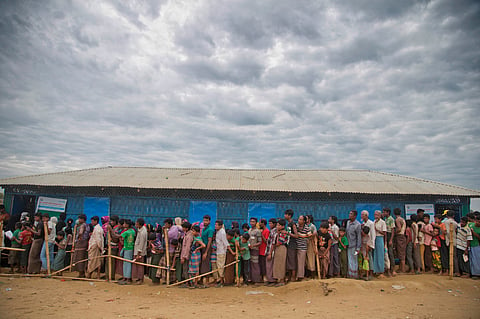
Why Myanmar’s promise to take back 300,000 Rohingya may lead nowhere
Myanmar’s military-backed government appeared to make a significant concession this week when it said it had verified more than 300,000 Rohingya refugees in Bangladesh as former residents of Rakhine State, potentially clearing them to return once security conditions there improve.
For Bangladesh, which hosts about 1.2 million Rohingya and has spent years trying unsuccessfully to begin large-scale repatriation, the announcement offered the prospect of movement in a crisis that has remained largely frozen since the mass exodus from Myanmar in 2017.
But the statement also exposed many of the obstacles that have defeated previous repatriation efforts. Myanmar’s military does not control most of the territory to which the refugees would return.
Fighting continues across Rakhine. The government offered no guarantee of citizenship. And its own figures indicate that it may reject a substantial share of the Rohingya now living in Bangladesh as ineligible for return.
“This announcement is essentially meaningless,” Dr Jeff Crisp, a refugee policy expert and research fellow at the University of Oxford’s Refugee Studies Centre, told Daily Waadaa.
“The conditions for the safe and voluntary return of Rohingya refugees clearly do not exist.”
Rakhine State remains a battlefield between Myanmar’s military and the Arakan Army, an ethnic armed group that has captured much of the state. Crisp, a former head of policy development and evaluation at UNHCR, said the Arakan Army had itself been credibly accused of serious human rights violations against Rohingya who remain in Rakhine.
Myanmar also continues to deny the Rohingya recognition as citizens, one of the central grievances underlying decades of persecution and displacement.
“The refugees in Bangladesh have made it clear that they will only return to Myanmar if their citizenship of the country is recognised, and there is no sign whatsoever that the junta is prepared to do that,” Crisp said.
Who’s controlling the Rakhaine?
The military’s loss of territory has introduced another complication. Nay Pyi Taw is discussing the return of refugees to areas over which it no longer exercises effective control.
Professor Imtiaz Ahmed, a former professor of international relations at Dhaka University, said Bangladesh should therefore seek the position of the Arakan Army before treating the announcement as the basis for a workable repatriation plan.
“We need to look beyond the fact that this is an announcement by the Tatmadaw,” he told Waadaa. “We also need to ask what the Arakan Army has to say, because it now controls around 70% of Rakhine.”
Still, Ahmed said Bangladesh should not dismiss the announcement. “Negotiations can begin. I don’t think it is right to reject the proposal outright,” he said.
Any talks, he said, would have to address more than the number of refugees Myanmar was prepared to receive. They would have to determine where returnees would live, how they could earn livelihoods and whether they would be able to rebuild their communities.
Ahmed also pointed to a broader geopolitical context, including China’s economic and energy interests in the region and increased diplomatic engagement following the Bangladesh prime minister’s visit to China. The announcement, he said, could provide an opening for negotiations even if the conditions for return remain absent.
Myanmar’s own figures, released by its Foreign Ministry on Aug. 15, illustrate the scale of the problem.
Bangladesh had submitted the names of 828,824 refugees for verification, according to the statement. Myanmar said it had reviewed 426,545 and confirmed 308,797 as former residents of Rakhine State.
It said 113,507 others could not be verified. An additional 4,241 were found to have been involved in what Myanmar described as “terrorist activities.”
Thomas Kean, a Myanmar and Bangladesh consultant for the International Crisis Group, said those figures suggested that Nay Pyi Taw was already indicating that a significant proportion of the Rohingya whose names it had examined would not be accepted.
“To me this suggests Nay Pyi Taw is indicating that it will not take back around a quarter of those it has so far reviewed,” Kean told Waadaa.
Myanmar’s statement also challenged a basic premise underlying Bangladesh’s refugee figures. It claimed that only 540,000 Rohingya had crossed into Bangladesh following the violence of 2017 and questioned whether all those now living in the camps had originated in Myanmar.
“It’s essentially signalling that it does not regard all of the 1.2 million Rohingya in Bangladesh as eligible to return, and may contest the eligibility of many of them,” Kean said.
The language could have consequences beyond Bangladesh.
Kean pointed to an unusually broad passage in the statement in which Nay Pyi Taw “categorically rejects” allegations that “boat people” and others who have arrived in other countries originated in Myanmar.
Unanswered questions
For countries such as Malaysia, which has received large numbers of Rohingya originally from Rakhine State, Kean said the assertion should be particularly concerning. It raises the possibility that Myanmar could deny responsibility for Rohingya who have travelled beyond Bangladesh, complicating efforts by governments elsewhere in the region to address their status.
Nay San Lwin, a Rohingya activist and co-founder of the Free Rohingya Coalition, said Myanmar’s figures also left unanswered what would happen to hundreds of thousands of refugees who had not been verified.
At least 750,000 Rohingya fled Myanmar in 2017 alone, he said, while others arrived in Bangladesh during earlier episodes of persecution. In the years since, children have been born to refugee families in the camps.
“Nine years later, Myanmar has verified only about 300,000 refugees,” he told Waadaa. “This raises a critical question: what will happen to the rest?”
The latest statement also makes no commitment to grant citizenship to those who are eventually allowed to return.
Myanmar does not recognise the Rohingya as one of the country’s official ethnic groups and has long referred to them as “Bengalis,” a term that implies they are immigrants from Bangladesh. Kean said the Aug. 15 statement largely repeated those longstanding positions even as the military government presented the verification process as evidence of its willingness to cooperate.
“There is no evidence here of genuine intent from Nay Pyi Taw to take the Rohingya back, or to create the conditions necessary for return,” he said.
A commitment to citizenship would have represented a substantive change, Kean said. Instead, the statement appeared to suggest that Rohingya who returned would have to apply for citizenship.
For Nay San Lwin, citizenship would be only one requirement of a credible repatriation process.
“First and foremost, the right to return to their original land and villages is essential,” he said. “Returnees cannot simply be placed in temporary areas that will later turn into permanent camps.”
Any agreement, he said, should also guarantee recognition of Rohingya identity, freedom of movement, land and political rights, and protection from further violence. International monitors would need to remain in the area until returnees believed they were secure.
The timing of Myanmar’s announcement has also drawn attention.
Malaysian Prime Minister Anwar Ibrahim said on July 30 that Myanmar had agreed to take back 300,000 Rohingya from Bangladesh, saying the understanding had been reached through diplomatic efforts. Myanmar’s subsequently announced figure of 308,797 closely matched the number cited by Anwar.
The verification process has also accelerated sharply.
When Myanmar’s military chief, Min Aung Hlaing, met Muhammad Yunus, then Bangladesh’s leader, at the BIMSTEC summit in April 2025, Myanmar had recognised around 180,000 refugees as eligible to return. The number has since risen above 300,000, even as the military has lost further ground in Rakhine.
“It is clearly speeding up processing in an attempt to improve its relations with the region,” Kean said.
But verifying names imposes few immediate obligations on Myanmar, he added.
“Crucially, this costs Nay Pyi Taw very little, because it does not control the area that the Rohingya would return to.”
Conditional offer
Myanmar has also made its offer conditional on an event for which it has provided no timetable. The refugees, it said, could be received “when the security situation in Rakhine State becomes more stable.”
“The claim that refugees can return ‘once security conditions improve’ means a return will not happen anytime soon,” Nay San Lwin said. “Heavy fighting with the Arakan Army is ongoing.”
He said Myanmar had repeatedly delayed meaningful action on repatriation while facing international pressure. But he argued that Bangladesh should continue pursuing return rather than abandon the process.
“If Bangladesh uses every available diplomatic channel to apply maximum pressure on all parties involved, repatriation remains possible,” he said.
Kean also said Bangladesh should maintain discussions with Nay Pyi Taw, while recognising the limits of what Min Aung Hlaing’s administration can currently deliver. Dhaka, he said, also needs to engage directly with the Arakan Army, “the group that actually controls most of Rakhine State and the territory to which most refugees would actually return.”
The uncertainty leaves Bangladesh confronting a problem that extends beyond the latest negotiations: what to do if large-scale repatriation remains impossible for years.
Crisp said preserving safe and voluntary return as a long-term objective should not prevent Bangladesh and international donors from preparing for that possibility.
Rohingya have been arriving in Bangladesh since at least the early 1970s, he said, making the crisis one of the world’s most protracted refugee situations. He called for improved security in the camps and fewer restrictions on refugees’ movement, livelihoods, education and vocational training.
Cuts in international assistance have made the existing system increasingly difficult to maintain.
“A strictly humanitarian approach to the situation is no longer viable due to cuts in the aid budgets of most major donors,” Crisp said.
He called instead for a medium-term development strategy that would improve conditions for both Rohingya refugees and Bangladeshi communities hosting them.
For now, Myanmar’s verification of more than 300,000 refugees gives Bangladesh another figure around which to negotiate. It does not establish when any of them could return, where they would live or what legal status they would have.
The military government does not control much of the territory where most Rohingya once lived. The Arakan Army does. Fighting continues. Hundreds of thousands of refugees remain outside Myanmar’s verified list, and Nay Pyi Taw is now openly questioning whether some Rohingya elsewhere in the region came from Myanmar at all.
Bangladesh can continue pressing for repatriation while negotiating with the actors that control territory in Rakhine. At the same time, Crisp said, it will have to reckon with the likelihood that the Rohingya will remain in need of international protection “for some time to come.”
—