
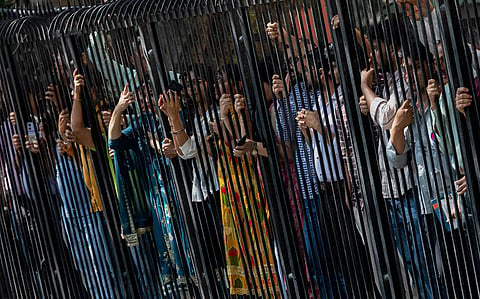
Delhi braces for October 10 protest over voter rolls as police impose sweeping restrictions
A dispute over India’s electoral rolls is set to reach the streets of New Delhi on Saturday, with a youth-led political movement planning a demonstration demanding the resignation of Chief Election Commissioner Gyanesh Kumar despite a police ban and extensive security restrictions.
The Cockroach Janata Party (CJP), a movement founded earlier this year, has called for a gathering at Jantar Mantar on October 10.
Opposition parties, student organisations and activist groups have expressed support for its campaign against alleged irregularities in the revision of voter lists.
Delhi Police have refused permission for the demonstration, citing procedural and public-order concerns. Authorities have announced plans to suspend train services at two major railway stations for 10 hours and restrict access to 57 metro stations.
The security preparations include the deployment of thousands of additional personnel, barricades and arrangements for detaining protesters.
The immediate question is whether the CJP can bring demonstrators into central Delhi despite the restrictions.
The more consequential issue is whether allegations surrounding India’s electoral-roll revision can be independently examined and resolved.
How a satirical movement entered national politics
The CJP was founded on May 16 by Abhijeet Dipke, a political communications strategist and Dalit activist.
Its name emerged from a controversy over remarks attributed to Chief Justice Surya Kant, who was reported to have used the terms “cockroaches” and “parasites of society” in reference to unemployed young activists.
The organisation adopted a name resembling that of the ruling Bharatiya Janata Party (BJP), using satire and social media to attract young supporters.
Although it is not registered as a political party, the CJP has expanded its activities beyond online campaigns.
Its initial demands concerned the accountability of parliamentarians and election commissioners, women’s political representation, media regulation and irregularities in public examinations.
The movement subsequently organised protests over alleged problems in entrance examinations.
It claimed a political victory following the resignation of Union Education Minister Dharmendra Pradhan in July, although the extent to which its campaign contributed to his departure remains unclear.
The episode helped establish the CJP as a vehicle for youth mobilisation outside conventional party structures.
Its campaign against the Election Commission is a more ambitious undertaking.
Unlike disputes over individual examinations, electoral-roll revision involves millions of voters, state-level election machinery and constitutional authorities.
The movement is also attracting established political organisations whose objectives extend beyond those of its original supporters.

The dispute over 130 million voter deletions
The latest controversy stems from the Election Commission’s Special Intensive Revision (SIR) of electoral rolls.
The exercise is intended to update voter lists by identifying duplicate entries, deceased voters and people who are otherwise ineligible.
The CJP and opposition leaders allege that the revision has resulted in large-scale deletions, potentially affecting communities and constituencies associated with opposition parties.
They have cited approximately 130 million deleted names.
That figure requires careful scrutiny. It does not establish that 130 million eligible voters have been unlawfully removed. A reliable assessment would need to distinguish duplicate or invalid entries from eligible voters who were wrongly excluded.
The Election Commission and government maintain that voter-list revisions are necessary to preserve the accuracy of electoral records.
Opposition parties argue that the process lacks sufficient transparency and could influence election outcomes by removing legitimate voters.
Congress leader Rahul Gandhi has described the alleged irregularities as “vote theft”, bringing the issue into the opposition’s wider campaign against the BJP government.
Questions have also been raised about reported disagreements within the Election Commission.
Election commissioners Sukhbir Singh Sandhu and Vivek Joshi have reportedly objected to certain decisions associated with CEC Gyanesh Kumar.
The nature and implications of those disagreements have not been independently established. Internal differences would not, in themselves, prove manipulation.
The substantive issues are whether the revision follows consistent procedures, whether affected voters receive adequate notice and whether wrongful deletions can be corrected before elections.
Without verifiable constituency-level data, the opposition’s allegations and the Election Commission’s assurances remain difficult to evaluate conclusively.
Why opposition parties are backing the CJP
The campaign has drawn support from parties associated with the opposition INDIA alliance, along with student organisations and groups representing farmers and Dalits.
This support has increased the movement’s political reach.
The CJP brings a predominantly young activist constituency and an established social-media presence. Opposition parties can contribute organisational networks, elected representatives and access to parliamentary forums.
Demonstrations in Mumbai and Bengaluru have helped sustain attention ahead of the Delhi protest.
But the participating groups do not necessarily share identical objectives.
Some are concerned principally about voter exclusions. Others are campaigning for greater institutional accountability or opposing the BJP government more broadly.
Their immediate demand for Kumar’s resignation provides a common position, but it remains uncertain whether that will produce a sustained national campaign.
The CJP’s longer-term prospects will depend partly on its ability to substantiate the electoral allegations and maintain organisational support after Saturday.
For opposition parties, the challenge is to convert the controversy into specific demands for disclosure, independent scrutiny and corrective procedures.
Delhi’s security response draws scrutiny
The authorities’ preparations for October 10 are unusually extensive.
Delhi Police have rejected the CJP’s application to demonstrate at Jantar Mantar, citing insufficient notice and concerns arising from earlier protests.
Prohibitory measures under Section 163 of the Bharatiya Nagarik Suraksha Sanhita have also been invoked.
Reports on Friday indicated that 221 companies of central armed police forces, comprising approximately 23,000 personnel, had been made available to Delhi Police.
Other accounts put the broader deployment at more than 25,000.
The proposed transport restrictions extend well beyond Jantar Mantar.
Train services to and from New Delhi and Hazrat Nizamuddin railway stations are scheduled to be suspended between 4am and 2pm on Saturday.
Police have also requested the closure of entry and exit gates at 57 Delhi Metro stations.
These measures could affect commuters, railway passengers and workers with no involvement in the demonstration.
Police have additionally prepared barricades, detention arrangements and security checks at entry points into the capital.
The authorities say the restrictions are intended to prevent disorder and unauthorised gatherings.
Their breadth, however, has raised questions about whether the anticipated security risks justify disruption across major parts of the capital’s transport network.
The issue has now reached the Supreme Court.
Senior advocate Kapil Sibal has challenged the transport restrictions, bringing the impact on ordinary citizens before the court.
Chief Justice Surya Kant reportedly told Solicitor General Tushar Mehta to “ensure everything is not halted”.
The observation concerned the extent of the proposed disruption. It did not amount to a ruling on the legality of the demonstration or the underlying allegations against the Election Commission.
The proceedings nevertheless place the proportionality of the security measures under judicial scrutiny.
The government has a responsibility to maintain public order. That responsibility must be weighed against the right to peaceful assembly and the practical consequences of restricting movement across a large city.
What Saturday’s protest could mean
The immediate outcome will depend on how many demonstrators reach Delhi, whether police enforce the ban through mass detentions and whether the gathering remains peaceful.
CJP founder Abhijeet Dipke has said the protest will proceed despite the restrictions. On Friday, he questioned the decision to disrupt public transport, arguing that the measures would inconvenience ordinary citizens.
There are three plausible developments.
Police could prevent a large gathering at Jantar Mantar, leaving protesters to assemble in smaller groups elsewhere. That would limit the immediate demonstration but could generate further disputes over detentions.
Alternatively, substantial numbers could reach the capital despite the restrictions, creating pressure on police to manage gatherings at multiple locations.
A third possibility is that the demonstration remains limited but the campaign continues through opposition parties, student organisations and legal challenges.
The last outcome may be particularly important for the CJP. A movement that began with satire and protests over examinations is attempting to establish itself as a sustained political force.
Its ability to do so will depend on more than attendance at Saturday’s demonstration.
The Election Commission’s handling of voter-list complaints, the availability of evidence supporting allegations of wrongful deletions and the response of established opposition parties will determine whether the controversy continues.
The government also faces a practical calculation. Extensive restrictions may prevent protesters from gathering in central Delhi, but the resulting disruption could attract additional criticism of its handling of dissent.
The Bangladesh comparison, and its limits
For Bangladesh, the confrontation has a relevant recent precedent in the protests that preceded Sheikh Hasina’s removal from power in August 2024.
Those demonstrations began over public-sector job quotas before expanding into a wider movement against the government. The authorities’ response, including restrictions on assembly, communications disruptions and lethal force, contributed to the escalation.
The comparison with India should be treated carefully.
The CJP’s campaign concerns electoral-roll revisions and the leadership of the Election Commission. Bangladesh’s 2024 uprising developed under different political circumstances and involved a far more extensive confrontation between protesters and security forces.
There is no evidence that the Indian government faces a comparable threat to its survival. Nevertheless, Bangladesh’s experience provides a useful reference for examining how government responses can affect the direction of protest movements.
In July 2024, the initial dispute over quotas was overtaken by public anger over the treatment of demonstrators. The government’s handling of the protests became as important as the original policy grievance.
In Delhi, a similar shift in the subject of political debate is possible, although not inevitable.
The CJP’s campaign initially focused on allegations against the Election Commission. The restrictions imposed ahead of October 10 have introduced a second issue: whether the authorities’ security response is proportionate to the anticipated threat.
For Indian opposition parties, that creates an opportunity to broaden the campaign beyond electoral administration. For the government, it creates a risk that measures intended to contain a demonstration could increase attention to the protesters’ demands.
But the differences between the two countries remain substantial. India’s federal political structure, electoral competition, judiciary and opposition networks operate in a different institutional environment.
A comparison of protest management is therefore more useful than any suggestion that the political outcomes will be similar.
The bigger question for India’s Election Commission
The October 10 demonstration has placed Chief Election Commissioner Gyanesh Kumar under political pressure, but his resignation would not, by itself, settle the dispute over electoral rolls.
The central issue remains the accuracy and fairness of the Special Intensive Revision.
The figure of approximately 130 million deleted names is politically significant, but it needs to be examined against the number of duplicate entries, deceased voters, changes of residence and eligible voters who may have been excluded incorrectly.
A credible assessment would require detailed data on deletions, the reasons recorded for them, the distribution of affected voters and the procedures available for reinstatement.
The Election Commission’s position is that the revision is a legitimate administrative exercise. Opposition parties contend that the process could disadvantage their supporters.
Those competing claims require evidence rather than political declarations.
Saturday’s protest may demonstrate the CJP’s ability to mobilise supporters.
The police response will also face scrutiny, particularly if detentions and transport restrictions affect large numbers of people.
Neither outcome will establish whether the allegations against the Election Commission are valid. The more important developments may come afterwards, through court proceedings, publication of electoral data and decisions on disputed voter registrations.
For now, Delhi’s immediate priority is managing a demonstration that authorities have refused to permit. For the Election Commission, the longer-term issue is whether it can provide sufficiently detailed and verifiable answers to the allegations that brought protesters onto the streets.
That question will remain even after the barricades are removed.