
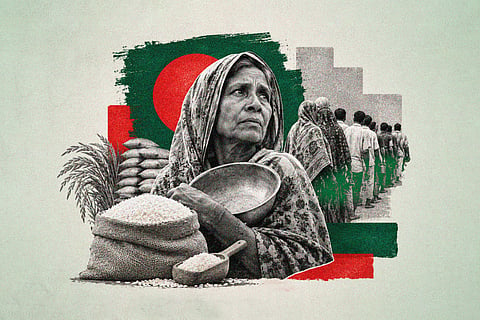
Not famine, perhaps, but is hunger looming?

Is Bangladesh heading towards famine in the next three to five years? The question is no longer confined to professional pessimists.
Since US and Israeli strikes on Iran in late February, the flow of oil, gas and fertiliser through the Strait of Hormuz has been repeatedly disrupted. A “very strong” El Nino is gathering over the Pacific. World food prices are close to a four-year high. In New York at the end of September, India’s foreign minister, S Jaishankar, warned that a major food crisis could arrive within months, describing it as a compound crisis of food, fuel, fertiliser and finance.
Before answering, it helps to be precise about the word. On the international scale of food security known as the IPC, famine is the final rung: at least a fifth of households in an area facing extreme food shortages, malnutrition killing on a wide scale, and people dying of starvation. Almost every case to reach that threshold in the past three decades has occurred in war zones or failed states, where getting food to people had become all but impossible.
In that sense, the risk of famine in Bangladesh over the next few years is low. But that is cold comfort, for the country’s own history shows that having food is no guarantee against famine.
Amartya Sen’s study of the 1974 famine marked a turning point in economics. He showed that food grain available per person that year was no lower than in the years before. People died for other reasons. Floods wiped out rural work, so farm labourers’ incomes dried up; the price of rice soared; hoarders profited; and shipments of foreign food aid were held up.
The famine came not from a shortage of food but from a collapse in people’s ability to buy it, compounded by policy failure. Today’s question should therefore be framed differently. It is not whether Bangladesh will run out of rice, but whether ordinary people will still be able to afford it.
A stronger food system, but growing vulnerabilities
The Food and Agriculture Organisation (FAO) expects this year’s paddy harvest to reach about 61.9 million tonnes, some 5 percent above the average of the past four years.
The boro yield came close to last year’s record, and the FAO expects rice imports to fall from 1.9 million tonnes last year to 0.8 million this year.
In April public granaries held 1.92 million tonnes of food grain, comfortably above the government’s own safety threshold of 1.35 million. Here lies the essential difference between the Bangladesh of 1974 and the Bangladesh of today.
The country now grows almost all of its own rice; a dense web of rural roads and markets can move food quickly from one place to another; and there is at least a framework of social protection, from open-market sales (OMS) to the Food Friendly Programme and VGF cards. Its experience in coping with natural disasters is also long and well tested.
Yet this abundance rests on inputs that are almost entirely imported, and four shocks are now hitting them at once.
The first is energy. More than 40 percent of the country’s electricity comes from imported liquefied natural gas, much of which once came from Qatar alone.
Before the war, spot LNG in Asia traded at about $10 per mmBtu; in September it climbed back towards $30. Diesel has gone up twice since February, from Tk 100 a litre to Tk 135.
By the Asian Development Bank’s count, about 1.22 million of the country’s 1.65 million main irrigation pumps run on diesel.
The price of diesel, in other words, is the cost of growing boro rice.
The second shock is fertiliser. Bangladesh imports 75 to 80 percent of the fertiliser it uses, and between a quarter and a third of that passes through the Strait of Hormuz. Domestic urea factories run on gas, and this year gas shortages have forced them to shut more than once.
The World Bank expects fertiliser prices to rise by more than 30 percent this year. About three-quarters of the country’s fertiliser goes on rice, and boro planting begins in December and January. How much fertiliser and diesel can be had over the next three or four months, and at what price, will decide the fate of the biggest harvest of 2027.
The third is the climate. The World Meteorological Organisation says the current El Nino will become “very strong”, peak at the end of 2026 and linger into 2027. India has already had its weakest monsoon since 2009, with rainfall some 15 percent below normal, and the US Department of Agriculture expects its rice output to fall by 7 million tonnes. India is the world’s largest rice exporter, and in 2023 it restricted exports to keep domestic prices in check. If the shortfall deepens, a repeat cannot be ruled out.
The World Food Programme reckons that this El Niño could push at least 49 million more people around the world into acute hunger by 2027.
The fourth is the world market. In September the FAO food price index rose to 136 points, 5.8 percent higher than a year earlier, with cereals up 17.2 percent. The FAO blames transport disruptions in the Strait of Hormuz and the Black Sea, along with fears for weather-hit harvests; its chief economist speaks of “broadening price pressures”. Bangladesh relies heavily on imports of wheat, edible oil, lentils and sugar, so those prices will land directly in the household shopping basket.
These four shocks are arriving at a time when people’s purchasing power is already frail.
Eroding purchasing power
A joint IPC analysis by the government and UN agencies found some 15.3 million people in acute food insecurity between May and August. Between September and December that number is projected to rise to 18.1 million, around 787,000 of them in an emergency phase.
No one is yet at the famine stage, but the direction of travel is unmistakable. A survey by the Bangladesh Bureau of Statistics last year found that 62 percent of households spend at least half their income on food. In such a household, a 10 to 15 percent rise in the price of rice means that fish, eggs and milk go first; then school fees and medicine; then the chickens and ducks are sold, and finally the land.
In 2008 world rice prices leapt within months from about $300 a tonne to more than $1,000, and domestic prices rose by nearly 38 percent.
There was no famine that year, but millions of families slipped below the poverty line.
Jobs, remittances and poverty gains under threat
Incomes are under strain too. A survey of knitwear factories hit by the gas and power crisis found that 78 percent had partially halted production and 55 percent had seen buyers cancel or cut orders.
A model-based analysis by SANEM, a Dhaka think-tank, suggests that the combined effect of fuel prices, shipping disruption and falling remittances from the Gulf could knock some 3 percent off GDP.
Garment workers and the families of migrant workers have been the chief engines of the fall in rural poverty over the past two decades. Now both are at risk at the same time.
Finally, there is the question of the state’s own capacity. Fuel, fertiliser and food imports all need dollars, and those dollars are being pulled in many directions at once. Foreign-debt repayments alone come to about $4.7 billion this fiscal year, and in early October the government had to take a six-month commercial loan just to pay for fuel imports.
Yet this year’s budget cut subsidies and incentives by about 6 percent. Just when the safety net is needed most, the money set aside for it has shrunk.
What, then, is to be done?
The first priority is the coming boro season.
Farmers need a guarantee, now, that fertiliser and irrigation diesel will reach them between December and April. That means contracts for fertiliser from sources outside the Gulf, priority gas supplies for urea plants, and protected allocations of power and diesel for agriculture during the irrigation season.
Every tonne of fertiliser or litre of diesel that goes missing now will be paid for several times over later, in imported rice.
Second, plan imports early. If India curbs exports, rice prices in Thailand, Vietnam and Pakistan will rise together, and the country with the fewest dollars will pay the highest price. Long-term government-to-government contracts, and keeping stocks above the safety threshold, should begin now.
In 2008 those who bought early bought cheap.
Third, widen the safety net rather than shrink it. Expanding OMS and the Food Friendly Programme, and targeting cash support at day labourers, garment workers and the families of returning migrants, is the cheapest insurance against famine there is. That is the heart of Amartya Sen’s lesson: food in the market is not enough; people must have the means to buy it.
Market monitoring must be tightened too, because in times of uncertainty nothing drives up prices faster than hoarding, as 1974 showed.
Fourth, prepare for El Niño in advance. Distribute seeds of drought- and heat-tolerant varieties, plan irrigation water for the north, and make sure early warnings actually reach farmers, so that a shock in the weather does not become a sudden catastrophe.
By the international definition of famine, the chance that Bangladesh will reach that point in the next three to five years may well be slim.
But that hunger is coming is hardly in doubt; indeed, it has already arrived. Nearly 20 million people now face acute food insecurity, and the shocks from fuel, fertiliser and weather have yet to peak.
This hunger will not look like the photographs of famine. It will show up in the fish and eggs missing from the plate, in children who leave school for work, in livestock and land sold off, and in families pushed back below the poverty line. Nor does hunger ever remain merely an economic crisis. Rising prices breed social unrest, crime and resentment, and the anger of hungry people finds its way, sooner or later, into politics. The food crisis of 1974 badly damaged the public standing of the government of the day; the global food-price spike of 2007-08 sparked protests in more than 30 countries; and the price of bread played a plain part in the Arab Spring of the early 2010s.
History suggests that while food crises may come from nature or from world markets, their consequences are settled by policy.
The decisions of the next six months will determine whether this hunger is confined to one hard year, or marks the start of a long chapter of poverty, social unrest and political discontent.
-----
***Murad Kibria is a writer and chartered accountant.