
When Seba leaves shelves: An era of imagination at risk
When the last book published by Seba Prokashani is removed from store shelves, it won’t just be the end of a publishing house.
It will be the end of an era. It will be the end of a fond trip down memory lane.
Established in 1963 in Dhaka by legendary writer Kazi Anwar Hossain, Seba Prokashani has long been one of Bangladesh’s most popular and influential publishing houses.
Now, mired in alleged irregularities and misconduct, it announced suspension of all its operations in a notice published on Wednesday, signed by Kazi Shahnoor Hossain, a partner of the publishing house.
But, like most of the characters that came out of the Seba, the publishing house isn’t going down without a fight.
On Wednesday, in a Facebook live video, the organisation's adviser Masuma Maimur said the decision was taken to suspend all operations temporarily while an independent audit firm is appointed.
Masuma, also the daughter-in-law of one of the publisher’s legendary writers, Qazi Anwar Hussain, said attempts had been taken for corrective steps within the institution, but those were obstructed by “dishonest individuals”.
She also raised suspicions on several management decisions.
On Thursday, in a post, she said that efforts were ongoing to complete an audit before the upcoming Eid so that online sales can start again immediately after the holidays.
The post was met with a lot of optimism by netizens.
‘Trip down memory lane’
News of the suspension stirred a storm of fond memories on social media, with many pleading for a revival, not a burial.
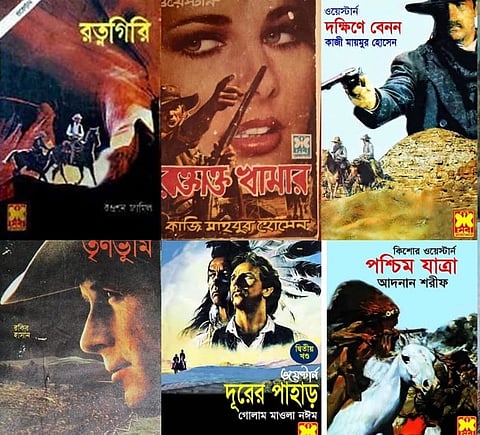
Journalist Mohiuddin Alamgir Jewel, taking to Facebook, wrote, “In my childhood and younger days, Sheba Prokashoni was more than just a publisher—it was a doorway to adventure, mystery, and imagination. From Kuasha to Masud Rana, from Tin Goyenda to the romantic and western series, these books shaped our dreams and gave us countless hours of joy.”
Seba Prokashani was indeed a gateway to a world unexplored.
Starting off as a monthly mystery and adventure magazine, it soon branched out to develop books and characters that captured the nation’s imagination.
This was at a time when there were no internet reviews, no social media posts and no doom-scrolling.
But more than once, Seba found virality before it even existed and managed to ensure it spanned generations.
When it introduced the spy series’ eponymous Masud Rana, Bangladesh’s answer to James Bond, it spread like wildfire.
Amid no digital distractions and constant load shedding, children and adults across Bangladesh were transcended to a world of thrills, chills and mysteries.
For post-war Bangladesh, Masud Rana was a hero they could all aspire to become.
The series, which began in the 60s, featured the character in around 472 books.
Then there was Tin Goyenda, a remake of Robert Arthur Jr’s Three Detectives.
The series described the adventures of Kishore Pasha, a Bangladeshi-American teen detective, and his two friends Musa Aman and Robin Milford.
With the setting in California, the series still managed to win hearts in Bangladesh, reminding readers of the Famous Five and the Hardy Boys.
It was also a series ahead of its time, with diversity a prominent fixture.
Aside from famous series, many also remember the horror stories, world mysteries and the children’s magazines.
Many an aspiring writer will recall how the publishing house was their first real inspiration.
The publications, which some now frown at for being pulp, demonstrated the hunger for book-led entertainment that dominated at least three eras.
Now, as Seba continues its suspension, it’s a rude awakening again for many.
When will Bangladesh see its next enduring fictional character? Will the digital space encroach and diminish the space for such a creation?
The growth of bookshops says otherwise.
Meanwhile, to ensure an impartial investigation and a comprehensive audit of the allegations, Seba authorities have decided to suspend all operational activities until further notice.
For now, the revival of Seba is the demand of the hour.
The country, collectively, desires that its childhood is not allowed to die.
The fight is on.