
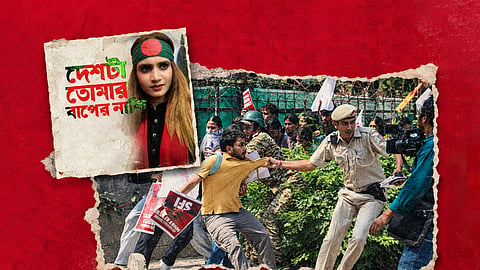
Bangladeshi protest song crosses borders, finds new voice in India
On Monday, the Indian National Congress’ Tripura unit posted a video on its verified Facebook page showing members of the opposition alliance marching towards the Supreme Court to protest a controversial revision of voter lists that has sparked days of unrest in India.
The video featured the Bangla song Deshta Tomar Baper Naki (Is This Country Your Father’s Property?) in the background.
Originally sung by Bangladeshi singer Mousumi Chowdhury and written by Ethun Babu, the song has crossed borders, finding a new audience among social media users and political activists in India, who are using it in videos of demonstrations and political dissent.
Created in December 2022 amid protests against Sheikh Hasina’s crackdown on the opposition, the song gained renewed momentum during the July Uprising that toppled her government in 2024. The UN estimated that up to 1,400 people were killed during the uprising.
The song became popular on social media, featuring in reels and videos associated with the protests.
Now, nearly four years after its creation, it is circulating widely again in India, where users have adopted it for videos linked to recent protest movements.
Its appeal, however, does not appear confined to a single political camp. The song has also surfaced in videos shared by accounts supportive of the Bharatiya Janata Party (BJP), suggesting that users are adapting it to different political contexts.
Mousumi, the singer, said she was aware of the song’s renewed popularity on social media and that seeing it reach audiences beyond Bangladesh had brought her joy.
“Of course, it feels wonderful when a song of your own is on people’s lips, when you hear people singing it or see it being used in different movements, dances, reels or other videos,” she told Daily Waadaa.
She credited Ethun Babu for recognising how her voice would suit the song.
“He is a talented person who understands which song would work with which voice. He gave me this song because he felt my voice was what it needed,” she said.
“This song is not just like any other song. It is an energetic song, one that stirs the blood. When people hear it, they feel something different inside; it gives them courage and confidence.”
For Mousumi, the song is a protest against repression and a defence of people’s right to speak freely. Its lyrics evoke the bloodshed surrounding Bangladesh’s independence and vow to shed blood again to protect the country, she said.
She said the song was written against the backdrop of years of repression under Hasina’s 15-year rule, when many people felt they could not express themselves freely.
“Whenever someone tried to say something, there were fears of enforced disappearance, murder, the Aynaghar detention centre, imprisonment, harassment and lawsuits,” she said, referring to the climate of repression under Hasina’s government.
---