
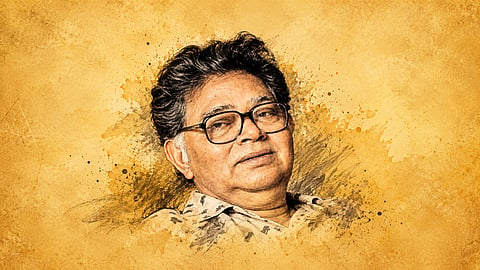
The Sunil nobody toasts today
Four young men load a car with rice, whisky and a transistor radio and drive out of Calcutta towards the Palamau forests, certain a few days away from the city will show them something true about themselves. It doesn't. The forest gives them a mirror they didn't ask for, and by the time they drive back none of them has become the person the holiday promised.
That novel, Aranyer Din Ratri, rarely makes the guest list when Sunil Gangopadhyay's admirers assemble their tributes. The seats go to Sei Shomoy and Pratham Alo, his sprawling historical epics, famous enough that people forget he wrote anything smaller, or anything set closer to his own lifetime. He did.
Six books, mostly from the same restless stretch of his career, about men who set out for somewhere and don't get there, and about a solitude that outlasts every attempt to escape it. Read alone, they look like detours. Read together, they look like a project he never announced and never abandoned.
The sequence's roots lie in Ardhek Jibon, written decades later but refusing the shape memoirs usually take. Sunil's account of his Krittibas years, of postwar Calcutta hunger and poets sleeping four to a room because none could afford otherwise, circles the same corridor rather than walking through it.
He remembers borrowed cigarettes and unpaid printer's bills more clearly than any moment of arrival. He was there when Bengali poetry was remaking itself, mimeographed magazine by magazine, and he describes it sideways, as a young man too broke and unsure to notice the history he was standing inside. Even the title withholds completion: half a life, not a whole one.
There is no arc of an artist discovering his gift, just years that felt like a waiting room, and a narrator surprised that anyone thinks the waiting adds up to a story.
Siddhartha, the young man at the centre of Pratidwandi, inherits that corridor and drags it through job interviews and his father's funeral procession. Ray's film found something in his face, a man who keeps almost meeting the world and flinching at the last second, and the flinch was on Sunil's page before the camera caught it.
Bengali fiction had no shortage of angry young men in the early seventies. Siddhartha isn't one of them. His anger arrives late, argues with itself, and loses steam somewhere between the thought and the act. The novel's achievement is making that hesitation feel like the century's own temperature rather than one man's flaw.
Then comes the forest. Aranyer Din Ratri takes men like Siddhartha and gives them, for once, somewhere to arrive: a holiday, a car, the promise of feeling something real away from the city's noise. What they discover is how badly they've prepared for stillness. One flirts clumsily with a local Santhal woman and can't tell afterwards whether he was being cruel or merely careless.
Another performs a class superiority that collapses the moment anyone tests it, and spends the rest of the trip pretending it didn't. The forest doesn't transform these men. It switches off the noise that had hidden how little they knew of one another and of themselves, and sends them home no wiser but more exposed.
Sudur Jharnar Jole takes the same restlessness out of the city and turns it into longing. Its title means roughly "in the water of a distant waterfall," and the waterfall is never the point. It is the furthest thing the protagonist can imagine wanting, which is why he keeps wanting it.
Sonali Dukkho sits beside it in temperament, though its subject is heartbreak. It refuses to let grief curdle into bitterness or flatten into nostalgia. Sunil calls the sadness golden, and seems to mean it. His characters take comfort in never getting over their losses, tending the wound the way another writer might tend a garden.
Eka Ebong Koyekjon names the whole argument. Alone, and a few others: the phrase sounds contradictory, but it describes the condition Sunil kept returning to, a solitude that survives marriage, friendship, a room full of people, because it was never about being physically by oneself.
His characters are alone the way a lit window is alone on a street of other lit windows: visible, surrounded, unreached. Go back to the earlier books with that in mind, and Siddhartha's hesitations, the forest's failed reckoning and Ardhek Jibon's stalled becoming stop looking like separate efforts. They read like six attempts at finishing the same sentence, written years apart by a man who kept discovering he hadn't finished it yet.
None of this displaces Sei Shomoy. It remains the bigger achievement by most measures, and it deserves every tribute it gets today. But that historical grandeur has swallowed the memory of the smaller, stranger project running alongside it. The epics look outward and close their circles.
These six look inward and won't. A man at a threshold, unable to make himself cross it, was telling Sunil something about his century that the men who crossed easily never could: that arrival might be the smaller achievement, and the standing there the truer report on what it felt like to be alive in his Bengal.
On a day built for remembering the doorstops, it's worth remembering the other shelf too, the one that didn't get anywhere, on purpose.
—
Mahmud Newaz Joy is a freelance feature writer