
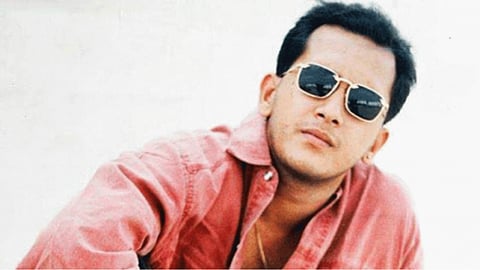
Court cancels order to exhume Salman Shah’s body
A Dhaka court has cancelled its previous order to exhume the body of popular 1990s film star Salman Shah to determine the actual cause of his death.
Dhaka Metropolitan Magistrate Jewel Rana issued the order on Tuesday following an application filed by the plaintiff appointed on behalf of Salman Shah’s family.
Plaintiff Mohammad Alamgir Kumkum, also Salman Shah’s uncle, filed the application with the court seeking cancellation of the exhumation, his lawyer Faruk Ahmed said.
After a hearing, the court allowed the application.
It stated that nearly 30 years have passed since Salman Shah’s death. After such a long period, the possibility of recovering any bodily remains is extremely slim due to natural causes.
It also noted that when the body was exhumed on 13 January 1997 under a court order, it was found in an advanced state of decomposition.
The application further stated that Salman Shah was buried in the premises of the shrine of Hazrat Shahjalal (RA) in Sylhet and remains buried there.
Any renewed initiative to exhume the body could hurt religious sentiments and risk creating public unrest.
Earlier, on 20 May, the case’s investigating officer and Criminal Investigation Department (CID) Inspector Ziaul Morshed filed an application with the court seeking permission to exhume the body.
On 24 May, after hearing the application, the court granted permission for the exhumation and ordered that the body be exhumed in the presence of an executive magistrate, an inquest report be prepared, and a post-mortem examination be conducted.
According to the case details, on 20 October last year, the court ordered that the unnatural death case filed over Salman Shah’s death be accepted as a murder case.
The following night, Alamgir Kumkum filed a murder case on behalf of the victim’s mother Neela Chowdhury.
On 6 September 1996, Salman Shah’s body was recovered from his residence in Eskaton in the capital.
At the time, his father, Kamaruddin Ahmed Chowdhury, filed an unnatural death case.
Later, in 1997, an application was made to investigate the matter as a murder case.
On 3 November 1997, the CID submitted its final report to the court, describing the incident as a suicide.
On 25 November of the same year, the court accepted the report. A revision petition was later filed against that decision.
In 2003, the case was sent for judicial inquiry, and after a lengthy 11 years, the judicial inquiry report submitted in 2014 also described the death as an unnatural death.
In 2015, she filed a no-confidence petition against the judicial inquiry report.
The case was subsequently investigated by the Police Bureau of Investigation (PBI).
On 31 October 2021, the court accepted the PBI report and disposed of the case.
Subsequently, on 12 June 2022, a revision case was filed before the Dhaka Metropolitan Sessions Judge’s Court challenging that order.