
Withdraw existing banknotes, legalise undisclosed money at 25% tax: Khokon
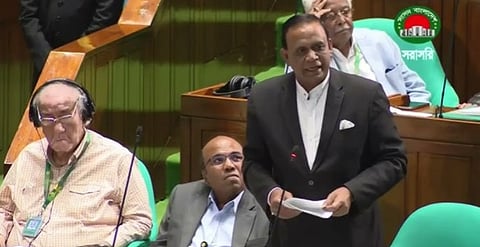
BNP lawmaker AM Mahbub Uddin Khokon on Sunday proposed withdrawing all existing banknotes from circulation and requiring people to deposit their cash in banks within one or two months, allowing holders of undisclosed money to legalise it by paying a 25 percent tax.
Taking part in the general discussion on the proposed national budget for FY2026-27 in the Jatiya Sangsad, the Noakhali-1 MP argued that such a move would channel large volumes of cash into the banking system, improve liquidity and generate fresh investment, helping the economy regain momentum.
Khokon said Bangladesh must overhaul its financial system to curb money laundering, restore public confidence in banks and encourage investment, arguing that existing efforts have failed to recover illicit funds transferred abroad.
"Since independence, every government has spoken about money laundering, but no significant amount of the money sent abroad has been brought back," he said. "Once money enters the global financial system, there is virtually no opportunity to recover it."
He said people keep their wealth where they feel secure, comparing the issue to families storing cash and gold at home when they trust their surroundings.
Bangladesh, he said, should reform its financial system to ensure that people feel confident enough to retain and invest their money within the country.
Referring to financial hubs such as Singapore, Dubai, Canada and Thailand, Khokon said Bangladesh should adopt a more effective financial framework to discourage capital flight and encourage domestic investment.
The BNP lawmaker also questioned the need for the large number of banks operating in the country.
"There is no need for so many banks. It seems that whenever someone becomes influential or enters politics, they want a bank or a leasing company," he said, calling for the closure of unnecessary financial institutions.
Khokon alleged that public confidence in the banking sector had eroded, prompting many people to keep cash outside the formal financial system.
He also stressed that improving law and order would not be possible without creating employment opportunities for millions of unemployed young people.
"We cannot expect a better law-and-order situation while leaving millions of youths unemployed. Employment generation must be a priority," he said.
Despite highlighting shortcomings, Khokon described the proposed budget as a forward-looking fiscal plan aimed at supporting the country's development.
He welcomed a number of social protection initiatives, including Family Cards and Farmers' Cards, saying they would channel money to grassroots communities and stimulate economic activity.
At the same time, he observed that a substantial portion of the proposed Tk9,38,000 crore budget would be spent on government operations, salaries, pensions, infrastructure maintenance and servicing interest on previous loans, leaving comparatively limited fiscal space for development spending.
Khokon also defended the government's handling of the economy, saying the administration inherited a financial system weakened by widespread looting and mismanagement.
He added that the relatively restrained criticism of the proposed budget in Parliament reflected the difficult economic circumstances inherited by the government rather than the absence of shortcomings.