
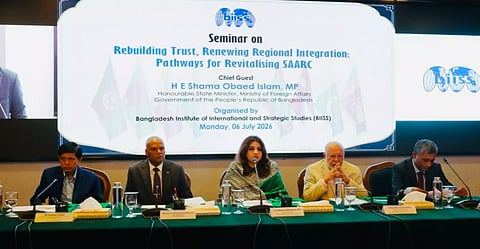
Dhaka doesn’t need to choose between SAARC, BIMSTEC: Shama Obaed
State Minister for Foreign Affairs Shama Obaed Islam on Monday said Bangladesh does not need to choose between the South Asian Association for Regional Cooperation (SAARC) and the Bay of Bengal Initiative for Multi-Sectoral Technical and Economic Cooperation (BIMSTEC), stressing that the two regional groupings should complement rather than compete with each other.
"BIMSTEC connects South Asia with the Bay of Bengal and Southeast Asia. SAARC represents the broadest South Asian regional identity, including countries that are not part of BIMSTEC," she said while addressing a seminar.
She said sub-regional initiatives should not undermine SAARC but instead serve as building blocks for broader regional cooperation.
Under the leadership of Prime Minister Tarique Rahman, she said, Bangladesh is committed to supporting both SAARC and BIMSTEC, as both organisations advance the country's interests in connectivity, stability, prosperity and development.
The Bangladesh Institute of International and Strategic Studies (BIISS) organised the seminar, titled "Rebuilding Trust, Renewing Regional Integration: Pathways for Revitalising SAARC."
Former ambassador Tariq A. Karim, Adviser to the Centre for Bay of Bengal Studies at Independent University, Bangladesh, and Visiting Research Fellow at the Institute of South Asian Studies, National University of Singapore, presented the keynote paper.
Former Additional Foreign Secretary (SAARC and BIMSTEC) Md Shamsul Haque, now Chief Executive Officer of CodersTrust Bangladesh, and Professor Dr Niloy Ranjan Biswas of the Department of International Relations at the University of Dhaka spoke as discussants. BIISS Director General Major General A S M Ridwanur Rahman delivered the welcome and closing remarks.
Bangladesh calls for a practical revival of SAARC
Shama Obaed said Bangladesh would like to see SAARC function at an "optimal functional level" until conditions become conducive to reviving summit-level political engagement.
"The phrase 'optimal functional level' is important. It does not mean keeping SAARC alive only symbolically. It means doing the maximum that is realistically possible under the current circumstances. It means being ambitious in spirit but realistic in method," she said.
She said such an approach would involve regular technical and official meetings, a predictable calendar of activities, stronger specialised bodies and regional centres, cooperation in key sectors, and tangible benefits for the people of South Asia.
She also advocated flexible, project-based cooperation among willing member states, recognising that not all members may be prepared to participate in every initiative simultaneously.
"Where several members are ready to cooperate, they should be able to move forward while keeping the door open for others," she said.
The State Minister said she had held separate discussions with representatives of all SAARC member states and found them broadly supportive of reviving the organisation.
"So now I think it is time to turn our aspirations into action. The intent has to be actionable," she said.
SAARC should remain an inclusive regional forum
Shama Obaed said the objective should not be to force bilateral political dialogue through SAARC, but to ensure that political disputes do not paralyse regional cooperation.
At the same time, she said, SAARC must remain an inclusive platform for all South Asian countries.
"We should keep the door open for all members while ensuring that agreed technical and developmental cooperation continues," she said.
She noted that SAARC provides smaller member states with a collective voice, allows India to demonstrate constructive regional leadership, keeps Pakistan engaged within the South Asian framework, and offers a platform to address shared challenges despite unresolved political disputes.
"Our approach to SAARC is both hopeful and realistic. We do not expect the organisation to return to full political normalcy overnight. Equally, we reject the notion that nothing can be done. Much can be achieved if the agenda remains realistic, technical and people-centred," she said.
She added that the way forward was to preserve the institution, strengthen existing mechanisms, address weaknesses and expand cooperation wherever consensus exists.
"SAARC is waiting for wise leadership, practical cooperation and renewed confidence. Bangladesh is ready to contribute to rebuilding that confidence," she said.
Map issue raised
During his keynote presentation, Tariq Karim displayed a map that prompted an objection from Pooja Kumari Jha, Second Secretary (Political and Information) at the Indian High Commission in Dhaka.
"The map of India depicted here is incorrect. Jammu and Kashmir is an integral part of India, and I think the map presented here is not correct," she said.
Karim responded that the map was intended for representational purposes and did not depict actual political boundaries.
"I understand, sir, but Jammu and Kashmir... we consider it part of India, and it is misrepresented here. So I just wanted to point it out," Jha said.
"Point noted," Karim replied.
Politics and energy key to SAARC's future: Tariq Karim
Speaking on the prospects for SAARC, Tariq Karim said the organisation already has the institutional framework but lacks the political conditions necessary for it to function effectively.
"You have the engine there, but the engine will not move unless the politics functions. That is one of the problems," he said.
He added that even with political will, SAARC would require sufficient resources to move forward.
"There are two things needed. Politics has to reach a point where it functions reasonably and does not misfire. Second, you need energy security. The fuel has to be there for revitalisation to proceed," he said.
"We have the idea of a brilliant car, but we have not been able to figure out how politics will start the engine or whether we have the fuel."
The seminar concluded with an interactive discussion in which participants exchanged views on SAARC's structural challenges, regional geopolitical dynamics and opportunities to advance functional cooperation despite political differences.
The event was attended by senior government officials, current and former diplomats, civil and military officials, representatives of regional and international organisations, academics, researchers, university students, media representatives and policy experts.