
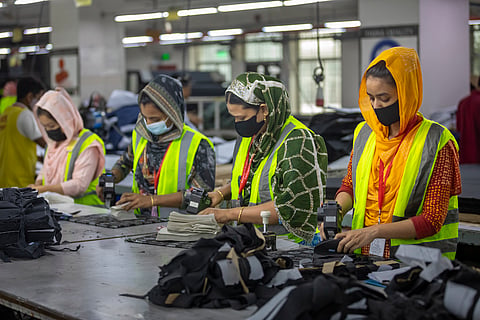
Trade deal with US offers major opportunity for Bangladesh’s RMG industry: Bengal Council
Bangladesh’s ready-made garment (RMG) industry could gain a significant competitive edge under the Bangladesh-US trade agreement, which provides a zero-tariff pathway for garments manufactured using the US-origin cotton, provided the arrangement is implemented effectively, Washington-based think tank The Bengal Council said on Wednesday.
In its policy brief titled The Cotton Corridor: Bangladesh’s Reciprocal Trade Agreement with the United States and the Path Forward, released earlier this week, the organisation said public discussion of the agreement has largely centred on the concessions made by Bangladesh, while overlooking its broader strategic and economic potential.
The report notes that while the agreement introduces substantial compliance requirements, its success will depend on effective implementation, strong institutional oversight, and parliamentary review.
Rather than viewing the agreement solely through the lens of tariff reductions or political controversy, the report argues that it should be understood as the beginning of a deeper and more structured economic partnership between the United States and Bangladesh.
"It is equally important to consider how Bangladesh can strategically manage the agreement to unlock its long-term economic and geopolitical benefits," it said.
The six-page brief evaluates the agreement across five key areas, including Bangladesh’s export economy, the commitments made under the deal, the broader geopolitical and commercial environment, opportunities for expanding bilateral economic cooperation, and the institutional capacity needed for successful implementation.
It also examines the agreement’s potential implications for Bangladesh’s relationships with the European Union, India, China, and other partners, while assessing how changes in US tariff policies could influence its future. Beyond trade, the report identifies opportunities to strengthen cooperation in investment, technology, supply-chain resilience, cybersecurity, and development finance.
To maximize the agreement’s benefits, The Bengal Council recommends eight policy measures, including the swift implementation of the zero-tariff cotton corridor, the establishment of formal parliamentary oversight, proactive management of relationships with third-country partners, the use of the agreement to accelerate domestic reforms, and closer coordination with other reciprocal-trade partners in future negotiations with Washington.
Bangladesh signed the Agreement on Reciprocal Trade (ART) with the United States in February this year.