
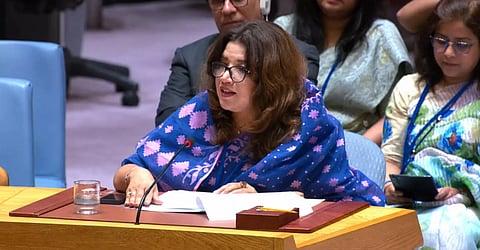
Ganges Water Treaty renewal moving in positive direction: Shama Obaed
State Minister for Foreign Affairs Shama Obaed Islam on Thursday said the issue of renewing the Bangladesh-India Ganges Water Treaty is moving in a positive direction.
“I hope India will understand its importance and come forward accordingly,” she told reporters at the Ministry of Foreign Affairs when asked about the renewal of the treaty.
The Bangladesh-India Ganges Water Treaty, which expires in December this year, needs to be reviewed and comprehensively reformed before a renewed agreement is signed, with economists, urban planners, sociologists and environmentalists involved in the process, experts say.
They said Bangladesh risks an inequitable sharing arrangement unless the treaty is updated to reflect current realities.
Officials said Bangladesh’s agriculture and food security would be severely affected, while the country’s climate vulnerability would increase substantially, if the treaty expires without a new water-sharing agreement in place.
The Ganges Water Treaty was signed on 12 December 1996 for a period of 30 years, making 2026 the final year covered by the agreement.
Bangladesh and India share 54 rivers, including the Ganges.
To discuss issues related to water cooperation, the two countries have an established bilateral mechanism, the Joint Rivers Commission.
Given the willingness and interest of both sides to reset bilateral ties, an arrangement for sharing the Ganges waters in an equitable and climate-resilient manner is expected to be one of the first major tests of that process.
Former Bangladesh High Commissioner to India Tariq A Karim said the 1996 Ganges Water Sharing Treaty demonstrated that cooperation is possible even on sensitive issues.
“But the treaty is due to expire in December 2026, and its renewal will test whether the region can adapt old agreements to new hydrological and climatic realities,” he said while speaking at a seminar recently.
The former diplomat, who also served as Bangladesh’s ambassador to the United States, said, “Across the wider region, water, food, energy, health, disaster management and climate resilience are regional public goods. No country can secure them alone.”
He said the imperatives of ecological integrity may therefore be South Asia’s strongest argument for renewed cooperation.
He suggested that the region consider shared river basin management, early warning systems, climate adaptation financing, joint research and a regional ecological security dialogue.
“Such cooperation would not require states to surrender sovereignty. It would require them to recognise that sovereignty in an age of climate stress is strengthened – not weakened – by cooperation achieved through pooling,” the foreign affairs expert said.
International affairs expert Prof Shahab Enam Khan recently said the Ministry of Foreign Affairs has significant preparatory work to do and stressed that data sharing would be crucial.
“We need to keep in mind that the situation in 1996 and 2026 is not the same. This cannot be viewed solely through engineering or diplomatic lenses. Economists, urban planners and sociologists should also be involved in the planning,” he said.