
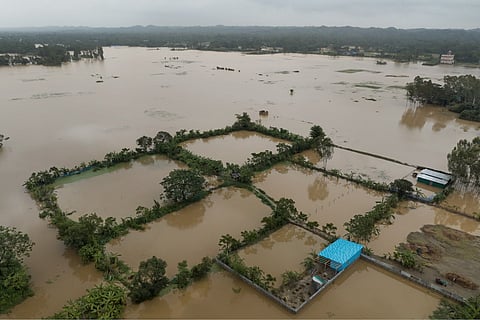
Floods in Chattogram deal 400cr taka blow to fisheries, livestock
More than a week of heavy monsoon rainfall, flash floods, and hill runoff has unleashed widespread devastation across Bangladesh. The disaster has left farmers facing catastrophic losses, with the fisheries and livestock sectors alone suffering an estimated damage of nearly 400 crore taka.
Floodwaters and strong currents swept away cattle, goats, sheep and poultry, while ponds, fish farms and shrimp enclosures were inundated. Millions of fish fry and market-size fish were washed away as embankments collapsed.
The worst-hit districts include Chattogram, Cox's Bazar, Rangamati, Khagrachhari, and Bandarban. Official estimates pin losses at 368.97 crore taka in the fisheries sector in 29 districts and 30.15 crore taka in the livestock sector. Field officials warn that the true scale of the financial damage will likely climb once floodwaters fully recede.
Over 112,000 livestock, poultry perish
Preliminary data from the Department of Livestock Services (DLS) show that 112,827 livestock and poultry have died in five districts of Chattogram Division — Chattogram, Cox’s Bazar, Rangamati, Khagrachhari and Bandarban.
The casualties include 45 cattle, 123 goats, 40 sheep, 111,098 chickens and 1,521 ducks.
The DLS also said nearly 300,000 livestock and 1.2 million poultry remain stranded in flood-affected areas.
At least 65 commercial livestock farms and 63 commercial poultry farms have been damaged. Large quantities of animal feed, hay, fodder and farm infrastructure have also been destroyed, raising concerns over prolonged shortages even after floodwaters recede.
According to the DLS, around 118 tonnes of concentrated animal feed have been destroyed, while nearly 12,000 tonnes of hay and dry fodder have become unusable after being submerged. Fodder crops cultivated on 2,126 acres have also been damaged.
34,000 ponds, farms submerged
The fisheries sector has suffered the largest financial loss. Government estimates show that 174.29 crore taka of losses reported from districts under Chattogram Division alone.
Strong currents caused by flash floods breached embankments of thousands of ponds, fish farms and water bodies, allowing large quantities of fish and fingerlings — including rui, katla, mrigal, tilapia, pangas, koi, shing and magur — to escape.
According to the Department of Fisheries, 30,036 ponds, lakes and fish farms across 602 unions have been affected, while another 3,884 enclosures have sustained damage.
In coastal areas, floodwaters breached shrimp farm embankments, allowing shrimp and fish to escape into nearby rivers and canals, wiping out farmers’ seasonal investments.
Fisheries officials said a final assessment of losses would be conducted after floodwaters recede.
More than 114,000 hectares of cropland affected
Heavy rainfall, flooding and hill runoff have affected more than 114,000 hectares of cropland across 43 districts, including Chattogram, Cox’s Bazar, Bandarban, Rangamati and Khagrachhari.
According to the Department of Agricultural Extension (DAE), 526,874 farmers have been affected so far.
The damaged crops include Aus paddy, Aman seedbeds, summer vegetables, ginger, turmeric, papaya and other crops.
DAE data shows that around 13.07 lakh hectares of land are currently under cultivation in the affected districts, meaning nearly 9 percent of cultivated land has been affected by flooding and excessive rainfall.
The affected areas include 79,550 hectares of Aus paddy, 10,504 hectares of Aman seedbeds and 17,800 hectares of summer vegetables.
Agricultural experts warned that extensive crop damage could disrupt food supplies and put further pressure on food prices.
"Prolonged waterlogging damages crops, particularly at the beginning of the Aman season," Abu Noman Faruq Ahmmed, Professor of Plant Pathology at Sher-e-Bangla Agricultural University, told Daily Waadaa. "Farmers have already started preparing Aman seedbeds. If seedbeds are destroyed in some districts, seedlings should be supplied from unaffected areas. Summer vegetables like onions and chilies are also vulnerable. The government must step in with support."
Md Obaidur Rahman Mondal, Director of the Field Services Wing at DAE, told Daily Waadaa that a comprehensive assessment is underway.
"The final assessment will determine the actual crop losses, estimate financial damage, and prepare a list of affected farmers," Obaidur said, adding that the government plans to distribute Aman seeds, early winter vegetable seeds, fertilizer, and other inputs to assist recovery.
Govt mobilizes emergency recovery support
At a press briefing at the Press Information Department (PID) in Dhaka on Tuesday, Agriculture Minister Mohammed Aminur Rashid detailed emergency agricultural interventions.
Highlighting that newly sprouted Aman seedlings suffered the worst damage, the minister announced that emergency seedbeds will be established on land owned by BADC, the Bangladesh Rice Research Institute (BRRI), and the DAE. These seedlings will be distributed as soon as water levels recede.
The recovery package will also target farmers who lost freshly applied fertilizers, using block-level agricultural records to identify beneficiaries. Additionally, the government will deploy livestock vaccination campaigns and supply cattle feed to help the livestock sector recover.