
The evening the tables turned on Hasina
By the evening of July 14, 2024, the anti-quota protest was already gaining momentum. Students had organized demonstrations, submitted memorandums, and demanded reforms to the quota system in government jobs after a High Court verdict restored the quotas that had been abolished by the government in 2018 following mass student protests.
Yet many who were there say the movement's defining moment did not come in the streets.
It came from a press briefing of the then Prime Minister Sheikh Hasina at her official residence, Gono Bhaban, after returning from an official visit to China.
Responding to a journalist's question about the ongoing anti-quota protests, she said: "If the grandchildren of freedom fighters do not get quota benefits, should the grandchildren of Razakars get them?"
By the evening, the remark reverberated across university campuses.
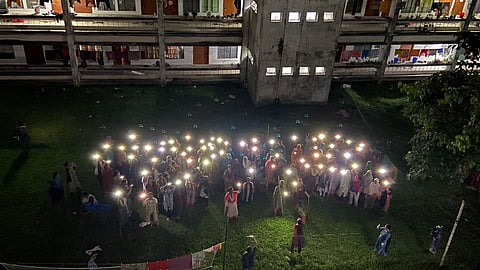
At the University of Dhaka, students poured out of their dormitories and onto the streets, chanting, "Who are you? Who am I? Razakar, Razakar."
The word Razakar usually refers to the auxiliary forces that collaborated with the Pakistani military during Bangladesh's nine-month Liberation War, and carries a deeply derogatory meaning among Bangladeshis.
But Hasina's remark, which protesters interpreted as branding them Razakars, did not scare them.
It infuriated them. Instead of being apologetic, they turned the label back on Hasina with defiance.
-Question of Dignity-
For many students, it was the night they stopped watching and started participating.
Maudud Hasan, then a fourth-year student of International Relations at the university, initially thought the High Court's order would be overturned by the Supreme Court, and he did not join the protests until that night.
When he returned to his room at Jasimuddin Hall that evening and heard Hasina's words, he felt a shift.
"After all these years of independence, whenever we tried to raise our voice, they tried to tag us as Razakars," he said. "We respect the freedom fighters from the core of our hearts. It's Hasina and her party that always exploited them to muzzle dissenting voices."

He joined the protest that night with the students who poured out of their dormitories in response to Hasina's remark.
For Maudud, the issue was no longer confined to the job recruitment process.
"After that night, everything changed. It was a question of dignity. Students like me, who had no political intent, joined the protest from that night," he said.
Residents of Haji Muhammad Muhsin Hall were the first to bring out a procession. Video clips quickly circulated in Facebook groups, prompting students from other residential halls to follow.
If the night transformed hesitant students into protesters, it also brought thousands of women onto the streets.
Students at Ruqayyah Hall broke the lock on the main gate to join the protests, as women's dormitories were supposed to remain locked after 9 p.m.
The rest of the halls followed suit.
Many female students came out carrying the utensils they used in their rooms.
Among those helping organize the female students was Tanjina Tammin Hapsa, now Assistant General Secretary (AGS) of the Bangladesh-Kuwait Maitree Hall Students' Union, who served as a coordinator of Students Against Discrimination during the movement.
Tanjina and her friends also had to break the lock on the main gate of Bangladesh-Kuwait Maitree Hall.
According to Tanjina, the demonstrations cut across political affiliations, with students of different beliefs and ideologies joining from the first week of July, when the protests began peacefully, including members of the now-banned Chhatra League.
But Hasina's infamous comment changed the tempo of the protests.
"It was a justified protest. How could she say something like that, tagging everyone as Razakars? She should have behaved reasonably," Tanjina said.
-Reclaiming the Liberation War-
Bangladesh has gone through a volatile political period since Sheikh Hasina came to power in 2009.
Her government initiated trials for crimes against humanity committed during the Liberation War more than 40 years after the country's defining event.
Critics argue that Hasina's government used the trials as a political weapon against the opposition instead of ensuring fair judicial proceedings.
The issue divided the country, as rights organizations such as Human Rights Watch (HRW) and Amnesty International repeatedly raised concerns that the tribunal's procedures fell short of international standards.
In the process, Hasina and her party were accused of claiming sole ownership of the Liberation War's legacy to silence opposition voices and shape public opinion.
Participants insist that chanting "I am Razakar, I am Razakar" was never an endorsement of the historical term. Instead, they describe it as an act of political irony—turning back a label they believed had repeatedly been used to delegitimize critics.
Samia Masud Momo, currently a fourth-year resident of Shamsunnahar Hall at the University of Dhaka, said she had experienced similar branding during the road safety protests in 2018.
"We thought, how long will this continue? This time we decided to reclaim it," Momo said.
For Momo, frustration had accumulated over the years.
"People were already cornered by 15 years of repressive rule. Hasina's remark ignited us like a matchstick. It sparked something in us that spread like wildfire," she added.
Two years later, participants still return to that evening when asked what changed.
Not the crackdown that followed. Not the speeches. Not even the marches.
They remember a single remark—and the night thousands of students answered it together.
Whether viewed as a moment of political miscalculation, a rhetorical flashpoint, or the catalyst for a broader movement, July 14 remains one of the most consequential nights in the story of the July Uprising that culminated in Sheikh Hasina's ouster on August 5, 2024, just three weeks later.
For those who marched out of their residence halls that evening, it was the moment when a campaign for quota reform became something far larger: a struggle over dignity, memory, and the meaning of citizenship.