
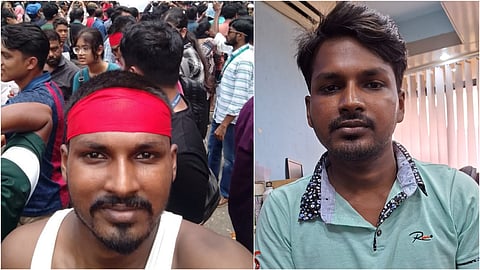
A verbatim: Tamim’s July survival story
"If I die in this movement, please make sure my body reaches my family."
Those were the words Tamim Iqbal recorded on his mobile phone as gunfire echoed around him and tear gas filled the air during the July 2024 uprising. Standing in an alley opposite the pocket gate of Jamuna Future Park, the Tejgaon College student believed he might not make it home alive.
Two years later, on July 18, Tamim looked back on the days that changed his life forever. His story is not only about surviving repeated attacks, but about enduring serious injuries and continuing to carry the physical and emotional scars of the movement.
For Tamim, the fear of death was real from the moment security forces opened fire on demonstrators. Yet, he says, he never considered turning back.
"I thought if I died, someone should at least return my body to my family," he recalled. "But in my heart I had already decided that if I had to die, it would be after the fall of the killer Hasina."
Tamim remembers July 18, 2024, as the day the country fell into silence after internet services were shut down. Two days later, a nationwide curfew came into force.
On July 21, the second day of the curfew, he joined around 70 to 80 fellow protesters marching towards Bashundhara Gate.
"We were moving forward when police suddenly began firing continuously and throwing tear gas," Tamim said.
Pellets struck the right side of his abdomen and his right thigh. Thick smoke covered the area as panic spread among demonstrators.
"I, along with three of my fellow protesters and a street vendor, was hit by gunfire," he said. "Even though we were unarmed, we did not lose our morale. We kept resisting with bricks and stones."
The violence did not end there. The protesters again gathered near Bashundhara Gate on July 27, where they faced members of Chhatra League and Jubo League.
"They first told us, 'You do your work, we'll do ours. We won't harm you,'" Tamim recalled, adding that the situation changed dramatically around 2pm.
"Suddenly, a RAB helicopter arrived over Pragati Sarani and began firing indiscriminately while also dropping tear gas."
As people desperately tried to escape, Tamim was crushed on the stairs of London Market at Bashundhara Gate, suffering a serious injury to his waist.
Later that day, he recounted the minutes when police beat him with batons and kicked him near the Bank Asia intersection, leaving the fourth and fifth discs of his spine badly damaged. Medical treatment was sought, but his pain never fully disappeared.
August 5 remains the defining day of the movement for Tamim. He recalled protesters assembling outside the Grameenphone office in Bashundhara Residential Area at around 10am, where police again opened sustained fire.
"After nearly two hours, the police ran out of ammunition and people began chasing them," he said. By noon, demonstrators had reached Bashundhara Gate, where army personnel arrived with armoured vehicles.
"We climbed onto the armoured vehicles and embraced the soldiers," Tamim recalled, adding the army then made an announcement over loudspeakers: "'We are with you. Not another bullet will be fired.'"
Shortly afterwards came the news the protesters had been waiting for.
"We learned that Hasina had fled the country." Although Tamim survived repeated attacks during the uprising, he says the cost has been lasting.
The injuries to Tamim’s body continue to affect him, particularly the spinal damage he suffered in July 2024.
He also believes the aspirations of those who participated in the movement remain only partially fulfilled.
"More than 2,000 martyrs and around 20,000 injured people had hopes and expectations," he said. "The interim government has not shown the pace we expected in fulfilling those aspirations."
Surviving the violence did not mark the end of Tamim’s journey; instead, it became the beginning of a different struggle.
To this day, Tamim is unable to return to the ordinary life he had before the uprising. However, the memories of gunfire, tear gas and the friends who stood beside him remain vivid.
Despite living with injuries sustained during those days, Tamim continues to remain active, believing the sacrifices made during the movement should not be forgotten.
Now, Tamim hopes to live long enough to carry forward the memories of those who did not return. Because to him, survival was never simply about escaping death.