
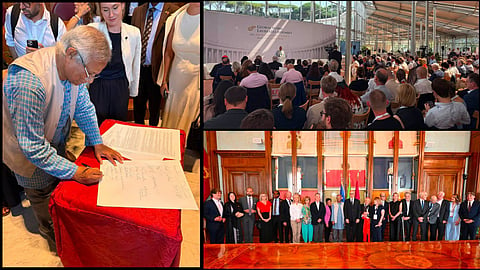
Professor Yunus joins Nobel Laureates in signing declaration on AI and nuclear weapons
Professor Muhammad Yunus joined fellow Nobel Laureates, including Romano Prodi, Jody Williams, Maria Ressa, Denis Mukwege, and Juan Manuel Santos, at the Global Nobel Laureates Assembly on Artificial Intelligence and Nuclear War, and signed a joint declaration warning that artificial intelligence and nuclear weapons together pose an unprecedented danger to humanity's future.
The Assembly opened at Borgo Laudato Si', Castel Gandolfo, with a ceremony featuring an opening address from Professor Yunus, alongside welcome remarks from Cardinal Fabio Baggio, C.S., President of Borgo Laudato Si', an opening address from Cardinal Ángel Fernández Artime, S.D.B., Pro-Prefect of the Dicastery for the Institutes of Consecrated Life and Societies of Apostolic Life, and introductory remarks from Cardinal Silvano Maria Tomasi, President Emeritus of the Domus Communis Foundation and President of the Global Nobel Laureates Assembly, said a press release.
Also taking part were Professor Daniel Holz, Chair of the Science and Security Board of the Bulletin of the Atomic Scientists; Cardinal Peter Turkson, Chancellor of the Pontifical Academies of Sciences; Archbishop Renzo Pegoraro, President of the Pontifical Academy for Life; a wider gathering of Nobel Laureates; and actress Sharon Stone.
On the second day of the Assembly, Professor Yunus took part in a high-level session on Artificial Intelligence, Democracy and the Economic Revolution: Toward a New World Order, where he delivered an address.

He also held a series of bilateral meetings on the sidelines of the Assembly, including with Cardinal Mauro Gambetti, Archpriest of Saint Peter's Basilica and President of the Fabric of Saint Peter, and Dr Qu Dongyu, Director-General of the Food and Agriculture Organization of the United Nations (FAO).
The three-day Assembly concluded on Thursday (July 16), with the signing of the declaration at Rome's Capitoline Hill. Titled "Humanity at the Threshold," the declaration draws a direct parallel between the dawn of the nuclear age and the current AI era, arguing that the world risks repeating the mistakes of the past by entering an AI arms race alongside a worsening nuclear one.
The laureates warn that AI is eroding human judgement in nuclear command systems, fuelling cyber threats to critical infrastructure, and enabling information warfare that undermines the shared trust nations need for peace.
Invoking Pope Leo XIV's call for an "unarmed and disarming peace," the signatories reject the idea that security can be built on fear or mutual destruction and instead set out six guiding principles. They urge restraint and cooperative governance to prevent AI and nuclear competition from shaping the coming century, while calling for greater transparency and accountability from AI developers, including an outright ban on unsupervised, fully automated recursive self-improvement in AI systems.
The declaration also calls for an international treaty to ensure AI is excluded from nuclear launch decisions and to protect nuclear infrastructure from cyber interference. It supports the UN's Independent International Scientific Panel on AI and the creation of new international institutions to oversee AI development, while emphasising the role of young people and education in addressing these emerging threats. The signatories further renew calls for the time-bound, verifiable elimination of nuclear weapons and for strengthening existing agreements, including the Non-Proliferation Treaty and the Treaty on the Prohibition of Nuclear Weapons.
The declaration closes by invoking Bertrand Russell and Albert Einstein's appeal to "remember your humanity, and forget the rest," framing the moment as one on which the survival of future generations depends.