
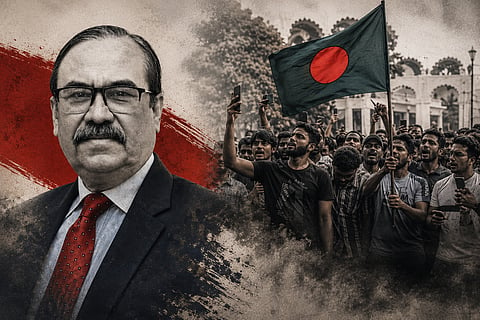
He asked, 'Can protests change verdicts?' Then history answered
Amid growing protests, on 4 July 2024, the Appellate Division of the Supreme Court upheld a High Court verdict restoring the 30% quota for freedom fighters' children in government jobs.
Leading a six-member bench, then chief justice Obaidul Hasan remarked: “Why have so many movements begun on the streets? Will you change the verdicts of the High Court and the Supreme by exerting pressure through the movement?”
The remark and the court’s decision reverberated across the country, with protests swelling further.
A change feverously hoped for had not transpired. The chief justice’s words sounded like mockery.
But this was not to be the end.
As the national situation grew increasingly volatile, the then chief justice softened his stance.
On July 11, 2024, he said, "The doors of the court are always open for the protesters."
The next hearing was scheduled for August 7.
But amid the intensifying movement and nationwide violence, the hearing was brought forward, and on July 21 the Appellate Division delivered its landmark verdict.
The ruling ordered that 93 percent of government jobs be filled on merit, with the freedom fighter quota reduced to 5 percent and all other quotas combined reduced to 7 percent.
However, despite the Appellate Division's verdict on July 21, the streets did not calm.
It was perhaps too little, too late.
On the same day, law enforcement agencies continued using force while a nationwide internet shutdown and curfew remained in effect.
On the same day, twenty-four hours after he was found in Purbachal following his disappearance, movement coordinator Nahid Islam alleged that he had been blindfolded, taken to an undisclosed location, and subjected to physical and mental torture.
That same day, amid the internet blackout, 56 coordinators issued a statement alleging that more than 300 people had been killed, declaring: "These killings cannot be absolved merely through a court verdict."
Former coordinator Asif Mahmud Shojib Bhuyain said after July 16, the movement was no longer limited to quota reform.
Demands for the home minister's resignation and a complete shutdown had become central to the protests.
On that single day alone, at least 19 people were killed across the country.
After Sheikh Hasina resigned and fled the country on August 5 amid the protesters' fury, Obaidul’s words and allegiance came back to haunt him.
On August 10, protesters surrounded the court premises and demanded Obaidul Hassan step down. His resignation was announced shortly after.
Then then went into hiding.
An allegiance, an unprecedented reception
Obaidul Hassan, who comes from a well-known Awami League family in Netrokona, was a former Chhatra League leader.
His brother, Sajjadul Hassan, was a former member of parliament and secretary, while his father, Dr Akhlakul Hossain Ahmed, was a close associate of Sheikh Mujibur Rahman.
After Obaidul Hassan became chief justice, Chhatra League activists greeted him with flowers inside the Supreme Court premises — an event widely regarded as unprecedented in the history of Bangladesh's judiciary.
Recalling the events, current Attorney General Barrister Ruhul Quddus Kajal said, "Faced with the movement, the former Chief Justice initially took one position but was later forced to change the verdict. That controversial judge is now a fugitive."
Escape in an ambulance
After news broke on the afternoon of August 5 that Sheikh Hasina had fled the country, Obaidul Hassan reportedly became alarmed at his official residence on Hare Road.
Fearing public anger, he quietly left the residence.
At around 2:00 pm, to ensure his safety, he boarded an ambulance waiting at the gate of his residence and quickly left Hare Road, taking shelter in a building used by Members of Parliament.
Later, he and three other judges staying in a flat on Minto Road were moved to a secure location by plainclothes intelligence personnel.
The former top judge, who had once dismissed the street protests, has remained in hiding ever since submitting his resignation letter.