
Govt to launch 'National Health Card' to bridge healthcare inequality: Fakir Mahbub
Posts, Telecommunications and Information Technology Minister Fakir Mahbub Anam has said the government is set to introduce a National Health Card to reduce the urban-rural healthcare divide and ensure every citizen has access to modern, quality healthcare.
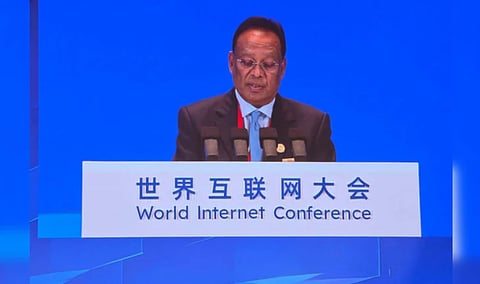
Speaking at a session titled "Digital and Intelligent Integration for Health – Towards a New Cooperative Ecosystem along the Silk Road" in Xi'an, China, Fakir Mahbub highlighted the transformative role of digital technologies and artificial intelligence (AI) in healthcare, according to a ministry press release.
The minister, who also oversees the Science and Technology Ministry, said the National Health Card would allow doctors to instantly access a patient's essential medical records from anywhere in the country, enabling faster, more accurate and better-coordinated diagnosis and treatment.
"It is not merely a technological innovation; it is a significant step towards ensuring equity in healthcare," he said.
"Our goal is to ensure that a patient in a remote riverine community receives the same standard of healthcare as one in a modern hospital in Dhaka."
Fakir Mahbub said the government is also formulating a human-centric National Artificial Intelligence Policy based on the principles of human rights, ethics, transparency and inclusive development.
He stressed that technological advancement must serve people's welfare and that no one should be left behind in benefiting from AI-driven innovation.
The minister said the government is simultaneously developing a robust data protection framework to safeguard citizens' personal health information, describing secure and trusted data management as essential to building a sustainable digital healthcare ecosystem.
He added that Bangladesh is promoting international partnerships, innovative technologies and AI-based solutions to improve healthcare services for marginalised communities, reaffirming the country's commitment to building an inclusive, equitable and technology-driven health system.
The remarks came at the Silk Road Forum, organised by the Secretariat of the World Internet Conference (WIC), also known as the Wuzhen Summit, with financial support from the Chinese government.
The forum brought together senior officials from the Cyberspace Administration of China, leaders of Shaanxi Province, representatives of the World Health Organization (WHO), and delegates from international organisations.
According to international analysts and leading Chinese media outlets, the forum's Digital Health Working Group has emerged as a key platform for advancing the digital transformation of healthcare under China's Belt and Road Initiative (BRI).
The conference, held in Xi'an, China, on 21–22 July, was attended by ministers, policymakers, technology experts and representatives of international organisations from Bangladesh, Cambodia, Algeria, Zambia, Cuba, Nicaragua, Morocco, Sudan, Tunisia, Russia, Brazil and several other countries.