
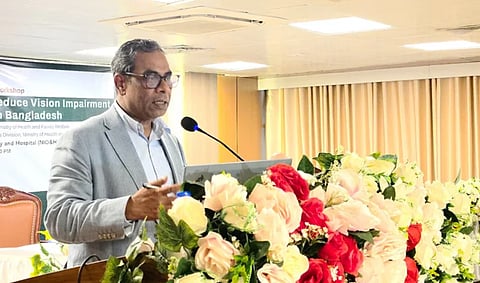
Bangladesh aims to eliminate cataract blindness within five years: Muhit
State Minister for Health Dr MA Muhit on Thursday expressed optimism that Bangladesh would eliminate cataract-related blindness within the next four to five years through a coordinated national initiative involving the government, the private sector and non-governmental organisations (NGOs).
"A nationwide cataract surgery programme will be implemented for elderly citizens, with several hundred thousand successful operations to be carried out annually to eliminate cataract-related blindness within the next four to five years," he said.
Muhit made the remarks while addressing a stakeholder consultation workshop titled "Advanced Eye Care in Bangladesh: Action Plan for Reducing Visual Impairment and Preventing Blindness" at the National Institute of Ophthalmology and Hospital in Sher-e-Bangla Nagar, Dhaka.
He said advanced eye care services powered by artificial intelligence (AI) and modern technology would be expanded to ensure quality treatment reaches poor and marginalised people as a basic right.
Muhit said Bangladesh has made significant progress in eye care through the combined efforts of the government, the private sector and NGOs, but still lacks a unified reporting system.
To address the gap, he said the government is preparing a five-year national perspective plan incorporating a common reporting mechanism to strengthen eye care services across the country.
Under the plan, the first year will focus on reassessing existing eye care facilities and planning services at district hospitals, followed by measures to improve infrastructure, recruit additional manpower where necessary and enhance service capacity.
The state minister said the government also plans to introduce comprehensive eye care services for people of all age groups.
As part of the initiative, school-based vision screening programmes will be launched to identify children with eyesight problems and provide corrective glasses, while workers in factories, offices and other institutions will receive regular eye examinations and access to spectacles.
Highlighting the growing burden of diabetic retinopathy, Muhit said modern technologies have significantly improved the delivery of eye care services at the grassroots level.
He stressed that advanced eye care should not remain confined to urban areas but must be made accessible to people living in remote and underserved regions.
Describing the shortage of skilled human resources as a major challenge, Muhit called for greater investment in training and capacity building for ophthalmologists and other eye care professionals.
He also underscored the need to expand both the number and quality of government and private training institutions.
Acting Director of the National Institute of Ophthalmology and Hospital Prof Dr ASMM Quadir also addressed the workshop, while representatives of the ARK Foundation and the World Health Organization (WHO) presented the keynote paper.