
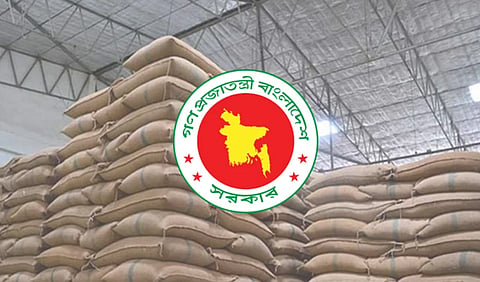
Govt targets 34 lakh tonnes food grain storage capacity
The BNP government is aiming to upgrade the country’s food grain reserve capacity to 34 lakh tonnes although Bangladesh currently holds an adequate satisfactory official reserve of food grains.
Bangladesh still holds a total stock of food grains reaching 23, 74,763 tonnes including floating reserves as of July 23, according to latest data from the Ministry of Food.
The current stock exceeds the country's standard safe food reserve threshold of 13, 50,000 tonnes by approximately 10, 24,000 tonnes, reflecting a robust food security system.
Meanwhile, the BNP government has decided to expand the overall food storage capacity across public warehouses to 34 lakh tonnes over the next five years.
The Ministry of Food has already started making the moves to achieve this target.
According to an updated report from the Directorate General of Food, public granaries currently store 19, 60,746 tonnes of rice and 2,95,689 tonnes of wheat.
Additionally, 1, 68,605 tonnes of paddy are in stock, which has been converted and factored into the total rice inventory while floating reserves of rice stand at 8,735 tonnes.
Under the ongoing domestic Boro procurement drive for the 2025-2026 fiscal year, a total of 13, 65,431 tonnes of paddy and rice were collected till July 23.
This comprises 4,59,498 tonnes of paddy, 9,89,420 tonnes of parboiled rice, and 76,814 tonnes of sun-dried (Atap) rice.
A total of 523 tonnes of wheat was also procured during this period.
In the first 23 days of the current 2026-27 fiscal year (July 1 to July 23, 2026), 3,20,800 tonnes of food grains were imported into the country. Of this, public sector imports amounted to 11, 65,000 tonnes; consisting of 7,83,000 tonnes of rice and 3,82,000 tonnes of wheat.
Private sector imports totalled 3,09,150 tonnes, including 2,94,000 tonnes of rice and 15,150 tonnes of wheat.
However, no imports were required under food assistance during this period.
Offices under the Ministry of Food reported that food grain reserves and procurement operations are being closely monitored to maintain adequate market supply, stabilize prices, and ensure smooth public distribution.
Talking to BSS, Mohammad Kamrul Islam Chowdhury, Joint Secretary of the Procurement Branch of the Ministry of Food, said this year’s food grain procurement drive has been implemented successfully.
“Our domestic food grain procurement drive for the current season is being implemented successfully and satisfactorily,” he said, thanking farmers and other stakeholders involved in the procurement drive.
"Public warehouses currently maintain adequate and safe stocks of rice and wheat and this inventory provides a strong foundation to navigate any situation and ensure national food security,” he said.
He added that the government is fully prepared to stabilize rice prices in the market and ensure uninterrupted food distribution under social safety net programs.
Firoz Al Mahmud, Research Director of the Food Planning and Monitoring Unit (FPMU) under the Ministry of Food, told BSS that the government is continuously working to align reserves and storage capacity with growing national demand.
Addressing overall procurement and supply management, Md. Jamal Hossain, Additional Director General of the Directorate General of Food, said the current food security situation is extremely satisfactory.
“Besides ensuring sufficient grain stocks in public warehouses, we place maximum emphasis on proper storage and quality preservation," he noted.
He noted that Boro paddy and rice procurement from marginal farmers is being conducted through a transparent and disciplined process across the country, ensuring fair prices for farmers.
He added that warehouse supply lines remain active to support public distribution programs such as OMS and the Food-Friendly Program.
"Previously, our storage capacity was around 24 lakh tonnes, which has now been increased to 27 lakh tonnes," he added.
He said that work is underway to meet the BNP government's manifesto target of upgrading food grain reservation capacity to 34 lakh tonnes by the next five years.
Around 13,50,000 tonnes has long been viewed as the safe reserve benchmark but the present government has decided to upgrade the safe food reserve target to 16 lakh tonnes to account for population growth and expanded social safety net programmes, he also noted.