
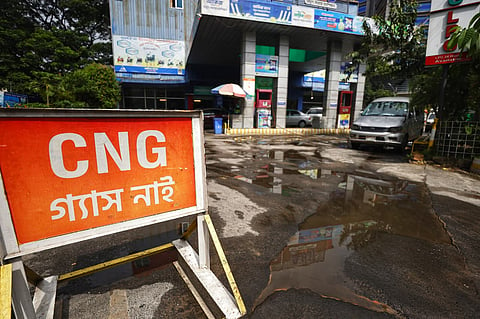
Govt fast-tracks new LNG terminal at Maheshkhali amid acute gas crisis
The government has moved to fast-track the installation of a new Floating Storage and Regasification Unit (FSRU) at Kutubjom in Maheshkhali, Cox's Bazar, as Bangladesh grapples with an acute natural gas shortage exacerbated by the recent fire at an existing LNG terminal.
The Cabinet Committee on Economic Affairs, chaired by Finance Minister Amir Khasru Mahmud Chowdhury, on Tuesday gave policy approval to process a proposal submitted by China's China National Energy Engineering & Construction Co Ltd (CNEE) to develop the Kutubjom FSRU under a government-to-government (G2G) arrangement.
The proposal was placed by the Energy and Mineral Resources Division.
The approval marks the first formal step towards developing another LNG import terminal at Maheshkhali, a move officials say has become increasingly urgent following the disruption to gas supplies caused by the recent fire at one of the country's operational FSRUs.
Bangladesh relies heavily on imported liquefied natural gas (LNG) to offset the steady decline in domestic gas production. Imported LNG is regasified through floating terminals before being supplied to the national transmission network.
The recent fire at an FSRU significantly reduced regasification capacity, forcing Petrobangla to curtail gas supplies to industries, power plants, fertiliser factories and households.
The incident exposed the country's heavy reliance on a limited number of LNG terminals and highlighted the lack of sufficient backup capacity in its import infrastructure.
The disruption has further intensified the country's gas crisis. According to official estimates, Bangladesh's daily gas demand is around 3,800 million cubic feet (MMCFD), while supply has fallen to about 2,700 MMCFD, leaving a shortfall of around 1,100 MMCFD.
The shortage has affected industrial production, electricity generation and household consumers across the country.
Business leaders, particularly from the textile and garment sectors, have repeatedly urged the government to restore adequate gas supplies, saying many factories are operating far below capacity because of extremely low pipeline pressure.
During recent meetings with business representatives, the government indicated that decisions on expanding LNG import infrastructure would be taken soon as part of broader efforts to strengthen energy security.
The proposed Kutubjom FSRU is expected to strengthen Bangladesh's LNG import network by adding regasification capacity and reducing the risks associated with dependence on only a few floating terminals.
Bangladesh began importing LNG in 2018 through its first floating terminal at Maheshkhali to compensate for declining domestic gas production. Since then, LNG has become an increasingly important part of the country's energy mix, supplying gas to power plants, industries and other sectors.
Although detailed technical specifications, investment costs and implementation timelines have yet to be disclosed, the proposed Kutubjom FSRU is expected to improve the resilience of Bangladesh's gas supply system by diversifying its LNG import infrastructure and reducing the impact of disruptions at individual terminals.