
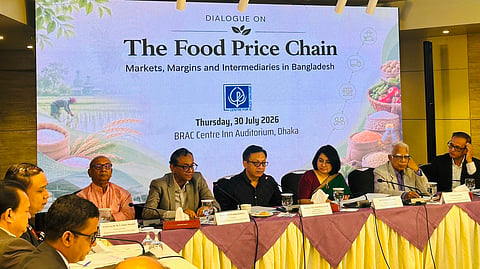
Cut logistics, input costs to rein in food inflation: Commerce Minister
Commerce Minister Khandakar Abdul Muktadir on Thursday said reducing logistics and input costs, eliminating informal expenses and improving agricultural productivity are essential to containing food inflation, as a new study identified inefficient supply chains rather than production costs as the main driver of rising food prices in Bangladesh.
Speaking as the chief guest at a dialogue titled, “The Food Price Chain: Markets, Margins and Intermediaries in Bangladesh” at the BRAC Centre Inn Auditorium in Dhaka, the minister said farmers continue to suffer from inadequate market information, resulting in poor production decisions and lower returns.
Citing the potato sector, he said farmers have continued producing similar volumes despite receiving poor prices for several consecutive years, suggesting they lack timely market information and production guidance.
"Market information asymmetry continues to disadvantage farmers," he added.
The minister also announced that the government is working to introduce a traceability system across agricultural supply chains to identify where abnormal costs and excessive price increases occur between production and retail markets. He stressed the need to reduce informal costs throughout the marketing system.
Longer supply chains push up food prices
Presenting the study, Foqoruddin Al Kabir, Senior Research Associate at the Centre for Policy Dialogue (CPD), said Bangladesh's persistent food inflation is being driven less by production costs than by inefficient supply chains, supply shortages, hoarding and trader collusion.
The study found that the longer the supply chain between producers and consumers, the higher the retail price of essential commodities, with some products recording farm-to-retail price increases of more than 100 percent.
Green chilli recorded the highest increase at 116 percent, followed by medium-grade rice (100 percent), native onion (87 percent), lentil (78 percent), brinjal (72 percent) and potato (50 percent).
By contrast, products with shorter supply chains experienced much smaller price increases. Farm-to-retail prices increased by 25 percent for eggs, 22 percent for broiler and Sonali chicken, 13 percent for beef and 10 percent for Rui fish.

According to the study, supply shortages, trader collusion and hoarding are the principal factors behind elevated food prices, while multiple intermediaries further widen the gap between farm-gate and retail prices.
The report suggests that streamlining supply chains and reducing unnecessary intermediaries could help moderate food prices and improve market efficiency.
CPD also found that farmers, millers, urban traders and retailers account for the largest share of consumers' expenditure in terms of gross margins. However, producers of beef and broiler chicken are operating with negative net market margins, largely because of rising feed costs.
The study further notes that retailers rely heavily on urban traders for sourcing products, giving these intermediaries considerable market influence and contributing to greater price volatility and bargaining power imbalances.
Addressing the impact of inflation on households, Foqoruddin said the burden falls disproportionately on poorer families.
"The poorest 5 percent of households spend 59.8 percent of their total expenditure on food, whereas the richest 5 percent spend only 28.9 percent. As a result, the impact of inflation is far more severe for the poor," he said.
The research was based on surveys conducted in 10 randomly selected retail markets across the Dhaka Division using the Bangladesh Bureau of Statistics (BBS) sampling frame. Researchers interviewed 500 retailers and a total of 820 market participants, tracing the movement of 10 essential commodities from producers to retailers while documenting production costs, buying and selling prices, marketing expenses and margins at every stage of the supply chain.
The CPD recommended improving transparency in agricultural markets, enhancing competition, reducing unnecessary intermediaries and strengthening supply chain efficiency to stabilise the prices of essential food commodities.
The dialogue was chaired by CPD Executive Director Dr Fahmida Khatun. Among the discussants were Professor Dr MA Sattar Mandal, former vice-chancellor of Bangladesh Agricultural University; former finance secretary Siddiqur Rahman; former National Board of Revenue chairman Abdul Majid; and Taslima Akter Lima, president of Bangladesh Garments Workers' Solidarity.