
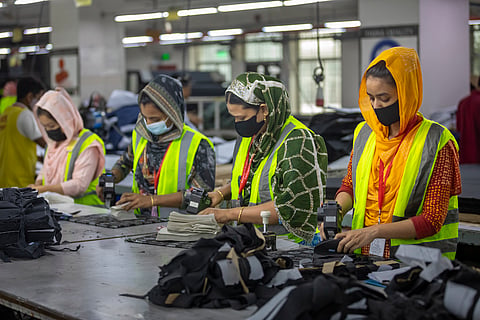
Gas crunch disrupts production at Ashulia garment factories, raises shipment fears
A severe gas shortage over the past several days has disrupted final-stage production at ready-made garment (RMG) factories in Ashulia, one of the country's largest industrial hubs, raising fears of delayed export shipments and possible penalties from overseas buyers.
Factory owners and industry insiders said inadequate gas pressure has left boilers operating well below capacity, bringing crucial finishing processes – including washing, drying, dyeing, ironing and packaging – to a near standstill.
The disruption comes as Bangladesh's garment industry exports products worth between $130 million and $140 million every day, making timely production critical to meeting buyers' deadlines.
A visit to factories in Jamgora, Kathgara, Zirabo, Narsinghpur, Beron, Shimultala, Palashbari, Nishchintapur, Baipayl and Jirani found that gas-dependent sections of production had been hit hardest. In some factories, workers are waiting idly for operations to resume, while others are attempting to continue production on a limited scale using alternative arrangements.
Garment factory owner Mohammad Ali said most manufacturing work had already been completed, but the absence of adequate gas pressure meant boilers could not be operated.
"Without the boilers, we cannot complete the finishing and ironing process. As a result, we cannot pack the garments or send them to the port, creating a real risk that shipments will miss their scheduled deadlines," he said.
Another factory official, Abu Taleb, said delayed deliveries often result in financial penalties from international buyers and could also jeopardise future export orders.
The crisis has also disrupted workers' daily routines, with many reporting that they spend hours waiting after arriving at work because production cannot begin without gas.
Worker Imtiaz said employees regularly report for duty in the morning only to find they cannot start work due to the gas shortage.
Another worker, Raihan, said the same situation had been recurring almost every day, with no certainty over when gas supplies would return.
Industry insiders said hundreds of factories in Ashulia export garments to Europe, the United States and other international markets every day, meaning any slowdown affects not only individual manufacturers but also the country's broader export supply chain.
They noted that while some factories have explored alternative fuel options, these are limited and significantly increase production costs.
Factory owners said low gas pressure in the industrial zone is not a new problem, but described the current crisis as the worst in recent years, making it increasingly difficult to maintain production schedules.
They urged the authorities to take immediate steps to ensure an uninterrupted gas supply to the industrial belt.
Garment factory official Din Islam warned that delays in delivery can prompt international buyers to shift their sourcing to competing countries at a time of intensifying global competition.
"Once a buyer is lost, it is not easy to win them back," he said.
Workers also expressed concern that if the crisis persists, factories may be forced to reduce overtime or even scale back production, although most manufacturers are currently trying to keep operations running.
Responding to the situation, Abu Saleh Muhammad Khademuddin, manager of Titas Gas's Ashulia Zonal Marketing Office, said efforts are underway to identify the cause of the disruption and restore normal gas supplies.
"Necessary measures are being taken to normalise the situation. However, it is not yet possible to say when gas supplies will fully return to normal," he said.
The gas shortage follows a technical fault at the floating storage and regasification unit (FSRU) in Moheshkhali, Cox's Bazar, on July 21 which normally supplies 500 million to 550 million cubic feet of gas a day to the national grid.
On July 27, State Minister for Power, Energy and Mineral Resources Aninda Islam Amit said the operator expected the FSRU to resume supplying 280 million to 300 million cubic feet of gas per day from next week.
"If they can restore about 50% of the supply next week, the plan is to return to 100% capacity in the following week," he said.
Factory owners, workers and exporters urged the government to restore normal gas supplies as quickly as possible, warning that every additional day of disruption increases pressure on production, export shipments and the country's export earnings.