
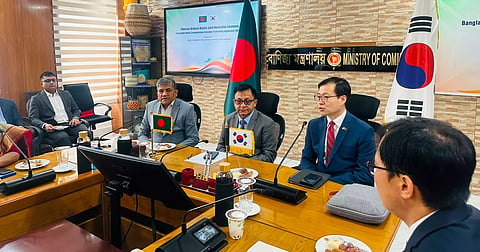
Bangladesh concludes South Korea CEPA talks, secures duty-free access for 8,428 products
Bangladesh has secured immediate duty-free access for 8,428 products in the South Korean market after successfully concluding negotiations on the Bangladesh-South Korea Comprehensive Economic Partnership Agreement (CEPA), marking a significant milestone in the country's trade diplomacy ahead of its graduation from least developed country (LDC) status.
The conclusion of the negotiations was jointly announced on Tuesday by Commerce Minister Khandaker Abdul Muktadir and South Korean Trade Minister Yeo Han-koo at the Ministry of Commerce.
Under the agreement, South Korea will receive duty-free access for 1,054 products in the Bangladesh market once the CEPA comes into force following the completion of legal formalities and cabinet approvals in both countries.
Bangladesh's major export items, including ready-made garments (RMG), leather and leather products, and footwear, will enjoy duty-free entry into the South Korean market from the day the agreement becomes effective.
The Ministry of Commerce said the CEPA is expected to expand bilateral trade, attract higher levels of South Korean investment, promote technology transfer and generate new employment opportunities in Bangladesh.
The agreement was negotiated through a structured process that began after both countries finalised the Terms of Reference (ToR) and established separate Trade Negotiating Committees, supported by 11 joint Technical Working Groups comprising representatives from relevant ministries and agencies.
Formal negotiations commenced in Seoul from August 22 to 27, 2025. The two sides completed the talks through five negotiation rounds—three held in South Korea and two in Bangladesh—while nearly 40 virtual meetings between the chief negotiators helped resolve outstanding issues before the negotiations were concluded.
Beyond merchandise trade, the CEPA also includes extensive commitments in the services sector. Bangladesh has agreed to open 95 service sub-sectors to South Korea, while South Korea will open 111 service sub-sectors across four modes of supply for Bangladesh.
According to the ministry, these commitments are expected to deepen economic cooperation, facilitate greater Korean investment and strengthen long-term commercial ties between the two countries.
As Bangladesh prepares to graduate from LDC status, the agreement with South Korea—the world's 15th-largest economy—is expected to help maintain the country's export competitiveness by ensuring continued preferential market access after graduation.
The ministry described the conclusion of the CEPA negotiations as one of the government's 180-day priority programmes, achieved under the guidance of the commerce minister and through the efforts of the negotiating teams.
Commerce Secretary Ataur Rahman Khan, Bangladesh's Chief Negotiator Ayesha Akter, Additional Secretary (FTA) of the Ministry of Commerce, South Korea's Chief Negotiator Park Geun-oh, Director General of Trade Agreement Policy, and Bangladesh's Deputy Chief Negotiator Feroz Uddin Ahmed, among others, attended the announcement.
Lutfey congratulates commerce team
Former Special Envoy on International Affairs to the Chief Adviser Lutfey Siddiqi welcomed the conclusion of the Bangladesh-South Korea CEPA negotiations, describing it as a milestone in the country's economic diplomacy.
In a Facebook post on Tuesday, Lutfey congratulated the negotiating team led by Commerce Minister Khandaker Abdul Muktadir and said the agreement built on initiatives launched during the interim government's tenure.
He said that after joining the interim government in September 2024, he pushed for Bangladesh to adopt a more proactive approach to economic diplomacy despite pressing challenges, including banking sector instability, foreign exchange reserve pressures, inflation and industrial unrest.
According to Lutfey, Bangladesh had not completed a free trade agreement with any country before the interim government began intensifying negotiations with key trading partners. He said the government initiated or accelerated talks on trade agreements with South Korea, Japan, Singapore and the United Arab Emirates, alongside discussions with other countries.
Lutfey said the government strengthened coordination among ministries, kept negotiating teams intact during critical stages of the talks and linked trade negotiations with broader reforms in labour, investment and banking.
He also claimed that the interim government completed Bangladesh's agreement with Japan in record time, creating a framework that helped facilitate subsequent negotiations, including the CEPA with South Korea and discussions with the Office of the United States Trade Representative (USTR).
"We created a format, style and muscle-memory of economic diplomacy that I hope will endure for years to come," he wrote.
Lutfey also welcomed South Korean Trade Minister Yeo Han-koo's visit to Bangladesh and said it was appropriate that the minister met Chief Adviser Professor Muhammad Yunus during the trip.