
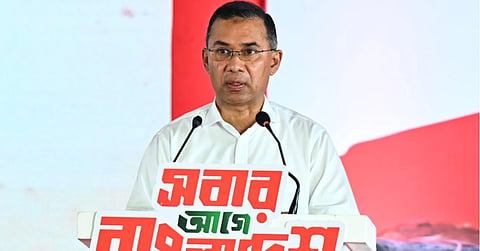
PM warns against attempts to create instability, aid return of fallen autocracy
Prime Minister Tarique Rahman on Wednesday warned that attempts to create unnecessary controversies and instability in post-fascist Bangladesh could inadvertently pave the way for the return of the ousted authoritarian forces, urging all to carefully consider the consequences of such actions.
"I would like to draw the attention of the people to one issue today. In a Bangladesh freed from fascism, some are trying to create unnecessary issues and destabilise the country. We need to consider whether, knowingly or unknowingly, such actions are facilitating the return of the defeated, deposed and fugitive authoritarian forces," he said.
The Prime Minister made the remarks while addressing a discussion titled "July 36" after inaugurating the July Mass Uprising Memorial Museum at Sher-e-Bangla Nagar in the capital on the occasion of July Mass Uprising Day.
Tarique Rahman formally inaugurated the July Mass Uprising Memorial Museum at Ganobhaban (the residence of the former prime minister) on the northern side of the Jatiya Sangsad Bhaban around 9:00am, marking the formal opening of a museum dedicated to preserving the memories of the 2024 July mass uprising.
Former interim government Chief Adviser Prof Muhammad Yunus attended the programme as a special guest.
The Prime Minister said the democracy-loving people of Bangladesh expect the museum to serve as a national institution preserving the country's democratic struggles rather than becoming a platform for promoting the political narrative of any single party, group or individual.
"The 2024 mass uprising did not belong to any one individual, group or political party. The true heroes of the uprising are the democratic people of Bangladesh," he said.
Tarique Rahman said the museum should preserve not only the memories of the July-August 2024 mass uprising but also the broader history of Bangladesh's democratic movements.
He said the museum will present future generations with both the courage and sacrifices of those who fought for democracy and the realities of authoritarian rule, while permanently preserving the nation's struggle, sacrifice, pain, courage and democratic aspirations.
The Prime Minister said the museum should include photographs, documents, personal belongings of the martyrs, testimonies of the injured, newspaper reports, graffiti, posters, cartoons, poems, songs, paintings and digital archives related to the July uprising.
He said exhibits should be based on facts and authenticity, warning that incomplete, exaggerated or politically motivated narratives weaken the credibility of history and create divisions for future generations.
Tarique Rahman also suggested presenting museum exhibits in English and other international languages alongside Bangla so foreign visitors can better understand Bangladesh's democratic journey.
Paying tribute to those killed in anti-fascist movements, he said thousands of people had been subjected to enforced disappearances, abductions and repression during more than one and a half decades of authoritarian rule, while students, workers, women and children lost their lives during the July-August uprising.
The Prime Minister expressed deep respect for all those who were killed in democratic movements and during the July mass uprising and sympathy for their families.
Reaffirming his government's commitment to accountability, he said all crimes committed during the anti-fascist movement will be tried through due legal process to ensure transparent, impartial and credible justice.
Tarique Rahman also announced that the government has decided to name at least one institution in the respective localities after each person killed during the anti-fascist movement over the past 17 years and the July uprising.
Recalling his oft-repeated remark, the Prime Minister said the 1971 Liberation War was fought to achieve independence, while the 2024 mass uprising was fought to protect the country's independence and the people's freedom.
He said the government is providing free treatment for the injured July fighters in public hospitals, while those critically injured are being sent abroad, including to Thailand, Singapore, Türkiye and Russia, for advanced medical care.
Tarique Rahman said 50 July fighters are currently undergoing treatment overseas, while more than 13,000 gazetted July fighters are receiving monthly honorariums through their bank accounts.
He said the government has also begun implementing its 31-point election manifesto and the July Charter signed at the South Plaza of Parliament as part of efforts to rebuild the state and fulfil the aspirations of those who sacrificed their lives.
The Prime Minister thanked architects, historians, researchers, museum experts, artists, collectors and all others involved in establishing the museum and expressed hope that Bangladesh will never again become a subservient state.
Following the inauguration, the Prime Minister toured the museum with Prof Yunus.
The museum houses photographs of the July uprising, belongings of the martyrs, letters, important documents, newspaper clippings, audio-visual materials, and exhibits depicting enforced disappearances, state repression, attacks on political opponents and the killings during the 2024 uprising, as well as the circumstances surrounding the fall of the previous regime.
The programme began with the playing of the national anthem, followed by recitations from the Holy Quran and other religious scriptures.
Family members of several July uprising martyrs, including the mothers of Shariar Khan Anas and Abdullah Bin Jahid, as well as July warrior Tabassum Parpti, shared their memories and reflections during the event.
Cultural Affairs Minister Nitai Roy Chowdhury, State Minister Ali Newaz Mahmood Khyom, Prime Minister's Adviser on Information and Cultural Affairs Zahed Ur Rahman, and Cultural Affairs Secretary Kaniz Moula also addressed the programme.
Local Government, Rural Development and Co-operatives Minister Mirza Fakhrul Islam Alamgir, Home Minister Salahuddin Ahmed, Power, Energy and Mineral Resources Minister Iqbal Hassan Mahmood, Liberation War Affairs Minister Ahmed Azam Khan, Prime Minister's daughter Zaima Rahman, members of civil society, families of the July martyrs, injured July warriors, and foreign dignitaries were present.
Acting Speaker Barrister Kayser Kamal, cabinet members, lawmakers, chiefs of three services, diplomats, eminent citizens, academics and senior government officials also attended the programme.
Former Prime Minister Sheikh Hasina fled Bangladesh for India on August 5, 2024, amid a student-led mass uprising. Her official residence, Ganobhaban, was subsequently vandalised by angry protesters.
On August 8, 2024, an interim government, led by Prof Muhammad Yunus, assumed office. During its tenure, Ganobhaban was transformed into the July Mass Uprising Memorial Museum to preserve photographs, documents and other artefacts related to the July uprising and its historical significance.