
As crises multiply across South Asia, the humanitarian safety net begins to fray
Nearly nine years after about a million Rohingya fled a campaign of violence and persecution in Myanmar, an emergency that once commanded the world’s attention has settled into something more enduring and, in some ways, more difficult to confront.
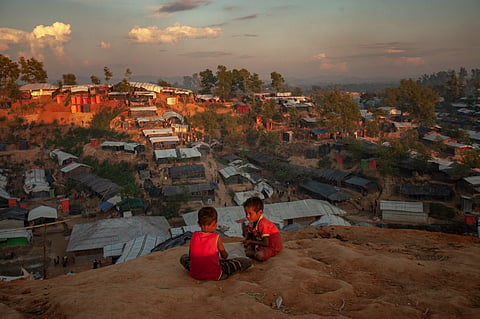
The sprawling refugee settlements of Cox’s Bazar remain crowded. Thousands of Rohingya have continued to cross the border as Myanmar’s civil war makes life increasingly precarious in Rakhine State. Water and sanitation remain inadequate, health services are stretched, and humanitarian funding is shrinking.
For the refugees, the consequences can increasingly be measured in illness.
“It’s become a protracted crisis,” Elko Brummelman, the Bangladesh country representative for Doctors Without Borders, known by its French initials, MSF told Daily Waadaa.
The displacement, of course, did not begin in 2017. Rohingya had been seeking refuge in Bangladesh for decades. But the extraordinary exodus that year transformed a long-running persecution into one of the world's largest refugee emergencies.
Almost a decade later, the emergency has not disappeared. Instead, it has become embedded in the landscape — prolonged enough to recede from international attention, but unresolved enough to keep producing new humanitarian needs.
And the Rohingya are hardly alone.
Emergencies are beginning to overlap
South Asia is home to some of the world's fastest-growing economies, expanding cities and largest populations. It is also confronting humanitarian pressures of a scale that increasingly tests the distinction between an emergency and ordinary life.
The region faces the continuing Rohingya displacement in Bangladesh, the needs of displaced Afghans, recurring emergencies in Pakistan and humanitarian challenges in parts of India,Parthesarathy Rajendran, executive director of MSF South Asia told Waadaa.
Layered over those pressures is a changing climate.
Floods, landslides and extreme weather are becoming more frequent and destructive across a region considered among the most vulnerable to climate change. Dengue has spread more widely, while Nipah and other diseases that can pass from animals to humans remain persistent public-health concerns.
“Climate crisis is not just an environmental issue,” Rajendran said. “It is increasingly a health and humanitarian crisis.”
The difficulty, he said, is that preparedness has not necessarily kept pace.
International donors have devoted considerable attention to mitigating climate change, Rajendran said, but less to strengthening preparedness, building health capacity and planning for emergencies that may arrive simultaneously.
That distinction matters. A hospital or health system capable of managing a flood may not be equipped to handle a flood, a dengue outbreak and a large displaced population at the same time.
The emerging challenge for South Asia, Rajendran said, is therefore not simply how to respond to the next disaster. It is how to build health systems capable of absorbing several shocks without collapsing under their combined weight.
Few places illustrate the consequences of a weakened safety net more starkly than the Rohingya camps.
About 1.2 million Rohingya now live in and around the camps of Cox’s Bazar. Their movement is restricted, and opportunities for formal employment and education are severely limited. The restrictions have left an enormous population dependent on an international humanitarian system whose resources are diminishing.
“Containment in this case means a population that's dependent on humanitarian aid,” Brummelman said.
That dependence presents an increasingly uncomfortable contradiction.
Humanitarian policy often speaks of resilience and self-reliance. But for refugees who have limited ability to work, study or move outside the camps, the opportunities to become self-reliant are themselves restricted.
The consequences extend directly into health.
Crowded settlements make infectious diseases easier to transmit. Limited supplies of safe water and inadequate sanitation increase the threat of diarrhea, cholera and other illnesses. At the same time, refugees require treatment for the same chronic conditions found elsewhere — diabetes, hypertension and other diseases that demand continuing care rather than an emergency intervention.
Then there is the psychological toll of displacement.
MSF provided more than 70,000 mental-health and psychiatric consultations in the camps last year, according to the organization. It also treats roughly 3,500 cases of sexual and gender-based violence annually, along with a similar number involving other forms of violence.
“The combination of tension, hopelessness and violence can further affect people's mental health,” Brummelman said.
For a population that has endured persecution, displacement and years of uncertainty, the medical consequences cannot easily be separated from the political circumstances that produced them.
As the money recedes, the consequences move into hospitals
The humanitarian system sustaining the camps is now confronting another problem: less money.
Funding cuts are already being felt in health facilities, Brummelman said. Some have fewer staff and shortages of medicine; others face the possibility of closing altogether.
The effects ripple through the camps. Patients wait longer for treatment. Some must travel farther to find care. Increasingly, Mr. Brummelman said, patients are arriving at MSF facilities because health centers closer to them cannot provide the treatment they need.
But health care is only one part of an interconnected system.
International organizations and local groups in Cox’s Bazar rely on donor support to provide water and sanitation, nutrition, education and protection. Each can affect health, sometimes in ways that become apparent only after services deteriorate.
At MSF’s hospital in Kutupalong, a recent study found that children were arriving later and with more severe and complicated illnesses, Mr. Brummelman said.
What happens inside a hospital, he cautioned, can therefore be the final stage of problems that began elsewhere — with sanitation, nutrition, access to transportation or the disappearance of another health service.
“It’s all those things that are connected,” he said.
Rajendran pointed to a large scabies outbreak as an example of how quickly deteriorating hygiene and sanitation can become a medical emergency. Further reductions in humanitarian services, he warned, could multiply the consequences.
The danger is particularly acute because the Rohingya emergency is not a static crisis involving only those who arrived in 2017.
New refugees have continued to enter Bangladesh as the war in Myanmar has intensified. Some have described being forced from their villages or being recruited into the conflict. MSF has also treated patients suffering from land-mine injuries near the border, although the organization said it could not determine who had laid the mines.
Yet every new arrival enters a humanitarian system with fewer resources than before.
The Rohingya crisis must also compete for diplomatic attention and donor money with wars and emergencies from Gaza and Sudan to Ukraine and elsewhere. What was once treated as an urgent international crisis risks becoming another unresolved catastrophe that the world has learned to accommodate.
Rajendran said governments, international organizations and humanitarian groups needed a collective effort to keep the Rohingya on the international agenda. Medical organizations like MSF can document what they see in clinics and hospitals, he said, while Bangladesh can use its diplomatic position, including at the United Nations, to maintain international pressure.
But medicine has limits.
Humanitarian organizations can vaccinate children, treat infections, provide psychiatric care and respond to outbreaks. They cannot resolve the political circumstances that keep more than a million people in refugee camps.
That requires a political settlement and conditions in Myanmar that would allow the Rohingya to return safely and with dignity, Rajendran said.
Bangladesh has shouldered an enormous burden by hosting the refugees, he added, and the international community must both support the country and press for a durable solution.
For all the years spent in Bangladesh, he said, the aspirations of many Rohingya have changed remarkably little.
“They don't want to stay in Bangladesh,” Rajendran said. “Of course, they want to go back.”
For now, however, a safe and dignified return remains out of reach, he added.
—