
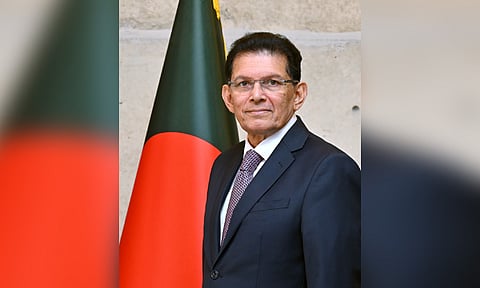
Mecca Pact: FM says no reason for anyone to be upset or worried
AI generated summary, newsroom reviewed
Foreign Minister Dr Khalilur Rahman on Sunday reiterated that the "Mecca Pact" is an internal matter of the world Muslim family" and that there is no reason for anyone to be upset or worried about this.
“This is not a matter of threatening. This is not a matter of attacking anyone. This is a matter of self-defense of our world Muslim family. So I do not see any reason for anyone to be upset or worried about this,” he said.
Dr Khalilur left Dhaka on Sunday night for New York to take up his responsibilities as President of the 81st Session of the United Nations General Assembly, a tenure that will coincide with a crucial period for the world body, including the selection of a new UN secretary-general.
The Foreign Minister left Dhaka shortly after 8:20pm on an official visit to New York, USA, in connection with his UNGA presidency from August 31 to October 21 and is scheduled to transit through Dubai, a senior official told UNB.
Asked about possible challenges in discharging the two responsibilities, Dr Khalilur said diplomats deal with realities rather than hypothetical situations.
“Look, we are diplomats. We do not work on ‘ifs’. We work on reality,” he told private television channel "Independent TV" in an interview before leaving Dhaka for New York.
The 81st session of the General Assembly will formally open on September 8, with world leaders expected to gather at UN Headquarters in New York later in the month for the annual high-level general debate.
The Foreign Minister said Bangladesh will maintain good relations with all countries while firmly protecting its national interests, reiterating that the government’s foreign policy is guided by the principle of “Bangladesh First.”
“Bangladesh First” means that Bangladesh is not alone. It means that we will maintain our relations by ensuring our mutual interests,” he said.
Dr Khalilur, who is also set to serve as President of the 81st session of the United Nations General Assembly, said he does not anticipate any major difficulty in handling the two responsibilities simultaneously.
He said another state minister has been appointed to the Foreign Ministry and that he has worked closely with the minister.
“So I do not see any particular challenge in performing my duties,” he said.
Dr Khalilur said the Rohingya crisis and the broader issue of refugees and displaced people would be among his priorities as President of the UN General Assembly.
“Refugees, displaced people, these are part of my priorities. I said that during my election. So I will definitely have a strong eye on this,” he said.
The issue would receive special attention during the UN General Assembly’s High-Level Week beginning September 22.
“There will be a high-level side event and I will present my statement there as President of the General Assembly,” he said.
Dr Khalilur reiterated Bangladesh’s longstanding position that repatriation is the only sustainable solution to the Rohingya crisis.
“There is only one solution to this problem - repatriation,” he said.
Dr Khalilur noted that the position has now gained broad international recognition and that even the Myanmar government has acknowledged the issue, although Bangladesh disagrees with some of the figures provided by Myanmar.
“Not everything in diplomacy is done publicly. Most of it is done behind the scenes. And when there is a success or failure, you see it face to face,” he said.
Assuming the presidency at a time of deepening geopolitical divisions, the Foreign Minister has pledged to make consensus-building and restoring confidence in the UN central to his tenure.
“The UN will commence its ninth decade at a time when trust in our organization is being tested on multiple fronts,” Dr Khalilur told UN member states.
He said the challenges facing the international community were undermining public trust and confidence in the UN’s ability to deliver on its commitments.
“As your president, I will dedicate myself to rebuilding trust, nurturing consensus, and opening space for good-faith negotiations that will lead to outcomes for all that are owned by all,” he said.
Dr Khalilur has also pledged to serve as a bridge-builder among member states, engage all sides, and work to find common ground amid widening divisions.
He said he would uphold the UN Charter and ensure geographical and gender balance within the Office of the President of the General Assembly while remaining attentive to the needs of smaller delegations.
Bangladesh is also expected to use the high-profile presidency to advance issues of national and regional importance, particularly the protracted Rohingya crisis.
State Minister for Foreign Affairs Shama Obaed Islam recently said Dhaka hopes to use its stronger diplomatic position at the UN to intensify international pressure on Myanmar and build momentum for a political and durable solution to the crisis.
“We are trying to involve the international community more,” she said, referring to a high-level UN session on the Rohingya crisis expected to be held in September, with Bangladesh’s Prime Minister Tarique Rahman expected to participate.
Shama Obaed said Dhaka hopes the high-level discussion will produce clearer international guidelines and stronger momentum towards resolving the crisis, which has become increasingly complex amid security and other challenges.
Bangladesh has repeatedly called for sustained international engagement to ensure the safe, voluntary, and dignified return of the Rohingya to Myanmar, while seeking greater global support for addressing the humanitarian and security dimensions of the crisis.