
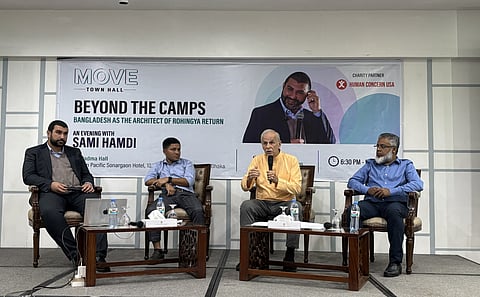
Dhaka has no clear roadmap for resolving Rohingya crisis: British journalist Sami Hamdi
Bangladesh has failed to present a specific proposal or a clear long-term roadmap to the United Nations for resolving the Rohingya crisis, British journalist and political commentator Sami Hamdi said on Sunday.
Hamdi said the lack of a clear Bangladeshi proposal had contributed to the emergence of a UN-backed framework under which Myanmar's government would effectively have a role in determining who qualifies as Rohingya.
“According to the UN's current proposal, the Government of Myanmar will decide who is Rohingya and who is not,” he said, arguing that such an approach was fundamentally problematic because Myanmar itself does not recognise the Rohingya as citizens.
He made the remarks while speaking at a seminar titled “Beyond the Camps: Bangladesh as the Architect of Rohingya Return”, organised by Human Concern USA at a hotel in Dhaka.
Hamdi's remarks came after a Rohingya activist described how the Myanmar government abolished the community's citizenship in 1982 and labelled them as “Bengali”, a process he said was intended to dehumanise the Rohingya and render them stateless.
Hamdi questioned how Myanmar could be entrusted with determining the identity of the Rohingya when the country itself refuses to acknowledge the community as citizens of Myanmar.
“If the Myanmar government is to decide who the Rohingya are, even though it does not acknowledge the Rohingya community as citizens of Myanmar, then it will not solve the existing situation,” he said.
Referring to Bangladesh's policy-level approach to the crisis, Hamdi argued that the Rohingya issue should not be treated merely as a humanitarian emergency.
“It is not a humanitarian crisis; rather, it is a political one. But the Government of Bangladesh is addressing it as a humanitarian crisis,” he said.
“Bengal was the architect of every return of the Rohingya for centuries, and Bengal alone repatriated them,” the journalist said, adding that contemporary Bangladesh lacked a sufficiently long-term vision for resolving the crisis.
Expressing both optimism and scepticism about the proposed Mecca Pact, Hamdi said that if Bangladesh joined the initiative, the Rohingya issue should remain one of its central priorities.
He also criticised the tendency among some policymakers to frame the Rohingya primarily as a “security threat” to Bangladesh.
Hamdi said such language echoed the vocabulary used by Myanmar's authorities, whom he described as the oppressors responsible for carrying out genocide against Rohingya Muslims.
Another speaker, Fadlullah Wilmot, a humanitarian veteran and activist, presented the historical context of the Rohingya issue.
He described how British colonial rule created divisions among the people of Arakan along religious and ethnic lines, divisions which, according to him, had not previously existed in the same form.
Wilmot then described how xenophobia and racism against Rohingya Muslims developed within Myanmar over time and eventually spread to a broader section of society, particularly during the past decade with the amplification of anti-Rohingya sentiment through Facebook.
“The international community has failed the Rohingya completely, and Bangladesh is trying to solve a problem that the world refuses to solve,” he said.
Rohingya activist Mahmudul Hasan also shared his personal journey to Bangladesh and, on behalf of his community, expressed his deepest gratitude to the people and the government of Bangladesh for providing shelter to hundreds of thousands of displaced Rohingyas.
However, he urged policymakers and the international community not to treat the Rohingya merely as a “crisis” or as “statistics”.
Hasan described how Myanmar's government stripped the Rohingya of their citizenship, labelled them as “Bengali” and gradually began persecuting talented and promising members of the community, a process that, he said, eventually culminated in genocide and forced him and countless others to flee to Bangladesh.
Human Concern USA Chief Executive Officer Masum Mahbub was also among the panellists at the seminar.