
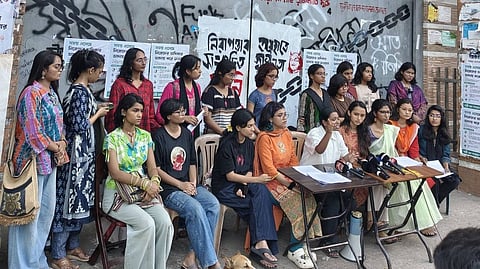
‘Evening curfew’: Inside DU’s female students’ fight for freedom
For Sidratul Muntaha Ohee, the journey back to Dhaka University from her home in Barisal did not end when she reached her residential hall.
Ohee, another resident of Ruqayyah Hall, wrote on Facebook on August 17 that she reached the hall gate around 4:45 in the morning, only to wait for more than an hour outside, as the gate remained closed until 6.
“I can’t even describe how bad I was feeling physically. There wasn’t even anything nearby to eat for breakfast so I could get some energy”, she wrote.
Her experience reflects a broader concern among female students at the university, who say restrictions on when they can enter or leave their residential halls, receive visitors and move around campus have become increasingly difficult to navigate.
Several groups of female students have recently protested against what they describe as an “evening curfew”.
Under three platforms, Oborodhbashini, Boishommohin Nari Hall Chai, and Nari Hall Sangskar Andolon, the students broadly have two demands: removing time restrictions on entry to and exit from female residential halls, and reducing bureaucratic restrictions on female relatives visiting residential halls.
There is, however, a significant difference over the first demand.
Oborudhbashini, a left-leaning platform, and Boishommohin Nari Hall Chai, which includes activists from Jatiyotabadi Chatra Dal, are demanding 24-hour access to female halls. Nari Hall Sangskar Andolon is seeking a more flexible arrangement. The group wants the main hall gates to remain open until midnight, with a late-gate system available throughout the night for both entry and exit.
What are the current rules?
The general rule requires female resident students of the five halls to return by 10pm, although each hall has a late-gate arrangement allowing students to enter later with prior approval.
Shamsunnahar Hall allows late entry until 11:30pm, while Fazilatunnesa Mujib Hall, Sufia Kamal Hall and Ruqayyah Hall allow it until 11pm. Kuwait Maitree Hall allows late entry until 10:30pm. Students said they are required to seek prior approval from house tutors and provide satisfactory explanations for late entry.
The restrictions also affect students who are already inside the halls at night. Students said they also need permission from a house tutor to leave the hall during emergencies, which can be difficult to obtain late at night.
The restrictions extend beyond the night-time gate. Non-residential students face restrictions when attempting to enter their affiliated halls. Students also said they face restrictions when entering halls other than their own.
Family members wishing to visit students also face administrative procedures, including prior permission and limited visiting periods.

Over the past week, Daily Waadaa spoke to students from different female halls. Many said their personal experiences with the existing system had convinced them that the rules needed to change.
For some, the issue is not only about being able to return to a hall late at night. It is about whether a university student should need permission to return to her own residence, leave during an emergency, receive a family member or access facilities at another hall.
Sayma Azam Mridula, another resident student, described an incident when she learned of her grandmother's death shortly after midnight in June this year. She had to call the house tutor responsible for her floor several times before receiving a response, and that too after the tutor initially appeared annoyed, according to Mridula.
Muntaha Rahman Manami, a third-year Fine Arts student and an organiser of the Oborodhbashini platform, said despite being eligible to live in a university hall, she stays with her parents in Mirpur because many of her university programmes end at around 11-12 pm, sometimes even later.
This forces her to go for alternatives such as ride-sharing services, when buses and the metro are no longer available, or to stay in campus till the morning.
“For women, travelling by ride-sharing services late at night is not always safe,” Manami told Waadaa, adding that she sometimes has to make alternative arrangements because of the hall-gate restrictions.
Why now?
Female students have demanded changes to hall restrictions for years.
The issue was also raised during the 2019 DUCSU election campaign, when candidates called for reforms to the ‘evening curfew’. After the election, the regular hall-gate closing time was moved from 9:30pm to 10pm.
But students say the underlying restrictions remained.
After the July Uprising, female students and hall representatives again raised the issue with the authorities, prompting the authorities to allow an additional hour through a late-gate arrangement, but students were seeking a broader reform rather than a limited extension.
Manami said recent developments on campus also created an opportunity to raise what she considers a longstanding issue affecting female students.
“We felt this was the time to demand one of the most important reforms that we, as female students, need,” she said.
Waadaa spoke to at least 15 female students from different halls, where all of them said they supported the movement, although some expressed reservations about how the demands should be implemented.
Priyonti Tripura, a final-year resident student, said she and her friends were supporting the movement because they had personally experienced difficulties under the existing system.
Some students, including Samiha, a second-year resident student, said they had avoided evening tuition opportunities because they were concerned that returning to their halls after 10pm would create difficulties.
While many students support the demands, however, another question remains: why has the movement not attracted a much larger physical presence on the streets?
Students interviewed by Waadaa cited their classes, tuition, part-time jobs and other commitments. Some said that although they support the movement, they cannot participate in every protest programme. Several also believed participation is going to increase as the movement continues.
When the rules affect work, study and opportunity
For some female students, the restrictions have consequences beyond inconvenience. Students who are involved in journalism, university programmes, cultural activities, internships, tuition or jobs may have to consider whether they can return to their halls before the gate closes.
Manami argues that this creates a professional disadvantage for women at a time when university students are increasingly expected to work, intern, participate in extracurricular activities and gain professional experience alongside their studies.
The question, therefore, is not just whether a student is allowed to remain outside after 10pm. It is whether a fixed closing time can indirectly determine which opportunities she can accept.
Students do not necessarily reject the need for safety, as the authorities tried to justify their stance from time to time. Rather, many of those involved in the protests argue that security and restriction are not the same thing.
They say the university could maintain security through measures such as controlled access, identification systems, surveillance and adequate security personnel rather than restricting the movement of female students.
They argued that the administration was effectively exercising greater control over female students than male students.
For Jarin Tasnim Tuba, a second year Journalism student, the safety measures once rose above an emergency situation when a former roommate developed a severe chest pain after 1:30 am.
The student, who needed to leave the hall immediately to go to the hospital with her brother who was waiting outside, had to wait for hours before she received the permission.
Another student, who wishes to be anonymous, raised a counterpoint within the protest itself: while she supports greater freedom of movement, she believes unrestricted access could be misused by some students. In her view, the possibility of misuse should not become a reason for denying access to students who genuinely need it.
She compared her own experience with that of a male classmate who was able to take a night shift during an internship, while she had to compensate by working additional hours on weekends because of the possibility of returning after 10pm.
All the students Waadaa spoke to say that the 10pm rule starts affecting them long before they reach the hall gate. Some change their travel plans, some turn down work or other opportunities, only to stay away from the ‘evening curfew’.
Women elsewhere have challenged similar rules
Female students elsewhere have also challenged gender-specific residential restrictions.
In India, students at Panjab University protested hostel curfews in 2018, arguing that restrictions imposed on women were not imposed on men. Following the campaign, the university agreed to keep its women's hostels open 24 hours.
The approach remains mixed across the region. Some institutions continue to impose gender-specific curfews or require permission for late entry, while others use controlled-access systems that allow students to enter their residences around the clock.
Waadaa contacted the provosts of all five female residential halls at Dhaka University. Four did not respond to calls, while the provost of Shamsun Nahar Hall declined to discuss the matter over the phone.
Professor Dr Mohammed Almujaddade Alfasane, Vice-Chancellor (Administration) of Dhaka University, said several groups of female students had presented their demands to the vice-chancellor and provosts.
He said the issue had been discussed at the Provost Standing Committee and that a final decision would be taken at an upcoming Syndicate meeting.
The vice-chancellor did not specify which demands the university would accept.
“We would make the decision after considering the overall security situation at the university and in the country, the social context and concerns raised by students' guardians”, he said.
However, for the students, the debate has grown beyond the question of when the hall gates should close.
At its heart is a broader concern: how can the university keep female students safe while also giving them the freedom to move, respond to emergencies, receive family members and pursue work and other opportunities without having to seek permission?
For many of them, the protest is ultimately about being treated as independent women, and having the same freedom as their male counterparts to live their university lives beyond the hall gates.