
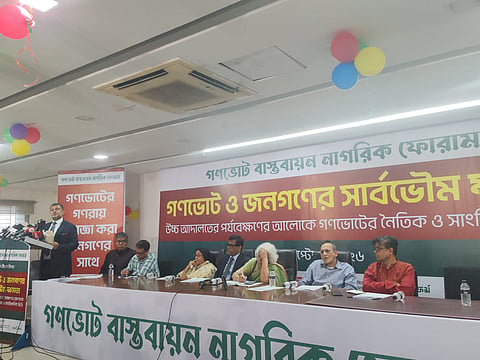
Failure to honour referendum could raise questions over government legitimacy: Speakers
AI generated summary, newsroom reviewed
Failure to honour the verdict of a referendum could raise questions over the legitimacy of both the interim government formed following the 2024 July Uprising and any subsequent government elected through a national election, speakers at a national seminar said on Saturday.
They also stressed the need to implement the July Charter and uphold the mandate expressed through the referendum.
The remarks were made at a seminar titled “Referendum and the Sovereign Power of the People: The Moral and Constitutional Basis of the Referendum in Light of the High Court’s Observations”, organised by the Citizens’ Forum for Referendum Implementation at the National Press Club.
Supreme Court lawyer Shishir Manir said the events of August 5 and the subsequent formation of the interim government did not follow the constitutional process.
“The uprising was not the result of the will of any individual, a single political party or the administration,” he said. “If the July Charter is not implemented, questions will also arise over the legitimacy of the government.”
He said the process – through which the previous government stepped down, the interim government was formed and the February 12 national election took place – did not follow a conventional constitutional framework.
Criticising the BNP, Manir said the party has been reluctant to recognise the July Uprising as a revolution because it did not have a single political leadership.
“The BNP claims to be a party of the people, yet it does not accept the referendum,” he said, adding that the interests and egos of a few individuals should not override the will of the nation.
Addressing the prime minister, Manir said the government now faced a choice between acting as a statesperson or prioritising party interests.
Barrister Tanim Hossain Shawon said weaknesses in the Constitution had contributed to the events of August 5.
He also noted that the previous government had used constitutional provisions to maintain what he described as authoritarian rule, while the July Uprising, the formation of the interim government and the subsequent political process had all taken place outside the existing constitutional framework.
Taznuva Jabin, an organiser of Alternative, said that the July Charter was not being implemented because of the “ego of the home minister”.
“The referendum belongs to the people of Bangladesh. Had everyone remained united, no one would have been able to prevent the implementation of its verdict,” she said.
Former chief prosecutor of the International Crimes Tribunal Tajul Islam said the BNP had repeatedly pledged to implement the July Charter in full but was now moving away from that commitment.
He also said the opposition had failed to ensure the implementation of the referendum verdict through Parliament.
Shafiqul Alam, editor of Daily Waadaa and former press secretary to the chief adviser of the interim government, said a section has been attempting to cast doubt on the July Uprising and the entire process surrounding the interim government.
He said such efforts reflected the narrative promoted by the Awami League, but added that the political awareness and aspirations that had emerged among young people and ordinary citizens could not be suppressed.
AB Party Secretary General Barrister Asaduzzaman Fuad said the BNP had been among the biggest beneficiaries of the political changes of 1975 and 1990 but had failed to meet public expectations after coming to power.
“This time, too, despite being one of the biggest beneficiaries of the mass uprising, they are following the same path,” he said, adding that the party had another opportunity to change course.
Arif Sohel, a representative of Ganabiplabi Udyog and former coordinator of the Anti-Discrimination Student Movement, said it would be unwise to prolong a political crisis out of fear of instability.
“The mandate for fundamental change expressed through the referendum and the July Charter must be fully implemented,” he said.
“Political liberation is not possible by following rules created by the old system. Lasting political stability can only be achieved by establishing the sovereignty of the people beyond the logic of the colonial system.”
Former diplomat Saquib Ali, JDP convener Nayeem Ahmad and Syed Hasib Uddin Hossain of Voice for Reform also addressed the seminar.
Political scientist Dr Dilara Chowdhury chaired the seminar, while Fahim Mashrur, convener of the Citizens’ Forum for Referendum Implementation, moderated the event.