
'I apologise to all those suffering from electricity and fuel shortages': PM
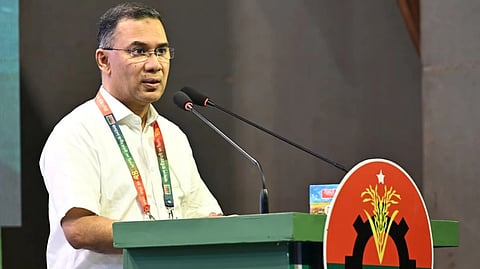
Prime Minister and BNP Chairman Tarique Rahman has apologised to people suffering from ongoing shortages of electricity and fuel, while accusing some political parties and individuals of exploiting the country’s crises to create confusion and anarchy.
“I apologise on behalf of the party to all those who are suffering from the shortage of electricity and fuel,” Tarique said on Saturday.
He was speaking at a discussion meeting marking the 48th founding anniversary of the Bangladesh Nationalist Party (BNP) at the auditorium of Krishibid Institution Bangladesh (KIB) in Farmgate.
Tarique said his government had inherited problems in various sectors, including the economy, energy, health, education and communications, from both the previous authoritarian regime and the interim government.
“We are trying to resolve all the problems we have inherited, whether from the authoritarian regime or the interim government,” he said.
Acknowledging that people are suffering because of problems in different sectors, the Prime Minister accused some political parties and individuals of attempting to exploit the situation.
“But we are noticing that some political parties and individuals are trying in different ways to create confusion by exploiting these problems, and through this confusion they are trying to create anarchy in the country,” he said.
He said the government would continue to uphold democracy, democratic principles and political ethics.
“But if anyone wants to create anarchy, the law of the country clearly sets out how to control such anarchy. Therefore, as a government—and not just as a government, but as a government elected by the people—I want to make it clear that everyone needs to remain within their respective limits,” Tarique said.
Energy crisis
Identifying the energy crisis as the country’s most pressing immediate challenge, Tarique said shortages of electricity and fuel were affecting both ordinary people and industries.
He said the government did not want to use the problems inherited from the previous regime or the interim government simply as excuses for its shortcomings.
“We do not want to simply cite these problems as excuses. Rather, we want to present the reality to the people and at the same time take measures so that people do not have to face such problems in the future,” he said.
Tarique said the BNP-led government had already adopted an action plan to address the energy crisis and prepare the country to deal with possible future global disruptions.
“An action plan requires time to formulate, and implementing it also requires some time,” he said.
He added that the government was taking its measures while keeping possible future global crises in mind.
Warning against ‘anarchy’
Tarique alleged that a political group had operated covertly during the previous authoritarian regime, with some of its members later admitting their involvement.
He accused some political parties of deliberately spreading confusion and warned that such activities could create an opportunity for forces associated with the ousted authoritarian regime to return to the political scene.
“Could it be that those who remained hidden under the authoritarian regime are now, from within that hidden network, trying to incite this anarchy?” he asked.
“If that is the case, then those who are hiding are actually working to bring that authoritarian regime back to the forefront,” he said.
Calling on nationalist forces and BNP leaders and activists to remain vigilant, Tarique said they should make people aware of who was taking responsibility for whom and who was trying to protect whom.
“Let us make the people more aware. Let us expose to the people who is taking responsibility for whom and who is trying to protect whom,” he said.
Tarique further alleged that certain political forces had protected one another at different points in Bangladesh’s history.
“This politics must be exposed before the people. We have to make it clear to the people,” he said, referring to what he described as covert networks that had shielded one another at different times.
He cited different periods in Bangladesh’s history, including 1971, 1986, 1996 and the past one and a half decades, saying such forces had continued to operate in different forms.
“So today, we have to expose their politics before the people. We have to make it clear to the people,” he said.
BNP’s democratic commitment
Tarique said the BNP had consistently worked to establish a democratic system and protect the political rights of the people since its founding.
“We still firmly believe in this,” he said, adding that hundreds of thousands of BNP leaders and activists had sacrificed their lives for democracy.
He said the BNP also wanted to build a humane state where people would be able to exercise their rights without facing obstacles.
The discussion was part of the BNP’s five-day programme marking its 48th founding anniversary, which began on Tuesday and concluded with Saturday’s event.
At the beginning of the programme, participants observed a one-minute silence in memory of BNP founder Ziaur Rahman, former BNP Chairperson Khaleda Zia and those who sacrificed their lives for the country and the party.
The programme began with the national anthem, followed by the BNP’s party anthem and a documentary on the party.
Ziaur Rahman founded the BNP on September 1, 1978.