
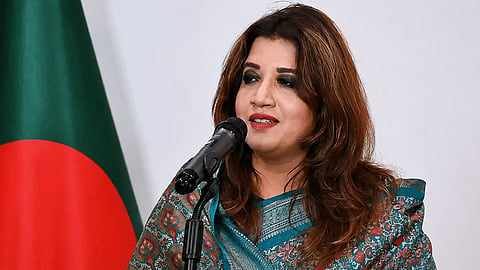
PM to champion 'Bangladesh First' agenda at UNGA: State Minister
Prime Minister Tarique Rahman will advance Bangladesh's national interests, economic potential and development opportunities globally under the government's "Bangladesh First" foreign policy during the upcoming United Nations General Assembly (UNGA), State Minister for Foreign Affairs Shama Obaed Islam said on Saturday.
"This year's session is an extremely important one for Bangladesh. It marks a new journey, a new possibility and a new aspiration," she said.
She was addressing a discussion titled "Upcoming UNGA and Branding of Bangladesh" as the chief guest at the Pan Pacific Sonargaon Hotel in the capital.
The Centre for Non-Resident Bangladeshi (Centre for NRB), a non-profit research organisation for expatriate Bangladeshis, organised the event.
Shama said the prime minister would attend the UNGA for the first time since the establishment of the new democratic government.
Guided by the government's "Bangladesh First" foreign policy, Tarique Rahman would present Bangladesh to the international community as a democratic, confident, responsible and promising nation, she added.
The high-level segment of the 81st session of the UN General Assembly is scheduled to begin in New York on September 21.
It will address poverty eradication, climate change, pandemic prevention, nuclear disarmament and the 40th anniversary of the Declaration on the Right to Development, among other pressing global issues.
Shama said the session carries added significance as Foreign Minister Dr Khalilur Rahman will preside over the General Assembly.
Terming his election a matter of national pride, she said Bangladesh secured the presidency despite Cyprus having campaigned for the position for nearly a decade.
She credited the diplomatic success to the coordinated efforts of the Foreign Ministry and Bangladesh's 83 missions abroad, alongside the country's return to democratic governance and stability.
The state minister said Bangladesh already enjoys considerable respect at the United Nations because of the courage, resilience and sacrifices of its peacekeepers, including women serving in some of the world's most dangerous missions.
Turning to economic diplomacy, Shama said the government was working to restore transparency and accountability in the banking sector and create an investment-friendly environment for foreign investors and non-resident Bangladeshis.
She said the government had introduced the "Bangladesh Invest" framework to offer investors one-stop services and was expanding digital facilities for company registration and other investment-related procedures.
Work is also underway on the "One Citizen, One Card" initiative to consolidate citizens' information in a single database, she added.
Shama said the government plans to issue 200,000 "Probashi Cards" by 2027 under an initiative of the prime minister to facilitate services for expatriate Bangladeshis.
She called upon non-resident Bangladeshis to use their networks to promote the country's investment opportunities, heritage, tourism, creative industries and exportable products internationally.
The state minister said irregular migration and the activities of human trafficking syndicates were damaging Bangladesh's image abroad.
"For the first time in the history of the Foreign Ministry, we have opened a separate Migration Wing," she said, adding that it would address irregular migration, expatriates' difficulties and other migration-related challenges.
She said the foreign and expatriates' welfare ministries were working jointly with the International Organization for Migration to curb irregular migration and encourage the overseas employment of skilled workers through legal channels.
The government has identified districts with higher levels of attempted irregular migration and begun awareness activities at the village, union, upazila and district levels, she said.
Shama said the Cabinet had recently approved changes to Bangladesh's visa policy to simplify business, tourism, work and visa-on-arrival procedures.
"The objective is to make Bangladesh more welcoming and investment-friendly," she said, adding that reforms were also underway in airport services and tourism.
She stressed the need to diversify Bangladesh's energy sources and reduce dependence on any single market, saying the government was exploring energy cooperation with African countries alongside additional sources of liquefied natural gas.
The government is also promoting solar power, waste-to-energy projects and blue-economy opportunities, she added.
Shama said the Prime Minister's Office had already been brought under 100-percent solar power, while efforts were underway to expand renewable energy use across government establishments.
Highlighting export diversification, she said the government had placed special emphasis on the creative economy, particularly women-led enterprises, traditional arts, muslin, cottage industries and cultural heritage.
She described jute as an ideal biodegradable alternative to plastic and said Bangladesh would seek to promote jute and jute products during the UN General Assembly.
A stall is also planned at the upcoming climate conference in Turkiye to showcase jute as a sustainable natural fibre, she added.
On the Rohingya crisis, Shama said a dedicated session would be held during the UN General Assembly with the participation of Prime Minister Tarique Rahman.
She said the crisis had become increasingly complex because of the involvement of the Myanmar authorities, the Arakan Army, regional actors and competing international interests.
"Without international pressure, resolving this problem will become very difficult," she said, urging Bangladeshis abroad and civil-society representatives to help mobilise international support for a sustainable solution.
The state minister said Bangladesh should no longer be portrayed internationally merely through floods, disasters or the repatriation of undocumented migrants.
"Bangladesh has opportunities in tourism, business and investment, and it has the potential to be presented properly on the world map," she said.
Shama said the government was committed to genuine reforms but cautioned that meaningful change would take time and require cooperation from citizens, businesses, civil society and Bangladeshis living overseas.
"We are trying to brand Bangladesh in the right way. The government alone cannot do everything; all of us must work together," she said.
Centre for NRB Chairperson M S Shekil Chowdhury said the organisation arranged the programme as part of its annual World Conference Series to showcase Bangladesh's positive developments to the international community.
He said the series also seeks to deepen Bangladesh's global engagement and encourage expatriate Bangladeshis to invest in the country and remit their earnings through legal channels.