
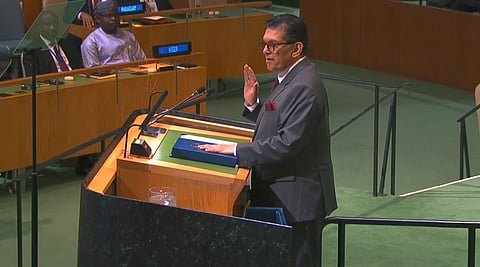
Won’t take instructions from any govt regarding duties, Dr Khalilur says during UNGA President oath-taking ceremony
At the oath-taking ceremony as President for the 81st session of the United Nations General Assembly (UNGA) on Tuesday, Dr Khalilur Rahman vowed to discharge his duties without seeking or taking instructions from any government.
“I solemnly declare that, as President of the United Nations General Assembly, I will faithfully discharge the duties and functions entrusted to me with full loyalty, discretion and conscience,” he said.
The oath-taking ceremony began at around 9:05pm at the General Assembly Hall of the United Nations Headquarters in New York, United States.
“I will perform these duties and regulate my conduct solely with the interests of the United Nations in view, in accordance with the provisions of the Charter of the United Nations and the Code of Ethics for the President of the General Assembly; where no instructions will be sought or accepted regarding the discharge of duties entrusted by any government outside the organisation or any other source,” he said.
UN Secretary-General António Guterres spoke first during the event.
Later, Dr Khalilur Rahman took the oath as President of the session.
The high-level general debate will begin on September 22 with addresses by heads of state and government.
Earlier this morning, a statement from the Ministry of Foreign Affairs said following a media briefing, Dr Khalilur Rahman would take the oath as President at 9pm Bangladesh time and would chair the first plenary meeting of the 81st session of the General Assembly at 1am.
Earlier, on June 2, representatives of UN member states elected Khalilur Rahman as President of the 81st session of the UNGA through a secret ballot in an election held at the UN Headquarters in New York.
In the election, he defeated Andreas S Kakouris, Special Envoy of the Foreign Minister of Cyprus, by a margin of eight votes.
After four decades, another Bangladeshi diplomat is once again serving in the important role of President of the United Nations General Assembly, the world’s largest multilateral forum.
In 1986, Bangladesh’s former foreign secretary and politician Humayun Rashid Choudhury served as President of the 41st session of the UNGA.
'Multilateralism as a whole'
Taking charge as the UNGA president, Dr Rahman said the United Nations and multilateralism as a whole are being tested in ways not seen before, but he also sees opportunities, particularly in emerging technologies and artificial intelligence governance.
“The UN, multilateralism as a whole, is being tested in ways we have never seen before,” he told reporters in New York after assuming office, UNB reports.
Despite the challenges, he said, “we have opportunities that we hadn't before.”
Dr Rahman, who first came to the United Nations as a delegate in 1985, said he would place a “high premium on cooperation and dialogue” during his presidency.
“I’m not naive to think that, okay, everything can be resolved quickly, amicably,” he said, noting that some issues would remain unresolved or take time to resolve.
“But that should not retard us from seeking common grounds wherever we can. And that is something I will continuously try to do,” he said.
Rahman also pledged an open relationship with journalists, saying he would regularly engage with the media and seek their views rather than treating press briefings as a one-way exchange.
“I’ll work very closely with you. This is my style back home. I work openly with the media. And this will be no different,” he said.
“Please make it easier on me,” he added, asking journalists to make their interaction with the presidency “two-way traffic.”
‘Organisation is larger than the member states’
Dr Rahman placed particular emphasis on the opening words of the UN Charter - “We the peoples of the United Nations” - saying the organisation should not be viewed as being limited to its member states.
“Unlocking the UN will be something that I will try to pursue during my presidency,” he added.
Asked specifically about the representation of stateless communities such as the Rohingyas, Dr Rahman said he would continue bringing their voices to the United Nations.
Referring to his previous role as Bangladesh’s high representative on the Rohingya issue, he recalled visiting refugee camps and witnessing their desire to return home.
“I’ve seen up close the distress. They’re yearning to go back home,” he said.
Dr Rahman said the UN secretary-general had also visited the camps, where large gatherings of Rohingya refugees expressed a clear message: “We want to go home.”
“That’s the agony of a large group of people kicked out of their own homes and hearth,” he said.
“And we got them to the United Nations. We added their voice. I will continue to do this, as we proceed,” he said.
‘Must make the United Nations fit for the future’
Dr Rahman said his campaign theme was “restoring trust, managing transformation,” but added a new priority after assuming office: making the United Nations “fit for the future.”
“This must be a place where countries can once again say and vote yes to the UN - with confidence and with enthusiasm,” he said.
On UN reform, Dr Rahman said the process must go beyond marginal or cosmetic changes and should help restore public confidence in the organization.
“The reforms must be meaningful,” he said.
“These reforms must regain, help regain the trust of this organization in the eyes of the public. So unless that happens, reform will be regarded as marginal or perfunctory,” he said.
“We have a situation where trust is in deficit, and the organization must undertake deeper reform in order to make it fit for future, not only today, for tomorrow,” Dr Rahman added.
“This is not 1945. This is the 81st session. So the world has moved on, the organization must move on,” Dr Rahman said.
He also welcomed the UN secretary-general’s proposals and efforts on UN reform, saying the reform process would continue under his presidency.
‘I will be a president for all countries’
Dr Rahman assured member states that he would serve all countries regardless of how they voted in his election.
“Throughout my campaign, I said that if elected, I’ll be the president for every country, irrespective of whether they voted me or not,” he said.
“And after the election, I said exactly the same thing. I will be a president for all countries,” Dr Rahman added.
He said his presidency would remain firmly anchored in the UN Charter and the mandates given by member states.
“I’ll be completely faithful to this, as well as the mandates that the member states have given to the United Nations,” he said.
Dr Rahman also stressed that member states should work together to resolve critical issues through dialogue rather than other means.
“I believe that my job will be much easier if member states work together, in order that some of the critical issues that we see before us could be resolved through dialogue rather than other ways,” he said.
On Security Council reform, AI and next secretary-general
Asked about Security Council reform, Dr Rahman said he would continue to support the ongoing reform process, while emphasizing the need for meaningful change.
He said his long experience at the UN — as a delegate and staff member — had given him a broad perspective on the organization.
“I’ve seen this organization as a delegate. I have seen this as a staff member. So I’ve seen it from probably, I should say, 360 degrees,” he said.
On the selection of the next UN secretary-general, Rahman said he would strictly follow the UN Charter, which provides for the Security Council to recommend a candidate and the General Assembly to appoint the secretary-general.
“I’ll work very closely with member states, with the president of the Security Council, so that we can come up with a name as soon as we can,” he said.
“We need to do this because we want the leadership of the organization to be seamless and the transition to be effective,” he added.
On artificial intelligence and new technologies, Rahman said the UN has an important role to play in AI governance and in harnessing the opportunities created by technological change.
He also said he wanted world leaders attending the upcoming high-level week to recommit themselves to development, people's well-being and human rights.
As heads of state, heads of government and other leaders speak, he said, the presidency would “sift through what they have said” and identify areas that could form a common agenda.
‘My doors will be open’
In his oath of office, Dr Rahman solemnly pledged to perform his duties “in all loyalty, discretion, and conscience” and to act with the interests of the United Nations only in view.
He pledged to act in accordance with the UN Charter and the Code of Ethics for the President of the General Assembly and not to seek or accept instructions from any government or outside source in performing his duties.
At the end of his interaction with reporters, Rahman reiterated his commitment to maintaining an open presidency.
“One thing I’m telling you, my doors will be open, and please keep your doors open,” he said.
“If not windows open, and we’ll always be in touch with each other,” he added.