
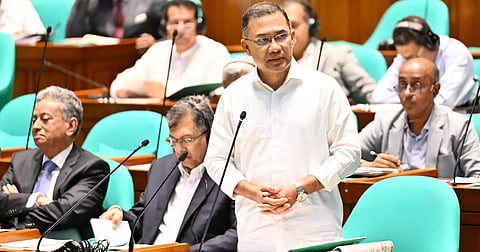
Govt taking steps based on white paper on past 17 years’ corruption: PM
Prime Minister Tarique Rahman on Wednesday said the government is taking necessary measures in phases based on the white paper prepared by the interim government on economic mismanagement and corruption over the past 17 years.
“The interim government formed a committee, and that committee published a white paper or such a report before the people of the country. Among various issues, the economy was a significant one. If you look at that paper, you will get a fairly clear picture,” he said.
“The current government is keeping that paper in front of us and, step by step, we are trying to take the measures that should be taken,” Tarique Rahman said.
He was replying to a supplementary question from Cumilla-10 MP Md Mobasher Alam Bhuiyan during the Prime Minister’s question-answer session in Parliament.
Measures to curb project delays, cost overruns
Replying to another question from Mobasher Alam on extensions of project timelines and increases in costs, the Prime Minister said such problems in government development projects were generally caused by multiple weaknesses rather than a single factor.
“Project delays and cost increases are the result of several weaknesses being interconnected at different stages, including project formulation, approval, land acquisition, financing, procurement and management,” he said.
Tarique Rahman said the government has identified a number of reasons behind the problem, including weak feasibility studies, inaccurate cost estimates, weaknesses in selecting project areas, delays in land acquisition and utility relocation, delays in procurement, failure to appoint project directors on time, weak monitoring and accountability, gaps between financing plans and budgets, and lack of inter-ministerial coordination.
He outlined a series of measures taken by the government to address the problems.
These include ensuring proper feasibility studies before taking up new projects and speeding up implementation preparations after project approval.
The government is also updating existing guidelines on project formulation, processing, approval and revision, while dashboards are being established in relevant ministries and divisions to strengthen monitoring of the implementation progress of ongoing projects, the Prime Minister said.
He said regular project reviews and closer field-level supervision are also being strengthened.
Tarique Rahman said coordination among relevant agencies is being strengthened to expedite land acquisition and utility relocation.
He said ministries have been instructed to review projects that had not been completed within their scheduled timeframe and determine the reasons for delays, irregularities, cost increases and revisions.
Necessary action will be taken under the rules against individuals and organisations responsible for delays, the Prime Minister said.
For projects with implementation progress of less than 30 percent, the relevant ministries and divisions will assess their utility and effectiveness and take appropriate measures to restructure them, change their scope or continue with implementation, he said, adding that the government has also instructed authorities to undertake cluster projects under integrated programmes instead of taking up projects separately.
Tarique Rahman said the government is expanding the use of e-GP in public procurement and will give the highest priority to professional qualifications, skills and practical experience in appointing project directors, while ensuring continuity in their responsibilities where necessary.
He said the government is also updating existing policies and encouraging the adoption of projects under the public-private partnership (PPP) model.
The Prime Minister said steps have been taken to update the Public Procurement Rules 2025 to make government procurement more competitive and accountable.
Plans to address gas shortages in industries
Responding to a question on the government’s plans to tackle gas shortages in the industrial sector during sudden or temporary crises, Tarique Rahman said the government has taken a number of measures to increase domestic gas supplies and expand LNG infrastructure.
He said the government plans to drill 150 wells by 2030-31 in line with its target.
The Prime Minister said the government also plans to conduct 4,500 line kilometres of 2D seismic surveys and 4,200 square kilometres of 3D seismic surveys to explore domestic gas resources.
For exploration and extraction of oil and gas in 26 offshore blocks, an international bidding round was invited on May 24, with the deadline for submission of bids set for November 2026, he said.
Tarique Rahman said the government is also working to formulate the Bangladesh Onshore Model PSC-2026 to attract international investment in onshore oil and gas exploration.
He said the country’s two existing floating LNG terminals could supply around 935 million cubic feet of gas a day on average.
To ensure that industries do not face major losses due to sudden gas shortages in the future, the Prime Minister said work is underway to establish a new floating LNG terminal at Kutubjom in Maheshkhali and a land-based LNG terminal at Matarbari.
According to the plan, the Kutubjom floating LNG terminal is expected to supply regasified LNG in 2028, while the land-based LNG terminal at Matarbari is expected to supply regasified LNG by December 2030, he said.
Tarique Rahman said the government is also conducting a feasibility study for setting up another floating LNG terminal at a suitable deep-sea location near the Payra or Mongla port areas or along the southwestern coast.
He said a feasibility assessment has also been initiated to bring gas from Bhola to the mainland in LNG form and supply it to interested industrial consumers.
Subject to gas availability, the government plans to supply gas to industries, giving priority to those located in planned industrial areas such as economic zones, EPZs and BSCIC industrial estates, the Prime Minister said.
Govt plans to use Bhola gas locally
Replying to a supplementary question from Sultana Ahmed, Tarique Rahman said bringing Bhola’s gas to the mainland through a pipeline will take at least seven years.
Instead, the government is considering whether industries can be established in Bhola itself using the locally available gas, he said.
Some industrial entrepreneurs are already trying to establish gas-based industries in the area, the Prime Minister said, adding that this will create employment and expand the local economy.
He said the government is also planning to establish a fertiliser factory and a 500MW power plant in Bhola to ensure proper use of the gas in the national interest.
The parliamentary session began at 3:30pm with Speaker Hafiz Uddin Ahmad in the chair. The first half-hour of the session was allocated for the Prime Minister’s question-answer session.