
Experts, activists call to scrap law that criminalises attempted suicide
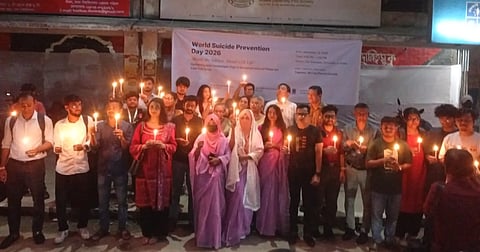
Mental health experts and activists on Thursday called for repealing a colonial era law that criminalises attempted suicide, at a gathering and candlelight vigil held at TSC, Dhaka University, to mark World Suicide Prevention Day.
The event, themed "Changing the Conversation, Strengthening Prevention, Saving Lives," was organised by the Innovation for Wellbeing Foundation (IWF), the Student Guidance Office of TSC, and the Nasirullah Psychotherapy Unit, Department of Clinical Psychology, Dhaka University.
Citing police records, organisers said 76,361 people died by suicide in Bangladesh between 2020 and 2024, and 13,491 more between January and November 2025. Media-identified cases showed 513 students died by suicide in 2023, 310 in 2024, and 403 in 2025. At least 10 student suicides were reported nationwide after the 2026 SSC results were published on August 10, though organisers cautioned the media-based figure is incomplete.
Speakers repeatedly pointed to Section 309 of the Penal Code, 1860, which remains in force and punishes attempted suicide with up to a year's imprisonment, a fine, or both.
Kamal Uddin Ahmed Chowdhury, professor at Dhaka University's Department of Clinical Psychology, said the law criminalises people already in deep distress, and called for suicide-prevention centres in all 503 upazilas.
Imdadul Haque Talukdar, a public mental health specialist, also urged reform of the law, noting its colonial origin.
He cited WHO estimates that Bangladeshi households bear the large majority of health costs out of pocket, and pointed to New Zealand's "wellbeing budget" as a model for prioritising mental health spending.
Mahmuda Rahman Khan, chief operating officer of the Global Center of Excellence, described Suicide First Aid, an international training programme teaching laypeople to assess risk using a framework she called CPR, current plan, previous attempts, resources.
Drawing on her own experience with postpartum depression, she said people rarely announce suicidal intent directly but often signal it indirectly. "No one who attempts suicide truly wants to die," she said. "They cannot see a way out of the problem consuming them."
Organisers called on the government, institutions, health professionals, media and families to strengthen prevention strategies, support pathways, responsible reporting and open conversation, linking the effort to SDG target 3.4. The event ended with a candlelight vigil.