
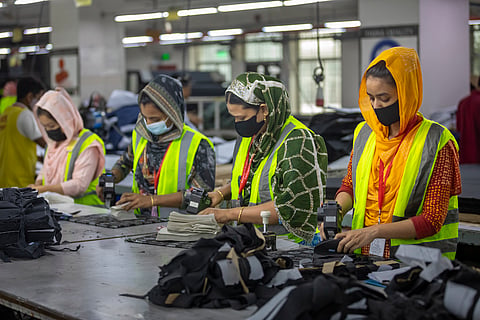
15 global fashion giants could help Bangladesh cut nearly 9 million tonnes of carbon by 2040, experts say
Just fifteen major global fashion companies could help Bangladesh avoid an estimated 8.59 million tonnes of carbon dioxide emissions by 2040 by supporting a shift away from fossil fuels, environmental experts said.
A new report, published by Canadian environmental non-profit Stand.earth on Tuesday, suggests that the companies, including H&M Group, Inditex, Primark and Walmart, account for 26.3% of Bangladesh’s apparel exports by weight, giving them significant purchasing power over the country’s garment industry.
The report, titled “Fashion’s Fair Share: Bangladesh Buyers’ Climate Opportunity”, estimates that coordinated action by the 15 companies could reduce carbon emissions by as much as 1.26 million tonnes annually.
Based on the findings of the report, Stand.earth has launched a campaign asking 15 companies to invest time and resources in helping Bangladesh move towards clean energy over the next 18 months.
Rachel Kitchin, Senior Corporate Climate Campaigner at Stand.earth said these 15 brands, acting together, could change the trajectory of Bangladesh’s energy transition.
“While the sector and the country deals with massive energy shortages and price fluctuations putting workers in even more precarious situations, Bangladesh’s biggest buyers must be part of the solution. That’s why we’re calling on these brands to act now”, she said.
The findings come as Bangladesh’s garment industry faces an energy crisis, forcing the factories to layoff thousands of workers and shut down operations with declining work orders.
Renewable sources currently account for less than 5% of the country’s grid electricity, according to the report.
The organisation said the potential emissions savings were calculated using customs and sourcing data and by modelling the impact of greater investment in renewable energy across Bangladesh’s electricity grid and garment sector.
The analysis also found significant gaps in the climate commitments and financing practices of the 15 companies.
Only Inditex and H&M Group have targets for 100% renewable electricity covering their supply chains, while only four companies publicly disclose participation in supplier-financing initiatives. None showed strong evidence of providing grant-based or debt-free financing, according to the report.
According to the report, H&M Group showed the strongest alignment with the principles assessed, particularly on financing and supplier support, while Kontoor Brands, Walmart, New Yorker, Gildan Activewear, LPP and Pepco showed some of the largest gaps.
The report comes amid rising emissions across the global fashion industry. Citing Apparel Impact Institute data, Stand.earth said sector emissions increased 7.5% in 2023 and another 6.3% in 2024, reaching about 1 billion tonnes of greenhouse gas emissions annually.