
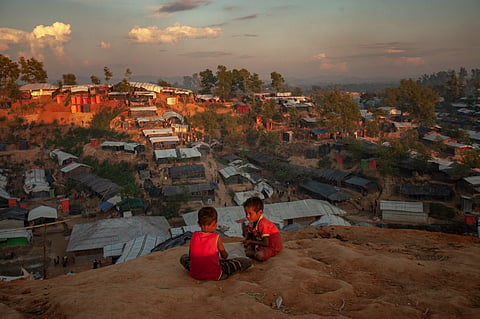
Six children among 10 dead as dengue sweeps through Rohingya camps
Ten Rohingya refugees, including six children, have died from dengue in the sprawling camps of Cox’s Bazar this year, as Bangladesh faces an accelerating outbreak that has already killed 271 people nationwide.
Between January 1 and October 5, at least 2,882 dengue cases were detected among Rohingya refugees, according to the latest report from the Cox’s Bazar Civil Surgeon’s Office.
The remaining four people who died in the camps were adults.
The figures mean Rohingya refugees accounted for more than half of the 5,033 dengue cases recorded across Cox’s Bazar district during the period.
The camps, which accommodate more than one million Rohingya refugees in an exceptionally dense settlement, have repeatedly experienced dengue outbreaks during and after the monsoon.
The latest camp figures come as Bangladesh enters what health experts fear could be an even more difficult phase of this year’s outbreak.
Nine people died from dengue in the 24 hours until Monday morning — the highest single-day toll this year — taking the nationwide death toll to 271, according to the Directorate General of Health Services (DGHS).
Another 1,902 patients were hospitalised during the same period.
Since January 1, at least 88,360 dengue patients have required hospitalisation across Bangladesh, while 82,335 have been discharged after treatment.
September alone accounted for 148 deaths and 43,774 hospitalisations, making it the deadliest month of 2026 so far.
The outbreak has accelerated dramatically since August, when 43 deaths and 20,536 hospitalisations were recorded.
Experts have linked the surge partly to prolonged rainfall and changing weather patterns that have extended breeding conditions for the Aedes mosquito.
Medical entomologist Kabirul Bashar of Jahangirnagar University told media that September rainfall could continue driving infections into October because dengue transmission can follow rainfall with a lag of 45 to 60 days.
Another concern is a change in the dominant dengue virus serotype.
An Institute of Epidemiology, Disease Control and Research survey earlier this year found DENV-3 in more than 91 percent of samples tested, replacing DENV-2 as the dominant serotype.
Changes in circulating serotypes can leave people previously infected with another strain vulnerable to reinfection. Secondary dengue infections can carry a greater risk of severe disease.
The rapidly increasing caseload is also putting hospitals under growing pressure.
Health authorities have now instructed hospitals, particularly those in Dhaka, to increase the number of beds available for dengue patients.
Officials are considering moving some burn patients from Dhaka Medical College Hospital's Burn Unit to the National Institute of Burn and Plastic Surgery to create additional capacity. Authorities have also discussed activating a field hospital at DMCH.
At Mugda Medical College Hospital, the pressure became stark earlier in the outbreak, with 145 dengue patients being treated in a ward designed for only 38 beds. Some hospitals have been forced to accommodate patients on floors and verandas as beds fill.
The crisis is particularly acute outside Dhaka, where experts say shortages in specialised treatment and monitoring capacity can lead critically ill patients to travel to the capital, sometimes after their condition has deteriorated.
Bangladesh is also fighting a major measles outbreak, adding further pressure to an already stretched public health system.
In Cox’s Bazar, health officials recorded another 32 dengue cases in the latest 24-hour reporting period, including one Rohingya refugee. Twenty-eight patients were admitted to hospitals and 23 were discharged.
The Rohingya camps remain particularly vulnerable because of their extraordinary population density, limited space, drainage problems and the difficulty of eliminating mosquito breeding sites during the monsoon.
And despite the rains beginning to recede, health experts warn the danger does not disappear with the monsoon.
--