
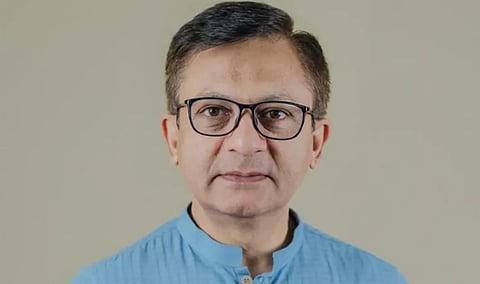
Govt. working to ensure adequate supply, reasonable prices of essentials: Commerce Minister
The government is working to ensure uninterrupted supply and reasonable prices of essential commodities for consumers during the upcoming holy month of Ramadan, Commerce Minister Khandakar Abdul Muktadir said today.
The government has taken initiatives to rationalise duties on fruits and dates, discuss lower interest rates on bank loans for importing consumer goods, and remove obstacles to transportation and clearance of imported goods, he said.
“The government will continue regular market monitoring to prevent artificial shortages and unreasonable price hikes,” the minister said.
Muktadir was speaking as the chief guest at a meeting with traders and importers on ensuring the supply of essential commodities and market stability, organised by the Chittagong Chamber of Commerce and Industry (CCCI) at the conference room of the World Trade Center in Chattogram, said a Commerce Ministry press release.
The minister also answered questions from journalists after the meeting.
Regarding preparations for Ramadan, Muktadir said sufficient supplies of essential commodities, including edible oil and sugar, were already in the pipeline, while opening letters of credit (LCs) for imports remained normal.
“Work is underway in coordination with the relevant agencies to keep the supply chain uninterrupted during Ramadan and throughout the year,” he said.
The minister stressed reducing import costs to keep the prices of essentials at a reasonable level.
He said the government was working to reduce the effective duty on fruits, currently at 121 percent, to bring fruit prices within the purchasing capacity of ordinary consumers.
The National Board of Revenue (NBR) has already received a letter seeking a reduction in the duty on dates, he said.
He also said he would discuss with the governor of Bangladesh Bank on the possibility of reducing interest rates on bank loans for importing consumer goods.
Replying to a question about unusually high fruit prices, the minister said it was unacceptable that oranges were being sold at Tk 400-500 per kilogram even after payment of duties.
He said prices had declined considerably following drives by the Directorate of National Consumers’ Right Protection and the administration.
“No attempt to create an artificial shortage or make excessive profits in the name of Ramadan or any other occasion will be tolerated,” he said, adding that market monitoring would continue throughout the year.
On reducing supply-chain costs, Muktadir said the government had taken initiatives to improve the efficiency of Chattogram Port and remove obstacles in the transport system with a view to reducing the country’s logistics costs from 16 percent.
He emphasised simplifying import, cargo clearance and transportation processes to improve supply-chain efficiency.
The minister also highlighted several government initiatives to facilitate business operations.
He said the trade licence system was being made fully online so that applicants could pay the prescribed fees from anywhere and download their licences.
He said work was also underway to modernise the Registrar of Joint Stock Companies and Firms (RJSC) on the model of Singapore and introduce a system for transferring shares after identity verification through facial recognition and fingerprints from home.
The minister said the government was also taking a policy decision to make pre-shipment inspection (PSI) mandatory for imports of sodium sulphate or synthetic salt and bitumen to ensure quality and transparency of imported industrial materials.
Asked about the impact of higher fuel prices, Muktadir said the government had long provided subsidies to manage the situation but had made a minimum price adjustment to maintain a balance in the state’s financial capacity.
He said initiatives were being taken to reduce duties on other imported products to prevent additional pressure on the market.
Regarding the proposed adjustment of salaries of government employees, the minister said their salaries had not increased for 11 years since 2015.
He said steps were being taken to offset the erosion of their purchasing power caused by inflation, but the measure had not yet taken effect and would be implemented in phases over one year.
“Therefore, it will not have any immediate impact on the current market situation,” he said.
At the meeting, business leaders assured the government that they were prepared to ensure adequate supplies of essential commodities during Ramadan.
CCCI President Mohammad Amirul Haque, who chaired the meeting, said traders were fully prepared to maintain normal supplies and market conditions during the upcoming Ramadan.
“There will be no artificial shortage of major consumer goods, including pulses, chickpeas, wheat, edible oil and sugar,” he said.
He also pledged that traders would conduct business transparently while protecting consumer interests.
Former CCCI president Amir Humayun Mahmood Chowdhury urged the government to remove unnecessary restrictions that hamper import-export activities and facilitate international trade through the national import policy and customs procedures.
Khatunganj Trade and Industries Association President Abdus Salam said traders were committed to maintaining normal supplies of rice, pulses, chickpeas, wheat, soybean oil, palm oil and sugar, as they did during the last Ramadan.
Former CCCI president Engineer Ali Ahmad, Senior Vice-President Md Amzad Hossain Chowdhury, former Vice-President M A Salam, Chattogram Customs House Commissioner Abul Bashar Md Shafiqur Rahman and former director S M Abu Tayeb, among others, also spoke at the meeting.