
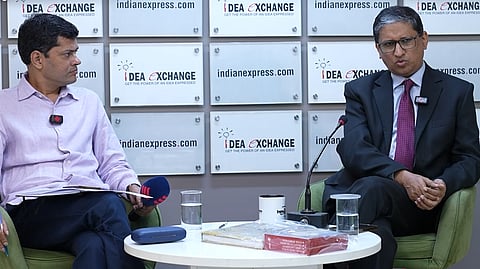
Bangladesh-India ties organic, ready to engage on even keel: M Riaz Hamidullah tells The Indian Express
Bangladesh’s outgoing High Commissioner to India M Riaz Hamidullah has called for a more equitable bilateral relationship grounded in mutual respect, dignity and shared benefits, saying Dhaka is ready to engage with New Delhi on an equal footing.
“We are ready to engage with India on an even keel but everything better passes through the intersection of dignity, trust, respect and shared benefits,” Riaz said in an interview with The Indian Express published on Monday.
Riaz highlighted cross-border mobility concerns, expanding bilateral trade, power and river ecosystem sharing, and the need for cooperation beyond the limited security lens.
He also said India-Bangladesh ties must balance state-to-state engagement with a deeper understanding of the people and their demographics.
India must recognise Bangladesh’s concerns
Asked if India can replicate the same elevated sense of trust with the BNP government as it had with Sheikh Hasina, Riaz said India must consider Bangladesh’s concerns over the July-August 2024 uprising, institutional damage and cross-border pushbacks, warning that domestic political interests should not undermine long-term ties between the two countries’ people.
“Can you ever imagine what Bangladesh’s concerns are? What happened in 2024 was brutalisation, decimation of institutions and our economy. Cross-border mobility of ordinary people was closed… people were arbitrarily pushed in across the border, disregarding long-agreed norms and procedures. Domestic political expediency is one thing but it must not be at the cost of India’s larger foreign policy pursuit, that is to have an even-grounded relation with Bangladeshi people. That brutally pushed us aside from where we could be, and I feel, this could have been avoided in the long-term interests of both people within our shared geography,” he said.
Asked how damaging was it for Bangladesh when Hasina addressed a press conference in Delhi, Riaz said Bangladeshis remain hurt by what they see as India’s limited acknowledgement of the violence during the uprising, including killings, enforced disappearances and injuries caused by state forces.
“There is little admission, little regard to what Bangladeshis went through or were subjected to. That is one aspect where, even now, people feel hurt vis-à-vis India.”
People’s aspirations key to bilateral relations
On how he sees the relationship moving forward, Riaz said the key is “appreciating aspirations” of the masses, not just the youth.
“As long as you come and connect with the fulfilment of my aspiration, I am here with you,” he said.
On divisive politics affecting ties, he said that, in the longest timeframe, it was the values that brought Bangladesh and India together.
“If that is little understood or appreciated, then we risk putting the relationship in jeopardy,” he said.
Tarique Rahman’s India visit depends on mutual respect
Riaz also said a bilateral visit by Prime Minister Tarique Rahman to India could materialise if both countries ensure dignity, mutual respect and interdependence, stressing that neither can afford strained ties.
“Visits are important but we have to get both a mix of sufficient and essential conditions together, where dignity, respect, mutuality and interdependence manifest aptly. These are not too much of an ask. Surely, geography and nature, on either side, show that neither of the two countries can afford disharmony in ties,” he said.
Organic ties
Riaz said Bangladesh’s defence ties with India remain stable, citing continued institutional engagement and “considerable comfort and confidence” between the two countries’ defence establishments.
Riaz warned that domestic political interests and divisive rhetoric risk undermining India-Bangladesh ties, saying the relationship is “organic” and rooted in shared values and history. He also urged the media to act responsibly to counter false narratives and called for shared responsibility in addressing climate change, stressing that “one cannot have a divisive approach or selectivity” on environmental issues.
Relationship with Pakistan
Asked how the Bangladesh and Pakistan relations are changing post-uprising with ministerial visits and considering the Mecca Pact, Riaz said interactions with Pakistan have been driven, guarded and judged across all attributes — people, economic, social, political, defence.
“We enjoy cultural aspects like music or cuisine but that is not to be traded off in respect of history, where several aspects remain unsettled. This March 25th, Prime Minister Tarique Rahman spoke out in an unambiguous manner on the Bangladesh genocide, referring to the Pakistani forces in 1971. So, Bangladesh engages with Pakistan just as it does with every other State. As for the Mecca treaty and others, there are some things in continuum.”
Visa regime as an economic opportunity
Riaz called for India and Bangladesh to move beyond viewing visa restrictions solely through a security lens, highlighting the potential of people-to-people exchanges, tourism, medical travel, education and broader economic cooperation.
“There are two ways to approach the visa regime: It can either be looked at as a security concern or liberated as an opportunity,” he said, urging both countries to pursue wider collaboration in higher education, research and the preservation of shared river and wetland ecosystems.