
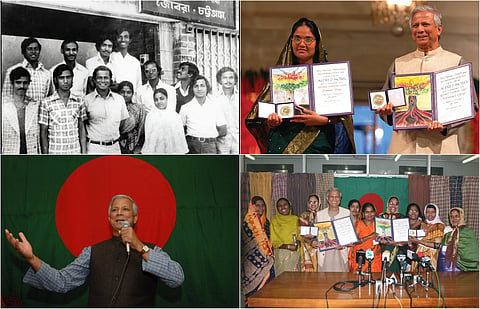
Yunus, Grameen Bank’s Nobel Peace Prize win marks 20 years
October 13 marks the 20th anniversary of the announcement that Professor Muhammad Yunus and Grameen Bank would jointly receive the Nobel Peace Prize.
On this day, the Norwegian Nobel Committee announced the award in recognition of their efforts to create economic and social development from below through poverty alleviation.
In a press release issued by the Yunus Centre to mark the occasion, it said the recognition brought global attention to the role of microcredit in empowering people at the grassroots level, particularly women, and creating economic opportunities for those traditionally excluded from the formal financial system.
The release said the work of Professor Yunus and Grameen Bank demonstrated how access to financial services and recognition of people's entrepreneurial potential could contribute to poverty alleviation and social development.
“In awarding the Nobel Peace Prize in 2006, the Nobel Committee recognised that poverty is not merely an economic problem. It is deeply connected to human dignity, security and peace. When people are economically deprived and have no opportunity to shape their own lives and futures, frustration and instability can follow.
“On the other hand, when people are economically empowered, given the opportunity to take control of their own lives and included in mainstream society, the foundations of peace become stronger.”
On December 10, 2006, the Nobel Peace Prize was presented at a ceremony at Oslo City Hall in the presence of members of the Norwegian royal family.
Professor Yunus received his medal and diploma and delivered the Nobel Lecture. Mosammat Taslima Begum, a Grameen Bank borrower and member of its Board of Directors, accepted the award on behalf of Grameen Bank.
The Nobel Peace Prize Concert was also held at Oslo Spektrum. The performers included opera singer Monica Yunus, Lionel Richie, Rihanna, opera and jazz singer Renée Fleming, singer Paulina Rubio, Hakim, Mick Hucknall of Simply Red, Yusuf Islam (formerly known as Cat Stevens) and Wynonna Judd.
The concert was hosted by Hollywood actors Anjelica Huston and Sharon Stone. Artists from Nrityanchal, a dance institution in Bangladesh, also performed on stage that evening.
The press release said that through the establishment of Grameen Bank five decades ago, “Professor Yunus sent a message to the world: a system that fails to recognise the lives and needs of poor people is a flawed system that must be changed.”
He envisioned a bank that would require no collateral and whose banking model would be built on mutual trust among people.
“Grameen's work has never been limited to microcredit alone,” the release said, highlighting the ‘Telephone Ladies’ initiative, healthcare initiatives and the Grameen Caledonian College of Nursing.
“Across housing, sanitation, solar energy, healthcare, education, technology and employment, these initiatives shared a common goal: not simply to provide people with loans, but to create the opportunities and build the capacities they need to stand on their own feet and become self-reliant.”
One of the most important lessons from Grameen's longstanding work, the release said, was that people must be seen not as passive recipients of assistance, but as individuals capable of transforming their own lives.
The release also highlighted Yunus' work towards “Three Zeroes”.
“Describing the current civilisation as ‘flawed’ and ‘self-destructive’, Professor Yunus continues to work towards a world of Three Zeroes: zero net carbon emissions, zero wealth concentration to end poverty, and zero unemployment through the development of entrepreneurship. This vision seeks to reshape the economic system around human potential, social equity and environmental sustainability.”