
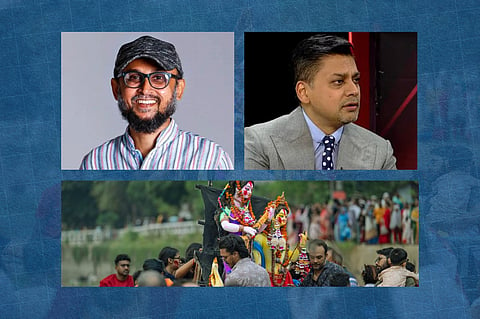
Peaceful Durga Puja draws praise as writers, filmmaker hail BNP government’s role
Bangladesh’s peaceful Durga Puja celebrations this year have drawn praise from writers, activists and cultural figures, who credited the BNP government and law enforcement agencies with ensuring the Hindu community could observe its biggest religious festival without major disruption.
Writer and activist Sadikur Rahman Khan, filmmaker Mostofa Sarwar Farooki and writer Faham Abdus Salam welcomed the celebrations, describing them as a significant departure from the atmosphere of fear and uncertainty they said had surrounded the festival in previous years.
In a Facebook post, Sadikur said nearly 4,000 Hindus had responded to a question posed by Indian media outlet Prothom Kolkata about the first Durga Puja under Bangladesh’s new government.
According to Sadikur, many respondents said they had not witnessed such a beautiful celebration since independence.
"The most peaceful Durga Puja in a Bangladesh without the Awami League has demonstrated who the real enemies of Hindus were," he wrote.
Sadikur accused the former ruling party of exploiting communal tensions to portray itself as the Hindu community’s only protector.
He acknowledged that religious hatred had not disappeared, particularly online.
"Derogatory comments about Goddess Durga continue to appear online. Nor can we say that online hatred surrounding Puja has disappeared," he wrote.
"But the fact that nobody dared to take that online hatred into the streets is a credit to the government."
Sadikur said the peaceful celebrations represented a collective achievement extending beyond religious identities.
"This joy belongs to Muslims. It belongs to Hindus. It belongs to Christians and Buddhists alike," he wrote.
Farooki also praised the authorities for maintaining security throughout the festival.
"Bangladesh has just celebrated a wonderfully joyous Durga Puja!" he wrote on Facebook.
He thanked law enforcement agencies, the Home Ministry and government officials at every level for ensuring a safe celebration.
"May every year be like this," he wrote, invoking what he described as the central spirit of the July mass uprising: "A Bangladesh that includes everyone and belongs to everyone."
Farooki also criticised those he believed were politically uncomfortable with the peaceful celebrations.
"Those who gain politically when our Hindu brothers and sisters suffer are bound to be unhappy," he wrote.
Meanwhile, Faham congratulated the BNP government for overseeing the celebrations.
"Congratulations and thanks to the BNP government!" he wrote.
He said Durga Puja during the Awami League's rule had often been accompanied by fears of communal disturbances.
"Ordinary Muslims in Bangladesh have never been so communal that they would prevent Hindus from celebrating Puja," Faham wrote.
He accused the Awami League of exploiting such fears for political advantage.
Addressing the Hindu community, Faham argued that religious minorities should not regard any single political party as their exclusive protector.
"I hope you will realise that the Awami League did not protect your interests. It used you," he wrote.
He expressed hope that Bangladesh was entering a period of greater religious tolerance, while acknowledging that the country had not yet overcome its communal divisions.
"We have entered a new chapter. Religious tolerance will increase," he wrote.
"Stay on the side of truth. There is no need for you to support the BNP."
--