
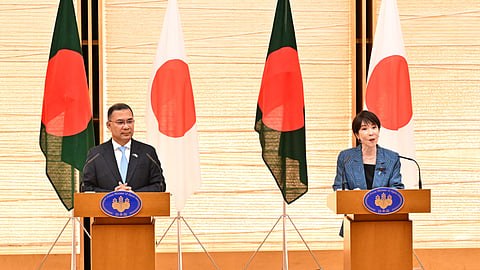
Bangladesh, Japan upgrade BIG-B initiative; Tokyo projects $6.5bn investment, 200,000 jobs
Japan has projected up to $6.5 billion in private investment in Bangladesh over the next five years, with the investment expected to create 200,000 jobs. The two countries also agreed to deepen cooperation in economic development, infrastructure, energy and defence.
The projection was welcomed by Japanese Prime Minister Sanae Takaichi and Bangladesh Prime Minister Tarique Rahman in a joint statement issued after their summit in Tokyo on Tuesday.
The statement outlines plans to develop the Matarbari area as a regional industrial hub, advance a bilateral trade agreement, explore Bangladesh’s entry into the RCEP, a major Asian trade bloc and strengthen maritime security cooperation.
A central part of the agreement is the upgrading of the two countries’ flagship initiative, BIG-B (Bay of Bengal Industrial Growth Belt), to “BIG-B for Shared Prosperity”.
The initiative aims to link power, energy, deep-sea port, industrial and information and communications technology infrastructure to strengthen supply chains and expand trade.
The statement says the initiative will seek to build a major hub for industrial value chains and develop Bangladesh into a trade and supply gateway.
It also highlights connectivity, resilience against natural disasters and geopolitical uncertainty, public-private partnerships and cooperation for regional peace and stability.
The two leaders agreed to develop the Matarbari–Maheshkhali area into a “major hub for logistics, energy and industry”, centred on the Matarbari Deep Sea Port.
They also agreed to advance preparatory work for the early operationalisation of the third terminal at Hazrat Shahjalal International Airport in Dhaka.
On trade, the leaders welcomed the signing of the Japan–Bangladesh Economic Partnership Agreement (EPA) and called for its early entry into force. They said the agreement could promote trade, investment and industrial diversification while supporting Bangladesh’s “smooth, sustainable, and resilient transition” from least-developed country status.
Japan also expressed its readiness to continue discussions on Bangladesh’s request to join the Regional Comprehensive Economic Partnership (RCEP), a major regional trade agreement.
The two countries also agreed to deepen defence cooperation amid an increasingly uncertain he two countries also agreed to deepen defence cooperation amid an “increasingly uncertain geopolitical environment”. They welcomed the signing and entry into force of an agreement on the transfer of defence equipment and technology. The declaration identifies “maritime situation awareness, coastal patrol and port security” as areas for further cooperation.
Energy security was another priority. The statement welcomed a 50 billion yen emergency support loan, worth about $330 million, to strengthen economic resilience and ensure stable energy supplies. It is the first yen-loan project under Japan’s Partnership on Wide Energy and Resources Resilience Asia programme.
PM Takaichi also stressed the need to improve Bangladesh’s investment environment. The joint statement says PM Rahman committed to facilitating investment by improving transparency and predictability in taxation, customs clearance, remittances and licensing procedures.
The leaders also discussed regional security, including the crisis in Myanmar and its impact on displaced Rohingya people and cross-border crime. They called for an immediate end to violence, humanitarian access and dialogue among the parties.
Both leaders said the ultimate solution to the Rohingya crisis was the “voluntary, safe, dignified and sustainable return” of displaced people, including the Rohingya, to Myanmar.
The statement also called for the urgent reopening of the Strait of Hormuz and the safe, unimpeded passage of vessels “without any additional costs”, citing the importance of maritime routes to global energy security and trade.