
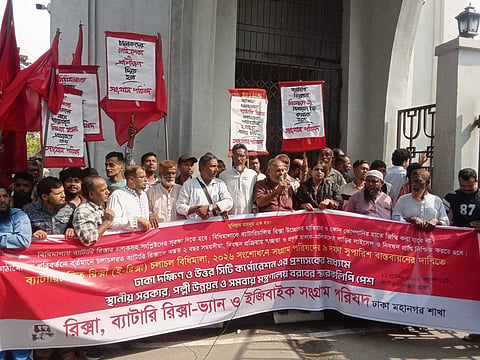
Rickshaw workers demand two years to comply with new e-rickshaw rules, warn of nationwide protests
Battery-powered rickshaw operators have demanded at least two years to comply with new government regulations, warning that the rules could threaten millions of livelihoods and leave the sector at the mercy of private companies.
The Rickshaw, Battery Rickshaw-Van and Easybike Struggle Council made the demand at a rally outside the National Press Club in Dhaka on Wednesday (November 11), calling for nine amendments to the Battery-Powered Rickshaw (E-Rickshaw) Operation Rules 2026.
The council said the regulations, introduced to bring order to the sector, contained serious ambiguities that could instead create confusion for an estimated six million vehicles.
"There is substantial public investment in the rickshaw sector, and destroying people's means of livelihood is unacceptable," speakers at the rally said.
They demanded that existing vehicles be allowed to operate for at least two years while owners modify them to meet the new standards.
The council also warned against regulations that could make drivers and small owners dependent on particular vehicle manufacturers or insurance companies.
"The regulations must not become an instrument for removing existing vehicles from the roads," the speakers said.
The workers' platform, which says it has campaigned for the legal recognition of battery-powered vehicles since 2013, welcomed the introduction of a regulatory framework but questioned several provisions.
One major omission, it said, was the absence of a clear driver licensing system.
"A driver is at the centre of any vehicle's operation. Yet nowhere in the regulations is there any mention of drivers obtaining licences," the speakers said.
They called for mandatory driver training and licensing, simpler registration procedures, lower registration and renewal fees, and measures to ensure genuine driver-owners receive permits.
The council also opposed placing costly solar-power requirements on small operators, arguing that most drivers could not afford them.
Instead, it proposed government-supported charging stations at important locations across Dhaka.
Other demands included publishing a clear list of major roads subject to restrictions and involving workers, owners and other stakeholders in revising the rules.
The rally was chaired by Jalal Ahmed, vice-president of the council's Dhaka metropolitan branch.
Among the speakers were Socialist Workers' Front president and labour leader Razekuzzaman Ratan, council convener Khalekuzzaman Lipon, SM Qadir, Afzal Hossain and Payel Akter Nupur.
The council said its campaign for legal recognition of battery-powered vehicles now covers 46 districts.
Following the rally, protesters marched through central Dhaka to Nagar Bhaban.
Delegations submitted memorandums addressed to the Ministry of Local Government, Rural Development and Cooperatives through Dhaka South City Corporation Administrator Abdus Salam and the office of the Dhaka North City Corporation administrator.
The council said it was willing to cooperate with the government in revising the regulations but warned of tougher nationwide protests if its nine-point proposal was ignored.
--