
'Surprise inspections, biometric attendance' as PM Tarique tightens oversight on bureaucracy
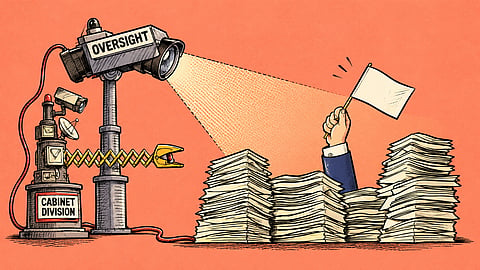
The Cabinet Division has assumed a stronger oversight role across Bangladesh's bureaucracy under Prime Minister Tarique Rahman's direct supervision, deploying inspection teams to ministries, monitoring officials through fingerprint attendance systems and scrutinising delays in government decisions.
Senior officials are examining pending files and reviewing the performance of ministries and divisions, a few top officials told Daily Waadaa, adding that they are also conducting surprise inspections.
The prime minister himself has reinforced the monitoring exercise through unannounced visits to government offices, questioning officials about attendance, administrative delays and the progress of their work.
A Cabinet Division official, speaking on condition of anonymity, told Daily Waadaa that 47 ministries and divisions had been connected to fingerprint attendance machines.
"The purpose is to bring all government officials under one roof. Keeping them in one place will ensure they remain under control," the official said.
"The prime minister is doing his office at the Secretariat, and the reason he is working from the Secretariat premises is that you have to keep the bureaucrats under control. Arbitrary conduct will not be tolerated."
The measures follow successive changes to the civil service since the fall of Sheikh Hasina's government in August 2024.
Under Hasina, the bureaucracy faced persistent allegations of political interference in appointments, promotions and postings.
The interim administration led by Nobel laureate Muhammad Yunus subsequently brought back some officials who had been sidelined during Awami League rule, including through contractual appointments, while sending others into compulsory retirement or assigning them as Officers on Special Duty, or OSD.
Tarique's government has continued making personnel changes while placing greater emphasis on file disposal and direct supervision.
Inspection teams track delayed files
Three teams headed by senior Cabinet Division officials have been visiting ministries and divisions to examine how files are processed and identify delays, according to the official.
The teams spend entire working days at selected offices, randomly reviewing files to establish how long they have remained pending and why decisions have not been taken.
"They are examining how files are being processed, which files remain pending and why they have not been disposed of," one official told Waadaa.
The inspections have found differences in performance between ministries. Some offices have been processing files within expected timeframes, while others have accumulated substantial backlogs.
Where delays are identified, the teams are seeking to accelerate decisions and prevent further accumulation of pending work. The Cabinet Division has also formed committees headed by additional secretaries to conduct surprise inspections and review whether officials are disposing of files on time.
The prospect of repeated inspections is intended to encourage compliance.
"Officials will work harder to keep file disposal on track because they know the team could return next month to check whether they are doing their jobs properly," the official said.
Delays in processing government files have long been a source of complaints from businesses and citizens seeking administrative approvals and public services. Prolonged decision-making can also create opportunities for unofficial payments and discretionary treatment.
The government has not released comparative figures showing whether the inspections have reduced average processing times or the number of pending files.
Talking with Waadaa, retired secretary Abdul Awal Majumder said the Cabinet Division had the authority to visit ministries because its officials effectively represented the prime minister.
"The Cabinet Division means that its officials represent the prime minister, as it is the prime minister's office," he said.
But Sadik Hasan, a professor of public administration at Dhaka University, questioned whether the Cabinet Division should directly scrutinise file management in other ministries.
Under the established administrative hierarchy, officials report to their respective ministry secretaries, who are responsible for supervising their work.
"It will create dual bossism because, under the normal chain of command, civil servants are accountable to their secretaries, not to the Cabinet Division. The Cabinet Division should not play the role of an auditor," Hasan told Waadaa.
The disagreement concerns whether central inspections strengthen existing accountability arrangements or introduce an additional reporting structure.
A fingerprint record of the working day
The government has also activated fingerprint attendance machines across ministries and divisions to monitor when officials and employees arrive at work. The system forms part of a wider set of attendance rules introduced after Tarique became prime minister on February 17.
He began working from the Secretariat the following day, arriving as early as 9am and asking about the attendance of ministers and government officials.
On February 24, the Cabinet Division issued a directive requiring employees of government, semi-government, autonomous and semi-autonomous institutions to observe their prescribed office hours.
The instruction referred to the Government Servants (Regular Attendance) Rules, 2019, and the Secretariat Instructions, 2024, which already require officials to attend and leave work at stipulated times.
A further circular, signed by Cabinet Secretary Nasimul Ghani on March 2, required officials and employees to remain in their offices between 9am and 9:40am every working day.
The directive followed concerns that some officials were arriving late after attending seminars, workshops, training programmes or personal appointments on their way to work.
The Cabinet Division said such absences disrupted communication between officials, other government departments and members of the public, delaying administrative work.
The instruction was not limited to the Secretariat. It applied to government, semi-government and autonomous institutions more widely. The administration subsequently moved to enforce the rules through fingerprint attendance machines.
Cabinet Secretary Nasimul Ghani, Principal Secretary ABM Abdus Sattar and the Information and Communication Technology secretary have access to attendance records, according to officials familiar with the arrangement.
The prime minister also records his attendance through the system. The monitoring arrangements allow senior officials to review attendance without relying solely on registers maintained by individual offices.
But the use of biometric attendance for senior civil servants has divided public administration experts.
Majumder welcomed the measure, arguing that punctuality was a basic requirement of professional conduct. "Officials in Europe, the United States, Singapore and Malaysia do not have a culture of arriving at work late," he said.
Hasan questioned whether the same system should apply to officials whose responsibilities regularly take them outside their offices.
"If they have to come to the office first in the morning to record their attendance, they will then have to leave for meetings or programmes. It will create inconvenience," he said.
He suggested that fingerprint monitoring was more suitable for employees whose duties required them to remain at a fixed workplace.
Prime minister makes his own inspections
Tarique has supplemented the administrative monitoring system with visits to ministries, sometimes arriving without prior notice. On March 29, the first working day after the Eid holidays, he arrived at the Secretariat at about 9:05am and began inspecting offices before going to his own.
He visited several ministries, including those responsible for power and energy, social welfare, education, housing and public works, and commerce.
He entered offices, spoke with officials and asked whether employees had reported to work on time. The visits also covered the use of government resources.
According to his press office, Tarique instructed officials to reduce unnecessary electricity consumption, limit the use of air conditioners, make better use of natural light and maintain office equipment.
He returned to his Cabinet Division office at about 10am for a meeting on the government's Farmer Card programme.
The visits prompted the Ministry of Public Administration to reiterate existing instructions on attendance, energy conservation and workplace cleanliness.
In a March 29 notification, the ministry acknowledged that compliance with earlier directives had been inadequate. It instructed government offices to ensure employees remained at their desks between 9am and 9:40am and to take measures to reduce electricity consumption.
Air conditioners were to be set at 25°C or above, unnecessary lighting was to be avoided, and electrical equipment was to be switched off when offices were unoccupied.
The ministry also called for vigilance teams to monitor compliance. The prime minister's visits have since extended beyond attendance checks to reviews of individual ministries' work.
On September 13, Tarique visited the Ministry of Agriculture at about 3:30pm. He walked from his office to Building 4 and climbed the stairs to the ministry's sixth floor rather than taking the lift.
During a meeting with officials, he called for increased domestic agricultural production to reduce dependence on imported food and agricultural products.
The discussions covered agricultural research, productivity, mechanisation and measures to reduce farmers' production costs.
The government has also been working on a Farmer Card programme, with the Agriculture Ministry targeting distribution to 4.3mn farmers during the 2026-27 financial year.
On October 11, Tarique visited the Ministry of Fisheries and Livestock to review its activities and the progress of development projects.
Three days later, he met officials at the Ministry of Cultural Affairs, instructing them to promote Bangladesh's cultural heritage and encourage reading among children.
On October 15, he visited the Ministry of Environment, Forest and Climate Change, where discussions covered environmental protection, air pollution and the implementation of government programmes.
The meeting also produced a decision to identify and preserve the country's mother trees within six months.
Reform beyond attendance
The government's monitoring drive comes as Bangladesh's civil service continues to face questions about politicisation, staffing and promotion practices.
A 2026 assessment by Transparency International Bangladesh found that the Yunus administration had promoted 1,549 officials during 2024-25 who were considered to have been deprived of career advancement for political reasons under the previous government.
The promotions included retrospective appointments and promotions to supernumerary posts.
But the assessment also raised concerns about appointments and promotions that did not consistently follow established criteria, as well as the continued use of contractual appointments.
It found that only three of the 18 recommendations identified for immediate implementation by the Public Administration Reform Commission had been carried out.
The commission had made 208 recommendations in total.
The assessment also reported a substantial mismatch between authorised posts and the number of officials occupying positions in parts of the administration, with 6,535 officials against 3,696 authorised posts.
The reform commission had proposed changes to the civil service's organisation, including reducing the number of cadres from 26 to 13 services and creating a Superior Executive Service for senior Secretariat positions.
The proposals were intended to address questions about recruitment, promotion and the distribution of authority across government. These proposals haven’t been implemented yet.
—