
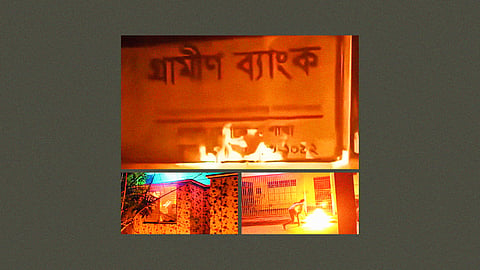
Nobel-winning Grameen Bank a target: 21 branches attacked by 'Joy Bangla' shouting AL suspects, women owners on edge

A crowd gathered outside a Grameen Bank branch in Tungipara, Gopalganj, after Maghrib prayers on Sunday. Some carried a loudspeaker. Their message was clear: destroy the office.
“Break the CCTV cameras,” a voice instructed over the loudspeaker, according to footage of the attack. “If necessary, we will give Yunus a drum of oil. Go and burn everything.”
“We will provide as much oil as needed today. Nothing should remain. Yunus has caused us a lot of pain.”
The crowd repeatedly shouted “Joy Bangla” and “Joy Bangabandhu” as the branch was attacked and set on fire.
Mohammad Anwar Zahid, the branch manager, had already left by then. Earlier that day, staff had been warned that the market was becoming unsafe. A borrower told him that people had set fire to property in different parts of the area and advised them to close the office.
Zahid and his colleagues shut the branch and left for safety.
The warning may have saved them from being caught in the attack. But the office was almost completely destroyed. Computers, monitors, CCTV cameras and important documents were smashed or burnt. The attackers broke open three cabinets, while the windows of the upstairs dormitory were also shattered.
Zahid had been living with his family in the same building. With help from local residents, he moved their belongings to another house on Monday. Fearing for his safety, he has since left Tungipara and returned to Gopalganj town.
“I think reopening the branch would be very difficult without the support of local people,” he said, adding that residents had advised staff to stay away for the time being.
The attack was among a series of recent assaults on Grameen Bank branches across Bangladesh.
The bank’s Managing Director, Sarder Akhter Hamed, told Daily Waadaa that 21 branches had been attacked as of Monday, with the most recent incident reported in Mithapukur, Rangpur.
Grameen Bank, a microfinance institution widely known as the Bank for the Poor, jointly won the 2006 Nobel Peace Prize with Professor Muhammad Yunus for its pioneering work in providing microcredit to millions of rural women, a programme it has been running since the 1980s.
The repeated incidents have unsettled employees and raised serious concerns about the safety of a bank whose majority shareholders are its rural borrowers, most of them women.
Anger over Yunus spills over to Grameen Bank
The messages heard during the Tungipara attack point to the attackers' anger towards the bank's founder, Nobel laureate Professor Muhammad Yunus, who led the interim government formed after the ouster of former prime minister Sheikh Hasina in a student-led uprising in August 2024.
The same association appears to have featured in an attack on another branch in Gopalganj.
At the Ulpur branch, manager Afroza Akter Lima said 20 to 30 people entered the office at around 6:15pm on Sunday. Nine employees, including Lima, were inside at the time.
The attackers shouted “Joy Bangla” as they entered and threatened to set the office on fire unless the staff left. The employees were forced out before the attackers set fire to the premises.
One bank official said the attackers referred to the branch as “Yunus's bank”. They burnt paper records, smashed digital equipment and took money collected from loan instalments, the official said.
Staff returned to work the following morning, Monday.
Video footage of the attack also captured slogans and anti-Yunus messages.
Aminul Islam, officer-in-charge of Gopalganj Sadar Police Station, said police were examining the footage. He acknowledged that it showed people shouting “Joy Bangla” but said no specific suspects had been named in a complaint to police.
‘Setting fire to the chests of rural people’
Grameen Bank is not owned by its founder, Nobel laureate Muhammad Yunus. Under its current ownership structure, 90% of the bank is held by borrower-shareholders, while the government owns the remaining 10%. Most of the borrowers are rural women.
“Mr Yunus has absolutely no ownership in the bank. Nothing. Zero,” Hamed told Waadaa.
He said the attacks were destroying records belonging to women who had painstakingly built their financial histories over the years.
“When a branch is set on fire, it is like setting fire to the chests of rural people,” he said.
Fear spreads among staff
The series of attacks has had a chilling effect on Grameen Bank employees across the country. It has left staff worried about their safety and the future of their branches.
Abdul Hannan, manager of the bank's Amtala branch in Netrokona, was woken at around 3:30 in the morning on November 10 by the night guard, who shouted that the roadside signboard was on fire.
Hannan, who lives on the second floor of the building, rushed downstairs. He and other staff members managed to put out the flames before they could spread.
The damage was limited, but the fear has stayed with him.
“Even while sleeping, I suddenly wake up thinking there is a fire,” Hannan said. “I start shouting, ‘Fire! Fire!’ Then I come to my senses and realise nothing has happened.”
At the Challisha Bazar branch in the same district, manager Shahjahan Ali said someone poured petrol on the signboard outside the building and set it alight at around 11:30pm on November 13.
The night guard and another staff member quickly extinguished the fire using sand, cement and water.
“There is a sense of fear. It creates anxiety among our customers,” Ali said. “We ourselves remain worried about what might happen and when another incident could occur.”
He said some people wrongly believed that Yunus owned the bank, a perception that appeared to be contributing to the hostility.
Police response under scrutiny
Police have yet to arrest those responsible for attacks reported in several districts.
In Netrokona, police have recorded one case and two general diaries in connection with three incidents, said Abul Khayer, officer-in-charge of Netrokona Model Police Station. The case was filed against unidentified people.
“We cannot say for certain, but neither can we rule it out,” Khayer said when asked about possible Awami League involvement.
Police have asked the bank to install CCTV cameras and deploy security guards at its branches. They have also increased night patrols around vulnerable offices, he said.
In Tungipara, Zahid said he contacted the local officer-in-charge during the attack but was told police could not deploy personnel to deal with the crowd.
The officer-in-charge, however, denied receiving a call from the manager when contacted by Waadaa, saying he had no knowledge of any such call.
Asked whether the branch was safe on Monday, he said he had seen no immediate problem that day, although he acknowledged that the situation had been unsettled the previous day.
In Pabna, police official Tariqul Islam said the bank had not filed a formal complaint over an attack on its Dogasi Bazar branch. Police had filed a general diary on their own, he said.
He also said they suspected possible Awami League involvement but stressed that a full investigation was needed before reaching any conclusion.
Hamed said the bank had informed law enforcement agencies about the incidents. General diaries had been filed in some places, while formal cases were being prepared in others.
He said he had visited branches in Pabna, Naogaon and Rajshahi to reassure employees, urging them not to lose courage and to continue their work.