
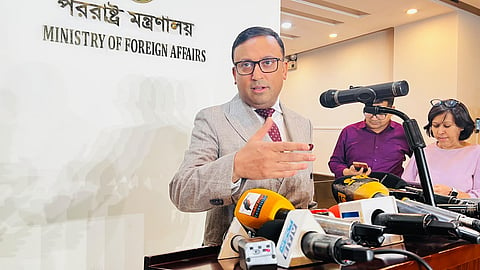
ICJ genocide ruling a historic first, positive for both Rohingya and Bangladesh, says State Min Humaiun
State Minister for Foreign Affairs Humaiun Kobir on Thursday welcomed the International Court of Justice's (ICJ) ruling holding Myanmar responsible for genocide against the Rohingya as a historic milestone, saying it would have positive implications for both the persecuted community and Bangladesh.
"It is the very first time ICJ condemned a state for genocide. State of Myanmar has been convicted for genocide against the Rohingya communities. It is for the first time in International Court history the condemnation taken place for such grave violence," Humaiun told journalists at the Ministry of Foreign Affairs.
He said the government would provide a detailed assessment of the ruling and its implications after reviewing the decision.
"So, we will inform you tomorrow. First, let us review it; tomorrow we will be able to speak in detail. Positive outcome for Rohingya communities, also the country affected by this. So there are positive implications for Bangladesh," he said.
His remarks came after the UN's top court ruled on Thursday that Myanmar had committed genocide against the Rohingya, finding that killings, widespread sexual violence and other atrocities by its security forces during the 2017 military crackdown constituted genocide.
The ruling came seven years after Gambia filed the case and marked the first time the ICJ had held a state responsible for genocide. It was also only the fourth time since the Nazi Holocaust that an international court had found the legal threshold for genocide to have been met.
"The court finds that Myanmar's security forces killed thousands of Rohingya civilians, perpetrated widespread acts of sexual violence as well as acts of extreme violence against children and attacked fleeing Rohingya," presiding Judge Yuji Iwasawa said while reading the decision.
The court specifically found "that the Republic of the Union of Myanmar has committed genocide against the Rohingya group in Northern Rakhine State".
The judges found that Myanmar's military had carried out mass executions of Rohingya men and boys, committed widespread rape and sexual violence against women, and burned or razed hundreds of villages during so-called clearance operations. They also found that the military had actively spread hate speech targeting the Rohingya population.
The court's ruling is final and cannot be appealed.
Genocide is rarely established in international courts because prosecutors must prove specific intent to destroy, in whole or in part, a national, ethnic, racial or religious group.