
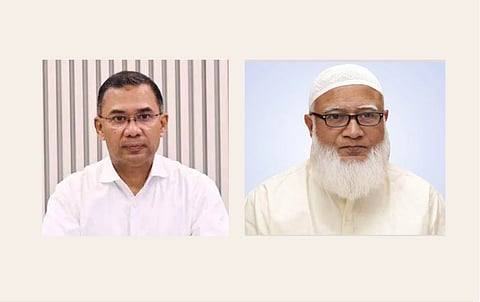
PM, opposition leader hold one-on-one talks on unity against Awami League violence
Prime Minister Tarique Rahman and Opposition Leader Dr Shafiqur Rahman held a one-on-one meeting on Wednesday to discuss a united political response to growing violence allegedly involving Awami League activists across Bangladesh.
The meeting, held at the prime minister's initiative, raised hopes of renewed cooperation between the government and opposition despite their differences over implementing the July National Charter, political leaders and analysts said.
The two leaders met for about 10 to 12 minutes at the Prime Minister's Office in the Jatiya Sangsad Bhaban during a break in the parliamentary session for Maghrib prayers, sources familiar with the meeting told Daily Waadaa.
The talks came amid a wave of arson attacks, political killings and violence targeting public institutions and lawmakers' residences, with activists of the Awami League, whose political activities have been banned, accused of involvement in several incidents.
On Tuesday night, Awami League activists allegedly attacked and set fire to Tungipara Police Station in Gopalganj. They also allegedly vandalised and torched the residence of Gopalganj-3 MP SM Zilany.
At least three ruling party leaders were killed in Narail and Faridpur on Tuesday and Wednesday in attacks allegedly carried out by Awami League activists.
A senior Bangladesh Jamaat-e-Islami leader familiar with the discussions said the prime minister sought Shafiqur's views on responding to the unrest and strengthening unity among political forces that opposed Sheikh Hasina's government during the July 2024 uprising.
The leader, speaking to Waadaa on condition of anonymity, said both sides showed willingness to narrow their political differences and work together against violence linked to the Awami League.
Tarique also raised the possibility of an all-party mass procession to demonstrate national unity, according to sources familiar with the meeting.
Shafiqur suggested that the prime minister, as head of government, first make a formal call for national unity.
The two leaders also discussed the July Charter and the referendum verdict, issues that have created differences between the BNP government and the Jamaat-led opposition.
The government favours implementing the charter through constitutional amendments in parliament, while Jamaat and its allies want the referendum verdict implemented in full through a constituent assembly or constitutional reform council.
Shafiqur stressed that implementing the referendum verdict would further strengthen political unity, according to the sources.
Although no breakthrough was reached on the charter's implementation, the discussions were viewed as a positive step towards easing tensions between the two sides.
Jamaat Assistant Secretary General A H M Hamidur Rahman Azad told Waadaa, "The meeting would be a positive development if it helped secure implementation of the referendum verdict."
The two leaders subsequently returned to parliament, where both called for unity against the political forces ousted during the July uprising.
In his concluding speech, Tarique urged political parties inside and outside parliament to stand together against attempts by the Awami League to regain influence.
Shafiqur also stressed the need for unity in defending the gains of the uprising.
Lawmakers from both the treasury and opposition benches thumped their desks in support of the speeches, reflecting a rare display of cross-party agreement.
The Jamaat-led 11-party alliance was scheduled to meet on Thursday at the opposition leader's residence on Minto Road to review the discussions and consider its next steps.
Analysts see hope for greater unity
Political observer Mubashar Hasan described the meeting as an encouraging step towards rebuilding political unity.
"It was a good leadership move from the Prime Minister to invite and have a candid discussion with the Jamaat leader," Hasan, an adjunct researcher at Western Sydney University's Humanitarian and Development Research Initiative, told Waadaa.
He said the BNP's focus on criticising Jamaat and the NCP after the election had weakened the broader unity forged during and after the July uprising.
That division, he argued, had created political space for the Awami League to regroup.
Hasan also welcomed Shafiqur's willingness to engage, saying the meeting could help reduce tensions between the former allies.
However, he warned against underestimating the recent violence, particularly attacks on lawmakers' homes and public institutions.
He also cautioned that resolving the July Charter dispute could be difficult because of competing political interests.
Hasan said political leaders needed a broader consensus on how to address the Awami League question beyond immediate security measures.
"How would you address the Awami League question legally, politically, culturally and socially? That needs a wider consensus. And maybe this meeting could be a step forward towards that," he said.
He warned that failure to address longstanding grievances and political divisions could undermine Bangladesh's democratic transition.
___