
Jamaat chief faces Australian visa challenge led by Bangladeshi filmmaker

Bangladesh Jamaat-e-Islami chief Shafiqur Rahman's visit to Australia has drawn opposition from Jewish and Hindu advocacy groups, with a Sydney-based Bangladeshi migration agent and filmmaker leading a legal push to revoke his visa.
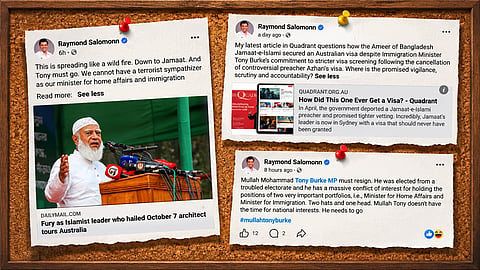
Raymond Salomonn, who wrote and directed a musical film depicting Sheikh Mujibur Rahman and his family in 2020, prepared a submission urging Australian Home Affairs Minister Tony Burke to exercise his executive powers to cancel Shafiqur's visa.
The Australian Jewish Association (AJA) and the Australian Hindu Association (AHA) have separately issued a joint statement demanding that Canberra explain why the Bangladeshi opposition leader was granted entry.
Meanwhile, Shafiqur has decided to cut short his Australian tour to attend a meeting with Prime Minister Tarique Rahman over alleged sabotage activities by the activity-banned Awami League.
There is, however no indication that the decision to return early was prompted by the visa challenge.
Jamaat Assistant Secretary-General Ahsan Mahbub Zubayer told Daily Waadaa that the Prime Minister's Office had contacted the party about Shafiqur's availability for talks.
"The prime minister is waiting for him. That is why he is cutting short his Australia visit and returning. He will no longer visit Malaysia," Zubayer said.
When asked about the Australian Jewish Association’s protest against Jamaat Chief, Zubayer told Waadaa that “anyone can have different opinion and we respect that. But the fact is Jamaat chief completed all his official programs there and he didn’t face any trouble."
Shafiqur left Sydney's Kingsford Smith International Airport on Tuesday afternoon and is expected to reach Bangladesh by Wednesday afternoon.
The Bangladeshi behind the visa challenge
Speaking to Waadaa, Salomonn denied any affiliation with the Awami League but said he opposed Jamaat because of the party's position against Bangladesh's independence in 1971.
He said he did not want “Jamaat leaders on Australian soil.”
Asked about his role in seeking the cancellation of Shafiqur's visa, Salomonn said his involvement had already been detailed in the Australian media.
Australian media outely The Australian on Monday published a story titled “‘Sinwar was a hero’: Fury as Hamas-praising Bangladesh Islamist leader arrives.” The newspaper reported on mounting pressure on the Albanese government to revoke the visa of Bangladesh Jamaat-e-Islami chief and opposition leader Shafiqur Rahman during his Australian visit.
The report pointed out Shafiqur’s past tributes to slain Hamas leaders Yahya Sinwar and Ismail Haniyeh, Jamaat's controversial role in Bangladesh's 1971 Liberation War and a disputed social media post comparing women's employment to prostitution.
The Australian Jewish Association and Australian Hindu Association jointly questioned his admission, citing Australia's exclusion of Israeli politicians. Burke declined to disclose details of the visa screening process, while Shafiqur did not provide a response.
When questioned about his political affiliations, Salomonn initially asked whether the Waadaa correspondent subscribed to the ideology of the 1971 Liberation War before directing attention to his public profile.
Asked whether he had any affiliation with the Australian Jewish Association, Salomonn said the question would be better directed at Tony Burke.
Salomonn is a registered migration agent, legal researcher and policy analyst specialising in international law, South Asian geopolitics and the declassification of historical records relating to Bangladesh's Liberation War.
He holds law degrees from the University of Technology Sydney and Western Sydney University.
His filmmaking credits include Baba, a 2020 musical film depicting Sheikh Mujibur Rahman and his family, featuring characters portraying Sheikh Hasina, Sheikh Rehana and other family members.
In a Facebook post on November 3, 2020, Salomonn announced that the film had been officially selected for the Sydney Lift-Off Film Festival, describing it as its second international award nomination.
From Azhari to Shafiqur
Salomonn's campaign against Shafiqur follows his earlier criticism of Australia's decision to grant a visa to Bangladeshi Islamic preacher Mizanur Rahman Azhari.
Australia subsequently revoked Azhari's visa over remarks praising Adolf Hitler. Asked whether he had played a role in Azhari's removal, Salomonn did not respond directly.
He told Waadaa that Australian authorities had obtained certain information concerning Azhari and had subsequently asked him to leave the country.
He did not disclose the nature or source of that information.
In an article published in the Australian conservative magazine Quadrant on November 23, Salomonn drew parallels between Azhari's admission and Shafiqur's visit.
He cited his previous article in April questioning how Azhari had obtained an Australian visa and argued that the government's screening procedures had failed again.
Salomonn invoked sections 133C(3) and 501(3) of Australia's Migration Act 1958, which provide ministerial powers to cancel visas on specified public order and character grounds.
He called on Burke to disclose whether Shafiqur's application had been referred to the Controversial Visitors Unit and whether screening procedures had changed following the Azhari episode.
Speaking to The Australian, Salomonn also alleged a conflict of interest arising from Burke's electoral constituency, which includes Lakemba and Bankstown, areas with substantial Muslim populations.
He questioned Burke's suitability for the home affairs portfolio, accusing him of failing to deliver on promises of tighter visa screening.
Jewish and Hindu groups join the opposition
The Australian Jewish Association and the Australian Hindu Association issued their joint statement on November 23, raising concerns over Shafiqur's statements about Hamas and Jamaat's historical record.
The AJA is a conservative pro-Israel advocacy organisation whose positions on Israel and Palestine have been characterised as far-right by critics. The organisation describes itself as centre-right.
The controversy received coverage in The Australian, Jewish News Syndicate and The Times of Israel.
AJA president Robert Gregory contrasted Shafiqur's admission with Canberra's decision to deny entry to former Israeli minister Ayelet Shaked and cancel the visa of far-right Israeli parliamentarian Simcha Rothman.
Gregory accused Canberra of applying inconsistent standards to foreign political visitors.
Australian Hindu Association president Amendra Singh cited allegations of violence against Hindus in Bangladesh, including killings, arson, kidnapping, looting and intimidation.
Both organisations highlighted Jamaat's opposition to Bangladesh's independence in 1971 and the subsequent convictions of several former party leaders for war crimes and crimes against humanity.
They also questioned reports that Australian parliamentarians had attended a luncheon hosted for Shafiqur by the Australian National Imams Council on November 21.
The organisations demanded that Canberra disclose whether any government representatives had met the Jamaat chief.
Shafiqur arrived in Sydney on November 20. His engagements included meetings with Islamic community leaders, expatriate Bangladeshis, academics and professionals.
On November 21, he attended a children's event at Western Sydney University's Bankstown campus and a discussion on state reform organised by former Islami Chhatra Shibir leaders.
He addressed another gathering at the university's Campbelltown campus on November 22 before attending a reception at the Crowne Plaza Hotel in Canberra the following day.
Hamas tributes and disputed X posts
Salomonn's submission cited Shafiqur's public tributes to Hamas leaders Yahya Sinwar and Ismail Haniyeh, both killed in 2024.
Shafiqur described Sinwar as a hero of the Palestinian freedom struggle and mourned Haniyeh's assassination in Tehran.
Hamas is designated a terrorist organisation under Australian law.
Salomonn argued that the statements warranted scrutiny under Australia's immigration and counter-terrorism provisions.
He also cited Shafiqur's diplomatic engagement with Tehran, his tributes to Iranian leaders and Jamaat's relationship with the Islamic Republic.
Australia has designated Iran's Islamic Revolutionary Guard Corps as a state sponsor of terrorism following allegations of Iranian-directed antisemitic attacks in Sydney and Melbourne.
The Australian also cited a post published from Shafiqur's verified X account ahead of Bangladesh's February general election, comparing women's employment outside the home with prostitution.
The post triggered protests by women, students and trade unionists. Women's rights campaigners highlighted the contribution of Bangladesh's nearly 24mn working women, including millions employed in the garment sector.
Shafiqur maintained that his account had been hacked. Several women's rights groups questioned that explanation.
The newspaper also highlighted Jamaat's failure to nominate a female candidate in the 2026 parliamentary election and Shafiqur's reported position against women leading the party.
Muslim community representatives reject allegations
In a statement circulated in response to the controversy, representatives of Australia's Muslim community accused The Australian of misrepresentation, selective reporting and character assassination.
They challenged the newspaper's portrayal of Shafiqur, saying it had presented no evidence connecting him to the October 7, 2023 attacks.
“Condemning an extrajudicial killing is not an endorsement of terrorism,” the statement said.
The signatories argued that Shafiqur's condemnation of Haniyeh's assassination on July 31, 2024 should be assessed in the context of opposition to political assassinations.
They cited similar reactions from Palestinian Authority President Mahmoud Abbas, Turkish President Recep Tayyip Erdoğan, the Qatari prime minister and representatives of other governments.
The statement also challenged the attribution of the disputed X post to Shafiqur.
Citing reports by The Daily Star and Prothom Alo, it noted that Jamaat had lodged a general diary with police over the alleged hacking. It also referred to a subsequent investigation and the reported arrest of a Bangabhaban official.
The signatories demanded that The Australian substantiate its allegations, correct inaccuracies and provide Shafiqur with a fair opportunity to respond.
They warned that inadequate contextualisation of political and religious issues could damage relations within Australia's multicultural communities.
They also called on Australian media regulators to investigate any substantiated breaches of journalistic standards and urged scrutiny of possible foreign interference and coordinated disinformation targeting Bangladesh.
Canberra declines to disclose visa screening details
Burke declined to confirm whether Shafiqur's public statements had been assessed before his visa was granted or whether his application had been referred to the Controversial Visitors Unit, citing privacy considerations.
His spokesperson said non-citizens applying for Australian visas were subject to applicable health, character and security requirements.
Shafiqur did not respond to The Australian's requests for comment.
—