
NBFI sector's net assets plunge into negative territory as bad loans, governance failures take toll
Higher levels of non-performing loans and sluggish economic growth are putting mounting pressure on Bangladesh’s non-bank financial institution (NBFI) sector.
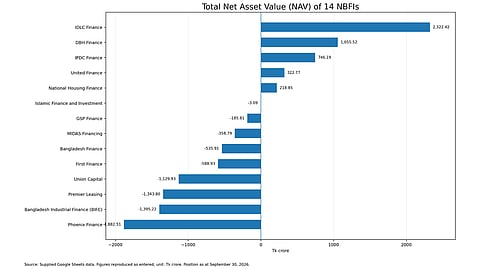
The aggregate results of 14 listed NBFIs show that their combined net asset value turned negative by around 2,800 crore taka during January–September 2026.
This means the sector’s combined liabilities exceed its combined assets. Nine of the 14 firms reported a negative net asset value totalling nearly 7,500 crore taka, while the remaining five had a positive net asset value of around 4,700 crore taka.
Investors and depositors are shifting away from weaker NBFIs towards financially stronger institutions, seeking safer investment and deposit options. Stronger NBFIs are attracting more deposits, while weaker ones are facing mounting liquidity pressures. This shift is taking place despite anomalies in the stock market, where shares of some financially stronger NBFIs continue to trade at relatively low prices.

Weak corporate governance at root of NBFI crisis
Weak corporate governance is the primary reason behind the financial distress facing several non-bank financial institutions (NBFIs), and the crisis has accumulated over many years rather than emerging suddenly, said Masud Karim Majumder, FCA, chief financial officer of IDLC Finance PLC.
“The crisis in the industry did not happen suddenly; it developed over a long period. The core issue behind the poor health of the NBFI and banking sectors has been corporate governance,” he said.
Institutions that failed to maintain strong governance practices are now suffering, while those with a strong corporate governance culture have continued to perform well, he added.
During the Hasina-led Awami League regime, banks and non-bank financial institutions (NBFIs) were subjected to widespread looting through the misuse of loan facilities, allegedly involving politically influential business groups and individuals close to the ruling establishment.
Business groups linked to S Alam, as well as PK Halder, Salman F Rahman and others with ties to the regime, were implicated in the extraction of funds from the financial sector. Such large-scale irregularities and alleged loan scams contributed significantly to the deep-rooted crisis now facing Bangladesh's banking and NBFI sectors.
NBFIs earn less from core lending business
Bangladesh’s non-bank financial institutions (NBFIs) are earning less from their core lending operations as sluggish private sector credit growth limits their ability to expand loan portfolios.
With private sector credit growth falling to its lowest level in 30 years, NBFIs are struggling to increase lending, putting pressure on net interest income (NII) — the difference between interest earned on loans and interest paid on deposits and borrowings.
In response, financially stronger institutions with surplus liquidity have increasingly turned to alternative investment opportunities, particularly government treasury bills and bonds, to generate returns.
Of the 14 listed NBFIs, only five recorded positive net interest income during January–September 2026, while the remaining nine reported negative figures, reflecting persistent pressure on their core business.
IDLC Finance, the country's leading NBFI by this measure, posted the highest net interest income at 263 crore taka, although the figure was around 8 percent lower than the 287 crore taka recorded in the same period a year earlier.
DBH Finance, meanwhile, registered remarkable growth of more than 57 percent, with its net interest income rising to nearly 159 crore taka from around 101 crore taka a year earlier.
IPDC Finance also posted strong growth, with net interest income increasing to 188 crore taka in the first nine months of 2026 from around 149 crore taka in the corresponding period of 2025.
United Finance and National Housing Finance were the other two institutions that recorded positive net interest income, at around 65 crore taka and 19 crore taka, respectively.
The remaining nine institutions reported negative net interest income, indicating that their interest expenses exceeded the income generated from their lending operations.
IDLC Finance dominated the investment income segment, earning 353 crore taka in the first nine months of 2026, up 36 percent from the same period a year earlier.
IPDC Finance also posted strong growth, with its investment income rising more than 24 percent to 116 crore taka.
Together, the 14 listed NBFIs generated around 550 crore taka in investment income during January–September 2026, a 27 percent increase year-on-year. Much of the growth was driven by financially stronger institutions, particularly IDLC Finance and IPDC Finance.
Explaining the pressure on net interest income, Majumder said declining private sector credit growth had encouraged financially stronger NBFIs with adequate cash holdings to explore alternative investment opportunities, particularly government treasury bills and bonds.
“Private sector credit growth has been declining over the past one and a half to two years and has recently come down to around 4–5%. In this situation, institutions with strong liquidity naturally look for alternative investment opportunities. Government bills and bonds offered attractive returns,” he said.
Only seven NBFIs manage to post net profits
Of the 14 listed non-bank financial institutions (NBFIs) analysed, only seven managed to report net profits during January–September 2026 after accounting for operating expenses, provisions and taxes.
IDLC Finance recorded the highest net profit, earning 203 crore taka during the first nine months of 2026. DBH Finance ranked second with a net profit of 81 crore taka, followed by IPDC Finance with 36 crore taka.
IPDC Finance set aside the highest amount for provisions among the 14 institutions, at 125 crore taka during the period.
Bangladesh Finance and National Housing Finance, meanwhile, reported negative provision expenses, indicating provision reversals or adjustments, while still managing to post net profits.
Strongest NBFIs trade at relatively low valuations
Despite being among the strongest institutions in the sector, IDLC Finance shares are trading at a relatively low valuation on the Dhaka Stock Exchange (DSE).
The company's shares closed at 42 taka apiece on Wednesday, with a price-to-earnings (P/E) ratio of 6.81, compared with the industry average of more than 10, according to stock research firm AmarStock.
The P/E ratio measures how much investors are willing to pay for each taka of a company's earnings. A lower P/E ratio means investors are paying less for each taka of earnings compared with companies having higher ratios.
However, a lower valuation does not necessarily mean a share is undervalued, as it may also reflect investors' concerns about future growth, risks or profitability.
Regarding the company's share price, Majumder said management and the board focused on maintaining the company's financial health, running its operations efficiently and delivering returns to shareholders.
He said share prices in Bangladesh's stock market were influenced largely by investor sentiment and broader market dynamics rather than being directly determined by management.
“From management's perspective, our responsibility is to keep the company healthy, operate it properly and deliver good returns. In Bangladesh's imperfect market, share prices largely reflect investor sentiment. Our focus is on taking the necessary steps to maintain the company's financial soundness,” he said.