
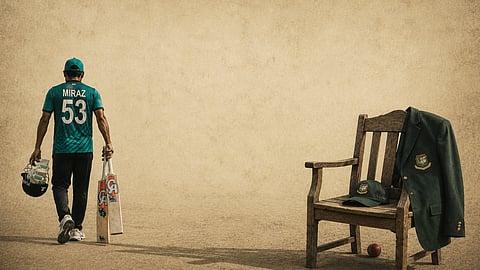
Miraz: Bangladesh’s best-ever mediocre captain?
There is a saying, ‘All good things must come to an end.’ While accurate, it’s not entirely truthful.
It’s not just the good things that come to an end, everything does – the good, the bad and the mediocre.
On Wednesday, Mehidy Hasan Miraz’s tenure as Bangladesh’s ODI captain came to an end.
He was removed from his post following a board of directors meeting of the Bangladesh Cricket Board (BCB).
During the announcement, BCB president Tamim Iqbal tried his best to sugarcoat the dismissal, saying Miraz was replaced by T20I captain Litton Das as the board wanted one captain for both white-ball formats, and the team needed Miraz the player more than Miraz the captain.
The removal didn’t send any shockwaves through the media or social media either.
Miraz had led the ODI side as its full-time skipper for a little over a year but never really matured into the role or convinced everyone that he is the ideal man to lead Bangladesh in next year’s ODI World Cup.
From his dismissal and the lukewarm response, it may seem like his captaincy record was mediocre at best.
But that’s not the case at all.
Miraz’s successes as captain
Since being named the full-time ODI captain on June 12, 2025, Miraz led the side in 21 matches, winning 10 and losing 11.
His win percentage in this period is 47.62 – the third best of all Bangladesh ODI captains behind Tamim (56.75) and Mashrafe Bin Mortaza (56.81).
At home, the 28-year-old was undefeated in bilateral series, winning four back-to-back series against West Indies (2-1), Pakistan (2-1), New Zealand (2-1) and Australia (2-1).
He is the first Bangladesh captain since Mashrafe to win four straight home ODI series.
While Mashrafe had stretched his streak to six home series, it included two series wins over Zimbabwe and one against Afghanistan – comparatively weaker opponents than the ones Miraz had to contend with.
On the basis of statistics, Miraz’s reign as ODI captain was one of the best in Bangladesh’s history.
But as Mark Twain – a pioneering American humorist and author – had once famously said, “There are three kinds of lies: lies, damned lies, and statistics.”
Miraz has the skills and experience to be a useful player in ODIs in the right conditions. But as he is no longer the captain, his position – solely based on performances – is no longer certain.
The statistical fallacies
Bangladesh, historically, do well in home ODIs.
Miraz inherited a settled bowling attack with a varied fast bowling unit, containing the X-factor of speedster Nahid Rana.
This bowling attack was the driving force behind his strong record at home. But in away series, where a captain’s tactical acumen is tested the most, he got exposed.
Under Miraz, Bangladesh played three bilateral away series, and lost all of them – against Sri Lanka (1-2), Afghanistan (0-3) last year, and against Zimbabwe (1-2) earlier this month.
The series defeat against Zimbabwe was the most telling of the three defeats.
In the first ODI, speedster Nahid Rana had snapped up five wickets to render Zimbabwe down to 70-8 inside 20 overs.
The conditions clearly favoured fast bowling, as Taskin Ahmed had also picked up two wickets inside the first 10 overs.
But instead of going for the kill, Miraz brought on Rishad Hossain and later himself into the attack.
With the pressure off, Newman Nyamhuri and Richard Ngavara added 63 runs for the ninth wicket, which proved to be decisive as Bangladesh lost the match by 25 runs.
In the second ODI, while chasing 248, the visitors lost their sixth wicket with 219 on the board, requiring another 41 runs to win off 42 balls.
As captain and the experienced player, the onus was on Miraz to guide Bangladesh to victory.
But Miraz failed to hit a single boundary from then on, took a single off the first two balls of the over four times, and twice the following ball led to a wicket.
With 13 needed off 12 and one wicket in hand, Miraz could not show any composure, went for a big shot, only to get caught at deep square leg, squandering the match and the series.
The strategic blunder in the first match and the ineptitude shown in the second, were not one-off instances but a recurring theme throughout Miraz’s captaincy.
The blunders
Mosaddek Hossain, a right-handed lower-middle order batter and off-spinner – just like Miraz, returned to the ODI side after nearly four years in the Australia series and immediately made a mark.
He took 2-37 in his comeback ODI against Australia, but was allowed to bowl only two overs in the next match.
In the Zimbabwe series, Mosaddek bowled just the two overs across three matches.
Similarly, Miraz hardly called upon part-time off-spinners like Saif Hassan and Shamim Hossain during his captaincy.
As a batter, Miraz could not settle into a position throughout his captaincy. In his last eight innings as skipper, he batted at No.7, but only once had a strike rate of above 100 in an innings – an 18-ball 22 against New Zealand in Chattogram.
This is also not a momentary dip in form, as his career strike rate of 75.74 is a clear indication that he is not a batter who can be depended upon to up the ante in the slog overs, which his current batting position demands.

The question
As captain, Miraz’s batting average improved by five runs – from 22.93 to 27.22 – while his bowling average worsened by four runs – from 39.5 to 35.66. Either way, his stats are far off the standards of a world-class all-rounder.
Miraz has the skills and experience to be a useful player in ODIs in the right conditions. But as he is no longer the captain, his position – solely based on performances – is no longer certain.
The all-rounder who was supposed to captain Bangladesh in the next World Cup, will now have to fight it out against all-rounders like Mosaddek, Rishad Hossain, Shamim Hossain and Mahedi Hasan for a place in the XI.
And when it comes to his captaincy term, the record book may look at him kindly down the line, but the ones who saw it unfold would be hard-pressed to call it anything but mediocre.